A Classical Aether Model
A revived classical Aether — a 3D lattice of repulsive, compressible Aetherons — offered as one mechanical medium behind dark matter, dark energy, light propagation and gravity.
“The rigid Aether was disproven. Their core intuition was not.”
— on Maxwell and Kelvin, Addendum O
1. The proposal
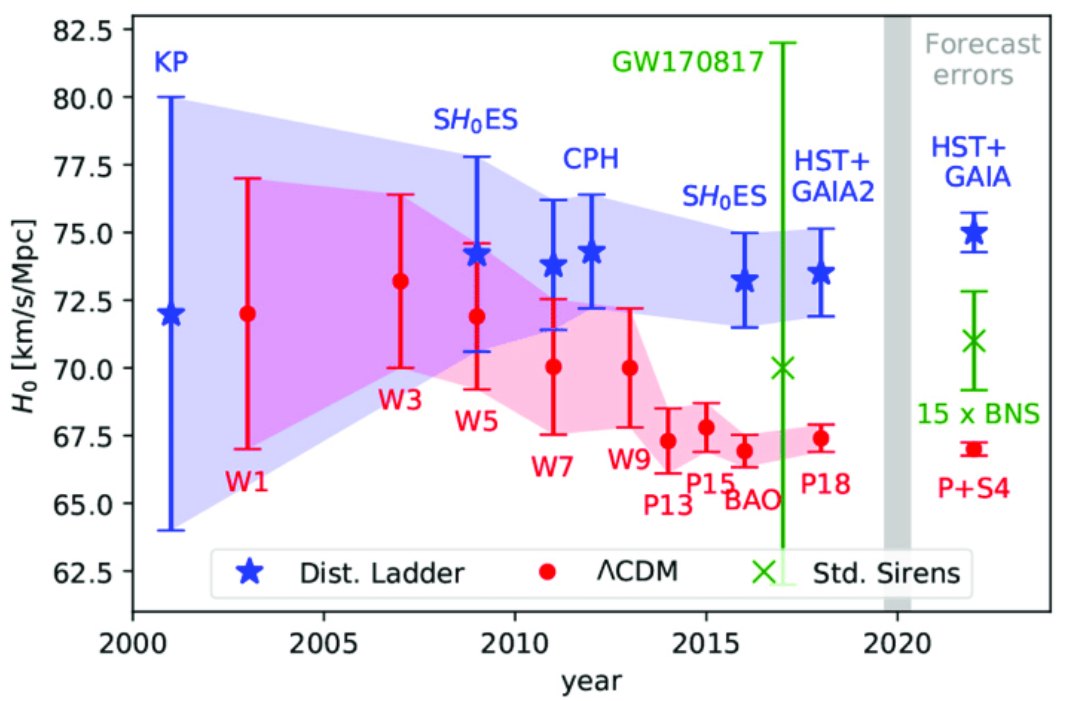
Modern cosmology leaves roughly ninety-five percent of the universe unexplained. Ordinary matter accounts for about five percent of the energy budget; the rest is labelled dark matter (around twenty-seven percent) and dark energy (around sixty-eight percent), inferred only through gravitational effects and accelerated expansion, with no direct detection of any particle or field. Alongside that, the cosmological-constant problem has quantum field theory over-predicting the vacuum energy density by some hundred and twenty orders of magnitude, and the Hubble tension has early-universe measurements (around 67–68 km/s/Mpc) disagreeing with late-universe measurements (around 73–76 km/s/Mpc) by a persistent five to nine percent.
This paper revives the classical Aether as a single mechanical medium that addresses all of these at once. The Aether is a three-dimensional cubic lattice of Aetherons — point-like, neutral particles filling all space. They are repulsive to ordinary matter at short range and compressible under gravity at long range. The lattice carries light as transverse mechanical waves, and it supplies a mechanical origin for dark matter (local compression gradients), dark energy (uniform lattice strain), gravitational light-bending (refraction in density gradients), the Hubble tension (local pressure variations) and large-scale structure (matter displacement and compression).
The Aether dismissed in 1887 was rigid, stationary and incompressible. This one is not. It is dynamic, depletable and elastic, and it is excluded from bulk matter the way oil separates from water — which is why the historical experiments saw nothing. The model is offered as a purely classical, mechanical framework with testable predictions, and it sits inside a theistic creation sequence: the medium first, then matter, then energy.
2. Properties of the Aether
The Aether is a three-dimensional cubic lattice of Aetherons: point-like, neutral particles with mass mA ≈ 5 × 10−46 kg, spacing d ≈ 1 fm (10−15 m) in cosmic voids, and number density n ≈ 1045 m−3. That gives a baseline deep-space density ρdeep ≈ 0.5 kg/m³ (central value, range 0.2–1.1 kg/m³ after mild gravitational pre-compression).
Four properties define it. It is neutral and lossless — no charge, no dissipation. It is repulsive to ordinary matter at short range, an antigravity-like force that displaces the lattice around objects and forms supportive envelopes at boundaries. It is compressible under gravity, the long-range attraction packing the lattice into high-density shells near massive objects, behaving as ideal Hooke's-law springs with spring constant k ≈ 5 × 1046 N/m. And it is elastic, the bonds storing energy as ½kε².
Light moves through the lattice as transverse mechanical waves. Its speed emerges from stiffness and density:
c = S × √(k / ρ)
where S ≈ 105 is a dimensionless scaling factor from the cubic geometry and the fact that only the two transverse polarisations propagate. With ρdeep ≈ 0.5 kg/m³ and k ≈ 5 × 1046 N/m, this returns c = 3 × 10⁸ m/s in voids — the observed vacuum speed. Where density rises (inside atoms, or in compressed shells) c falls; where the lattice rarefies, c rises. The spacing of 1 fm is fine enough to embed toroidal magnetic fields topologically, like knots in an elastic gel, which is what allows stable atomic dynamos without quantum fine-tuning (Section 7; the full atomic mechanism is the Governor Atom Model).
3. Interaction with matter and gravity
Matter repels the Aether at short range, displacing Aetherons outward and forming supportive envelopes at boundaries. Inside a stable hydrogen atom the trapped Aether density holds at about 2.25 kg/m³, uniform through the atomic volume and stabilised by the toroidal field and the repulsion equilibrium; heavier elements trap more at formation. Repulsion prevents further compression but does not rarefy the interior to near-zero — the lattice persists at the formation-trapped value, which is what lets it embed and lubricate the atomic field.
Gravity is not a separate force in this model. It emerges from the Aether field gradient. Matter displaces the lattice, creating a pressure imbalance — high density and pressure farther from the mass, low near it — and other masses are pushed toward the low-pressure zone. That push is attractive gravity. Near a large mass, gravity overcomes the short-range repulsion and compresses the lattice into high-density shells.
The same push-pull does two jobs. The external pressure gradients herd matter together, driving clumping. The outward spring force from the uniform baseline strain drives expansion. Attraction and repulsion are responses of one compressible, repulsive lattice, with no need for separate fundamental forces.
4. Dark matter as compressed Aether gradients
Dark-matter effects, in this model, are the gravitational illusion of locally compressed Aether. The true density is about 0.5 kg/m³ in voids — weak and undetectable there because a uniform lattice produces no net gradient — but near a galaxy or cluster, matter displaces and squeezes the lattice into high-density shells that store elastic energy (½kε²) and exert extra inward pressure, mimicking additional gravitational mass.
That accounts for the three standard lines of dark-matter evidence without new particles: galactic rotation curves get their extra pull from compressed shells around stars and galaxies; gravitational lensing is light refracting through density gradients (Section 6); cluster dynamics reflect collective compression. The low inferred dark-matter density is an average over vast volumes — most Aether sits near baseline in voids, and only the compressed fraction is visible in its effects. The true value is hidden in voids but revealed at the atomic scale through the neutron mass excess (Section 11).
5. Dark energy, the cosmological constant, and the Hubble tension
The cosmological constant emerges from a tiny, uniform strain — ε ≈ 10−21 — present across cosmic voids as the lattice's equilibrium state. Each bond stores elastic energy ½kε², and scaled across the lattice this matches the observed dark-energy density, ρΛc² ≈ 5.25 × 10⁻¹⁰ J/m³. The outward spring pressure drives accelerated expansion and does not dilute, because the lattice is effectively incompressible on the largest scales. This is a classical origin for dark energy that avoids the quantum vacuum-energy catastrophe entirely: there is no zero-point sum over modes, only elastic storage from a uniform strain.
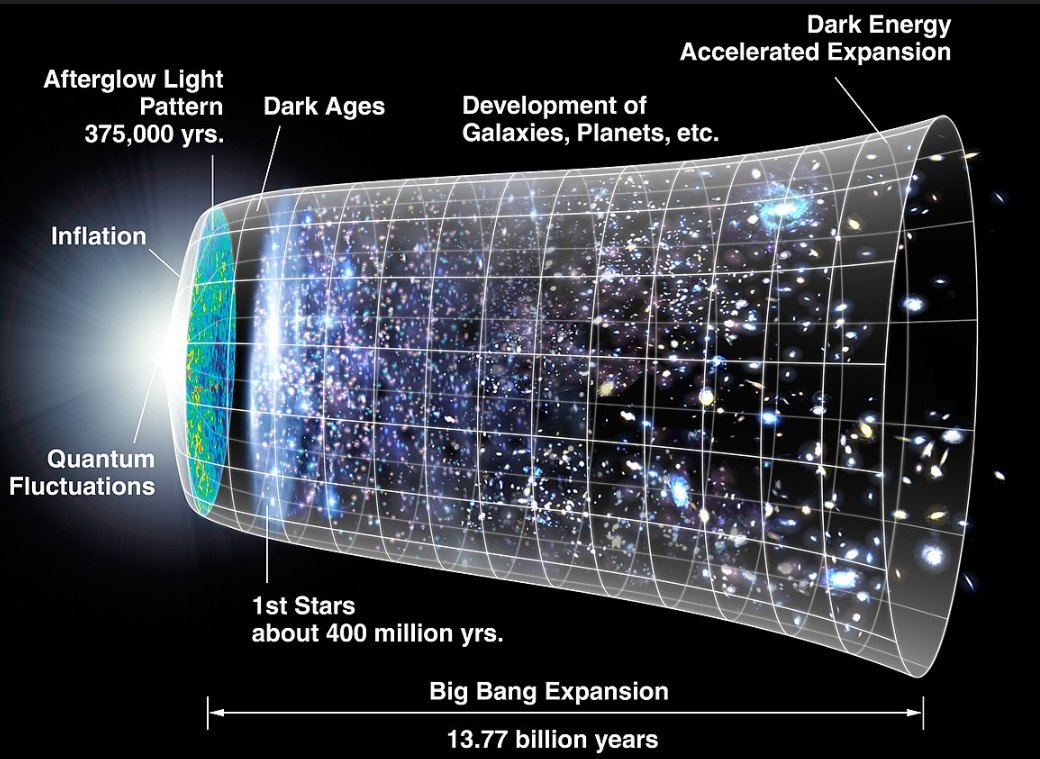
The same mechanism resolves the Hubble tension as a spatial variation in strain rather than a conflict in the data. In matter-rich regions — local groups, clusters, filaments — compression raises the local strain (to perhaps 10−20–10−19 against the void's 10−21), which strengthens the outward pressure and the apparent local expansion. Late-universe probes (supernovae, Cepheids) sample those dense regions and read a higher H0 (about 73–76 km/s/Mpc); early-universe probes (the CMB) reflect the void baseline and read lower (about 67–68 km/s/Mpc). The enhancement works out to roughly eight to nine percent — the size of the observed discrepancy — with no modified gravity, new particles or distance-ladder error invoked.
The model therefore predicts that H0 should track local matter density: higher in clusters and filaments, lower in voids, testable with DESI, Euclid and Roman.
6. Light propagation and gravitational bending
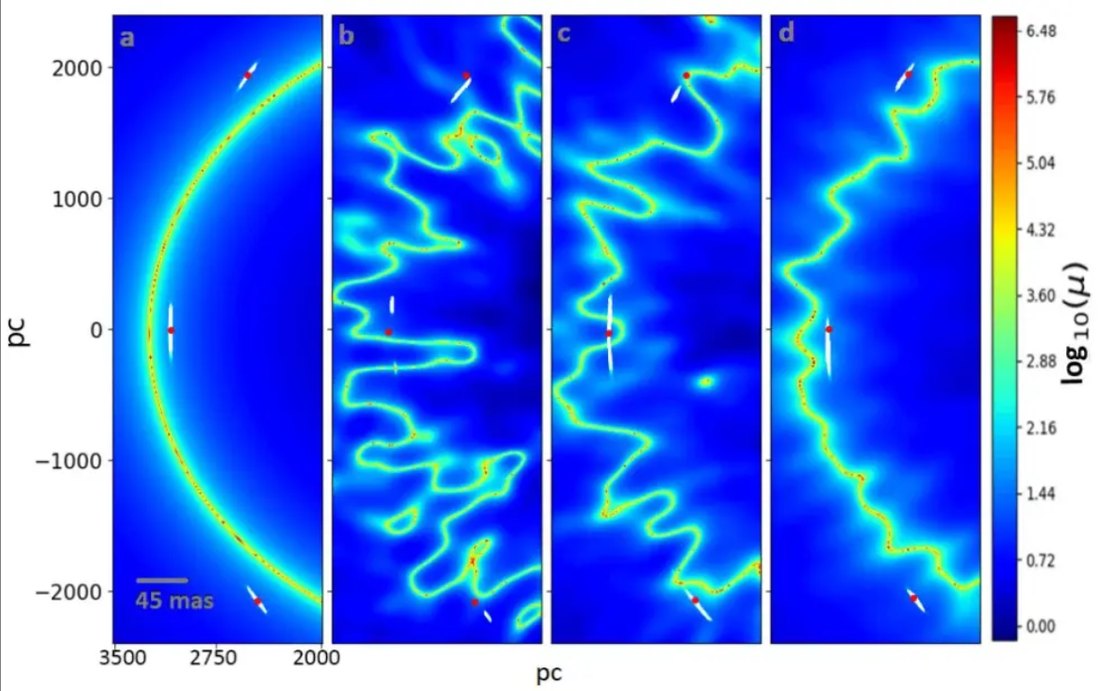
Light is a lossless transverse wave in the lattice. Gravitational bending is classical refraction through compression gradients rather than the geometry of curved spacetime: as density rises toward a mass, the local wave speed changes and rays curve toward the massive object. Because the lattice has a characteristic spacing (1 fm), the model expects the bending to carry a faint wavelength dependence in the most strongly compressed regions — a chromatic signature beyond the achromatic prediction of general relativity.
7. Matter, atoms and the toroidal dynamo
As matter expands it displaces the lattice, hollowing low-density regions inside structures and compressing the lattice at their boundaries — the same push-pull that drives clumping and expansion, now read at the scale of the atom. Inside a stable atom the displaced Aetherons form a thin, slightly denser supportive envelope just outside the electron shell, anchoring the field lines, while the bulk interior holds at the trapped formation density rather than emptying out.

The atom itself is treated as a self-sustaining toroidal dynamo — the subject of the companion Governor Atom Model. Rotation generates nested toroidal magnetic fields that knot into the lattice; the trapped Aether lubricates the dynamo, letting it rotate, expand and contract without seizing or radiating. Discreteness — shells, magic numbers, stable states — comes from topological knot classes and the governor's balance points rather than from quantised wavefunctions. The neutron is read as a highly compressed hydrogen atom: a proton core with an electron in a tight relativistic orbit, encased in a high-density Aether shell (Section 11).
8. A lossless cosmic channel
Because the lattice is elastic and lossless, it can in principle carry signals with no energy dissipation — transverse mechanical waves that return their energy perfectly, with no 1/r² falloff. The fine spacing (1 fm) would allow very high frequencies (up to roughly c/d ≈ 3 × 10²³ Hz), well above electromagnetic bands. The paper suggests a transmitter could modulate a rotating dense core to encode information in the lattice, analogous to how atoms interact internally through toroidal fields, scaled up.
The speculative consequence is a candidate resolution of the Fermi paradox: if advanced civilisations signalled through the Aether rather than electromagnetically, we would be listening on the wrong channel. The paper flags this as one of its most conjectural sections and ties it to laboratory tests in engineered acoustic-metamaterial or spin-torque-oscillator lattices, and to timing anomalies in pulsar arrays.
9. Black holes as extreme Aether shells
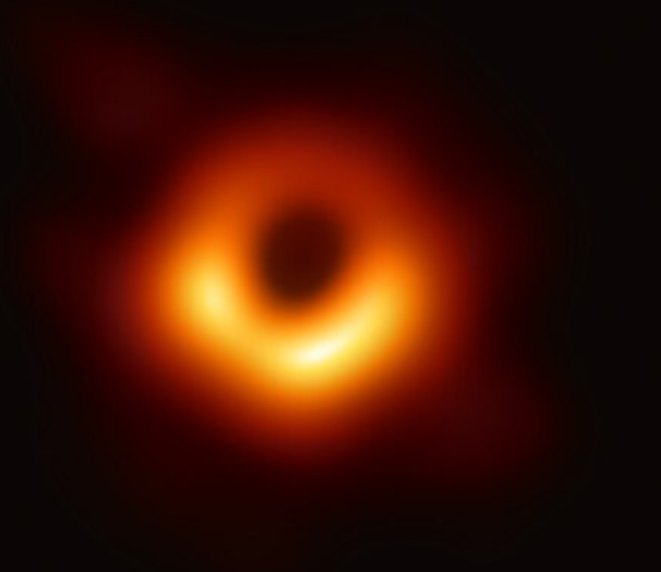
A black hole, in this model, is an ultra-dense core wrapped in a high-density Aether shell — not a singularity. Extreme gravity overcomes the short-range repulsion and traps Aetherons in a boundary layer where the strain approaches its maximum. The event horizon becomes a mechanical refraction barrier: since c = S × √(k/ρ) falls as density climbs, the wave speed drops toward zero in the fully compressed shell, and light cannot escape. The core stays finite, a compressed neutron-like dynamo, so there is no information paradox and no singularity.
The model reframes the standard phenomenology mechanically. Horizons are density cut-offs rather than curvature. Any Hawking-like emission would be shell vibration or instability, not quantum pair production. Trapped Aether in the shell adds to the effective mass, scaling up the same neutron mass excess seen at the atomic level. The distinctive predictions are wavelength-dependent lensing near the shell, possible gravitational-wave echoes from shell vibration in post-merger ringdown, and a no-singularity neutron-star-to-black-hole transition.
10. The creation sequence
The model is explicitly theistic in its ordering of events, and the paper states this plainly. The sequence is mechanical and deterministic once it starts, with the Aether as the foundational medium.
First, the void is filled with Aether — a cold, uniform lattice in equilibrium, carrying the tiny baseline strain that will later drive expansion. There is no matter, no light, no structure, only the medium. Then matter appears: protons, electrons and neutrons are introduced into the lattice, hydrogen forms, and the toroidal dynamo ignites, generating fields that embed as knots. Repulsion activates as the dynamo fires, displacing the lattice outward into a supportive envelope while holding the trapped interior density. Then energy is added — rotation increases, orbits expand, magnetic moments amplify, and the governor mechanism regulates the expansion. Finally structure forms: atoms clump into molecules and dust, stars compress hydrogen into neutrons, galaxies and clusters emerge as pressure gradients herd matter, and the uniform void strain accelerates the expansion.

The paper draws no quantum fine-tuning into this: discreteness emerges from topological knot attractors and governor balance points, and the order is Aether first, particles added, energy activated, structure formed through mechanical push-pull.
11. The empirical anchor: deep-space density from the neutron
The model's strongest claim to falsifiability is that it fixes its central parameter from laboratory data, not from cosmology. The neutron is read as a compressed hydrogen atom whose excess mass is the literal rest mass of Aetherons trapped in its shell. The measured mass excess is precise:
Δm = mn − (mp + me) = 939.565 − (938.272 + 0.511) = 0.7823 MeV/c² ≈ 1.395 × 10⁻³⁰ kg
Dividing that trapped mass by the Bohr-model hydrogen volume (VH = 4/3πa0³ ≈ 6.207 × 10⁻³¹ m³) gives the pre-formation Aether density inside the forming atom: ρpre ≈ 2.247 kg/m³. Allowing for mild gravitational pre-compression in the formation cloud (a factor f ≈ 3–5, typical of molecular clouds) back-calculates the resting deep-space density to about 0.45–0.75 kg/m³ — the central working value of 0.5 kg/m³ used throughout. The derivation uses only three ultra-precise quantities (the neutron, proton and electron masses) plus the Bohr radius, with no adjustable cosmological input. It replaces the model's original placeholder deep-space density with a value tied directly to measured masses, and it predicts a buoyancy effect that can be checked directly (Section 12).
12. Addressing the historical disproofs
The classical Aether was abandoned after a series of 19th- and early-20th-century null results. The model's answer is that those experiments tested the wrong conditions. All of them — Michelson–Morley (1887), Kennedy–Thorndike (1932), Ives–Stilwell (1938–41), Trouton–Noble (1903) — were run on Earth, inside the atmosphere, where bulk matter repels the Aether away to a near-zero local density. With the lattice already displaced from the apparatus, there was no medium present to drag, no relative motion to detect, no torque to register. The null results, on this reading, support exclusion rather than non-existence.
The model is explicit that this only holds because its Aether is dynamic, compressible and repulsive — the very thing the 19th-century tests did not assume. The original experiments disproved a stationary, non-repulsive, incompressible medium; they leave a repulsive, compressible, elastic lattice untouched. The paper's stated requirement is that a real test must reach a region where external Aether is actually present: a cosmic void, a deep-space probe, an ultra-high-vacuum chamber with minimal wall effects, or a high-altitude / stratospheric setup. It proposes specific checks — light speed through pressurised hydrogen versus vacuum, transit-time comparisons in void versus near-Earth regions, and balloon or vacuum buoyancy.
13. Testable predictions
The model is built to be falsifiable, and every prediction is derived from the locked-in parameters (ρdeep ≈ 0.5 kg/m³, mA ≈ 5 × 10−46 kg, d = 1 fm, k ≈ 5 × 1046 N/m, trapped hydrogen density ≈ 2.25 kg/m³, c = S√(k/ρ)). The paper groups them by scale and ranks the laboratory tests as nearest-term and lowest-cost.
Laboratory. The signature test is extra anti-gravity buoyancy in hydrogen: trapped Aetherons (2.25 kg/m³) should produce an additional upward force of roughly 0.44–2.21 N/m³ (about 45–225 g/m³ of reversed weight) on hydrogen systems in vacuum, strongest near the ground, undetectable in open atmosphere because the Aether is excluded there. It is proposed as a vacuum-chamber force measurement (hydrogen versus helium versus vacuum, 0.1 g resolution) or a slowed-descent drop test. Related laboratory checks: a minute slowing of light through pressurised hydrogen, and a slight extension of neutron lifetime in higher-density environments (decay read as toroidal-dynamo failure that stronger embedding stabilises).
Cosmic. Wavelength-dependent lensing near neutron stars, black holes and clusters (EHT upgrades, JWST); neutrino flux deficits through compressed shells (IceCube-Gen2); cumulative cosmic-ray energy loss over gigaparsec paths (GRAND); light-speed variance in stellar wakes and voids; and the Hubble-tension–density correlation (DESI, Euclid, Roman). A clean null in any category constrains the parameters — a lower trapped density or weaker repulsion — rather than leaving the model unfalsifiable.
14. Conclusion
The model revives and extends the 19th-century intuitions of Maxwell and Kelvin with explicit modern parameters and an empirical anchor. By positing the Aether as a 3D cubic lattice of point-like, neutral Aetherons, it offers a single classical mechanism for light propagation, emergent gravity, dark-matter effects, dark energy, atomic structure, neutron formation and decay, the Hubble tension, and stellar and cosmic structure — without curved spacetime, exotic particles or quantum fine-tuning. Its central density is fixed by the measured neutron mass excess, independent of any cosmological fit, and its predictions are stated so that a null result constrains rather than rescues it.
The paper's own framing is that this is a hypothesis built for scrutiny, not a settled result. It calls for the experiments above — vacuum-chamber buoyancy, precision light-speed work, lensing and particle anomalies — and rests its case on whether those tests find the predicted effects.
15. Addenda
The full white paper carries fifteen technical addenda extending the core model. They are summarised here; each is given in full in the source PDF linked below.
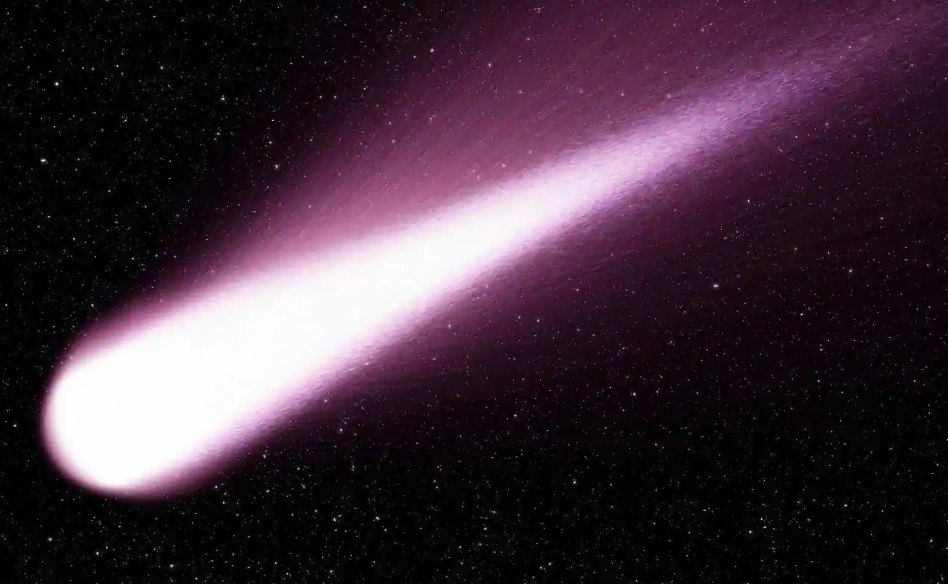
A — Comets. A comet's motion compresses the lattice ahead (a bow-shock head glow) and rarefies it behind (the tail), with the density gradient diffracting light — offered as a mechanical supplement to solar-wind and radiation-pressure accounts, addressing the extent, speed and symmetry of tails.
B — Cosmic rays and high-energy particles. Ultra-high-energy cosmic rays, neutrinos and gamma rays should scatter, lose energy or phase-shift slightly in compressed regions — below current detection limits, within reach of GRAND, IceCube-Gen2 and CTA.
C — The "missing mass" illusion. A fuller statement of Section 4: the lattice is always present at baseline, but only its compressed gradients near matter produce observable pull, so the inferred dark-matter density is an averaging artefact.
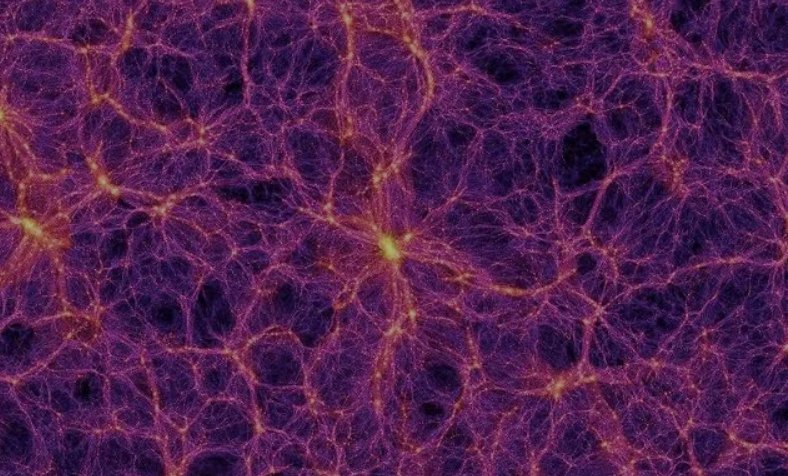
D — The cosmic web. Filaments, walls, nodes and voids emerge as the lattice's elastic response to matter displacement — filaments as high-pressure channels, voids as rarefaction bubbles — producing the web's brain-like appearance without dark-matter halos or inflation seeds.
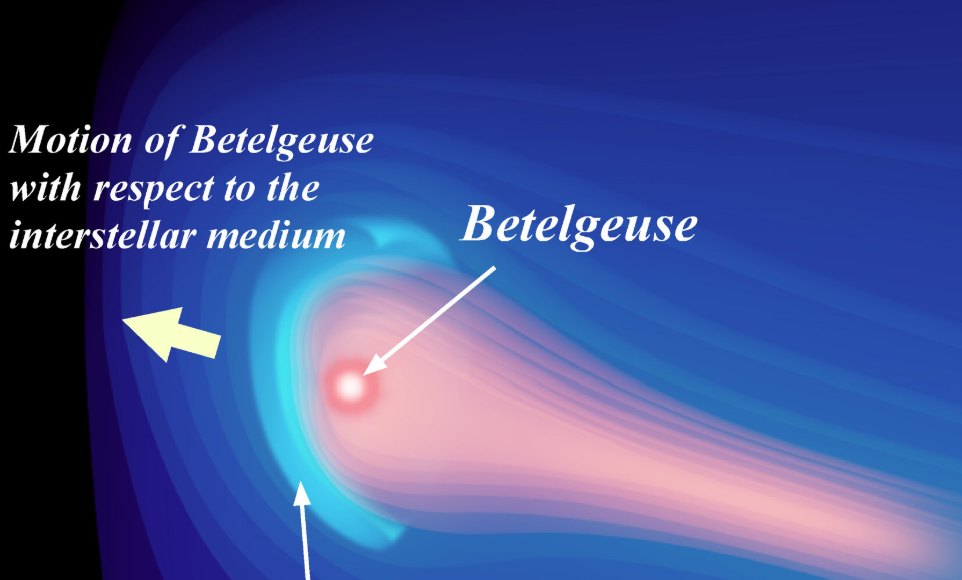
E and M — Stellar and solar motion. The Sun and other stars moving through the lattice raise a bow shock ahead and a rarefied wake behind — offered as a mechanical reading of the heliospheric boundary (Voyager crossings, the IBEX ribbon, the heliotail) and a source of small light-speed variance (slower in the compressed bow, faster in the wake).
F and O — Maxwell and Kelvin. The historical core. Maxwell's elastic Aether (c = 1/√(εμ)) is mapped onto the lattice spring constant k, and Kelvin's vortex-knot atoms are mapped onto the Governor Atom Model's toroidal knots — with the model supplying the three pieces they lacked: repulsion, compressibility and self-regulation.
G and J — Atoms are not empty space. Atomic interiors are filled with trapped Aether at formation density, not rarefied to near-zero; the lattice embeds the toroidal field and acts as a frictionless lubricant for the atomic dynamo. The "empty atom" is an illusion of weak probe interaction, not absence of medium.
H — Satellite and orbital anomalies. Pioneer, flyby, GPS and LEO-drag residuals are read as small mechanical forces from partial Aether access at altitude — on the order of 10−10 m/s² — with re-analysis of tracking data proposed as the test.
K — Neutron formation. The classical-mechanical formation and decay of the neutron as a compressed hydrogen atom; the antineutrino of beta decay is reinterpreted as high-speed Aetheron ejecta from the unwinding shell.
L — Buoyancy and the density derivation. The neutron-mass-excess derivation of deep-space density (Section 11) and the hydrogen-buoyancy prediction (Section 13), with detailed test protocols.
N — The equivalence principle. Trapped Aether is predicted to add to inertial mass slightly more than to gravitational mass, giving tiny equivalence-principle violations (around 10−18–10−21) — below current limits, larger for neutron-rich material, a target for next-generation Eötvös tests.
16. References
- Brett Murrell. A Classical Aether Model (White Paper: Aether), v6.4, 14 January 2026. The full work this memo summarises, including all sixteen sections and fifteen addenda. PDF.
- Brett Murrell. Governor Atom Model (GAM). The atomic-model companion — the toroidal dynamo, the perfect ratios, the assembly of the periodic table from one particle. PDF.
- J. C. Maxwell. A Dynamical Theory of the Electromagnetic Field, Philosophical Transactions of the Royal Society, 155 (1865), 459–512. Elastic-Aether basis for the lattice spring constant and lossless wave speed (Sections 2, 15; Addendum F).
- W. Thomson (Lord Kelvin). On Vortex Atoms, Proceedings of the Royal Society of Edinburgh, 6 (1867), 94–105. Vortex-knot atom theory revived as the toroidal knots of the Governor Atom Model (Addendum O).
- A. A. Michelson & E. W. Morley. On the Relative Motion of the Earth and the Luminiferous Ether, American Journal of Science, 34 (1887), 333–345. The historical null result addressed in Section 12.
- A. G. Riess et al. Observational Evidence from Supernovae for an Accelerating Universe and a Cosmological Constant, Astronomical Journal, 116 (1998), 1009–1038. Dark energy as uniform Aether compression (Section 5).
- Planck Collaboration. Planck 2018 Results. VI. Cosmological Parameters, Astronomy & Astrophysics, 641 (2020), A6. Baseline for the Hubble-tension and Λ-density comparison (Section 5).
- Event Horizon Telescope Collaboration. First M87 Event Horizon Telescope Results (2019) and subsequent papers. Source of the M87 image and the wavelength-dependent-lensing prediction (Sections 9, 13).
- LIGO Scientific Collaboration and Virgo Collaboration. Observation of Gravitational Waves from a Binary Black Hole Merger, Physical Review Letters, 116 (2016), 061102. Black holes as extreme Aether shells (Section 9).