The Engineer Who Gave Japan Its Railways
Edmund Morel (1840–1871): a young British civil engineer who, in nineteen months and while dying of tuberculosis, designed Japan’s first railway, set the gauge of its entire network, and helped found the ministry and the college through which a nation industrialised — then died before the line opened. His English wife, Harriett Wynder, died within a day of him; they are buried together at Yokohama. He is honoured in Japan to this day as the father of its railways.
1. The young engineer
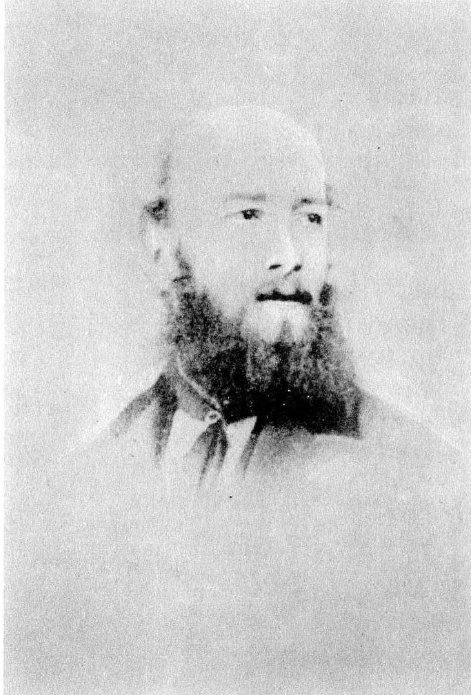
Edmund Morel was born in London on 17 November 1840 — though his own gravestone records 1841, so even the primary stone is a year uncertain. He was the only son of Thomas Morel, by one account a wine importer of Piccadilly and Notting Hill. He grew up in mid-Victorian London, whose polluted air has been linked to the respiratory weakness that later killed him. He studied civil engineering at King’s College London, was articled to the engineer Edwin Clark, and trained partly in applied chemistry.
He did not stay in England. By 1862–63 he was building railways in New Zealand, rising to Chief Engineer of the Province of Wellington; then private practice in Australia in 1864–65; then, from 1867, building railways and sinking mine shafts for the Labuan Coal Company in British North Borneo. By his late twenties he had worked on three continents — including, like many Australian readers’ own forebears, the railways of colonial Australia and New Zealand.
2. Japan, 1870: nineteen months that founded a railway nation
While at Labuan, Morel was invited to Japan by the British envoy Sir Harry Parkes. The timing was historic: the Meiji Restoration of 1868 had swept away the old shogunate, and the new government saw railways as the very symbol and instrument of a centralised, modern state. They appointed Morel their first foreign Engineer-in-Chief. He arrived at Yokohama on 9 April 1870, aged twenty-nine.
What he accomplished in the months that followed is out of all proportion to the time he had:
He designed Japan’s first railway — the line from Shimbashi in Tokyo to Sakuragichō in Yokohama, some twenty miles, built with British locomotives and rails and British engineering practice. He set out the survey himself, beginning within days of landing.
He set the gauge of the nation. Through direct discussions with Itō Hirobumi and Ōkuma Shigenobu — two of the founding statesmen of modern Japan, both future prime ministers — Morel advised on the industries and technologies the country would need, and out of those discussions came Japan’s standard track gauge of 1,067 mm (3 ft 6 in). That gauge still defines the conventional Japanese network today. A decision made on the advice of a man in his twenties, in his first year in the country, shaped the physical form of every ordinary railway Japan has built since.
He helped build the institutions, not just the line. On his advice the government established the Ministry of Public Works in December 1870, to integrate the importation and application of foreign technology; and an engineering college — later the Tokyo Imperial Technical University — opened on his counsel. He understood that a railway is only as durable as the engineering culture that maintains and extends it, and he set about creating that culture from nothing.
3. The dying teacher
This is the part of the record that matters most for why Morel appears here.
Morel was already suffering from tuberculosis before he arrived in Japan. He took on the founding of a nation’s railways as a dying man, and he knew it. The conditions were brutal: of the nineteen British engineers on the project, four died and three were invalided home. And yet, during poor weather when work on the line was impossible, Morel took his Japanese engineers and surveyors into his own house and lectured them. A man with failing lungs, spending the strength he had left teaching the local people the knowledge, so that the work would not depend on him and would outlast him.
This is the stewardship principle the site argues for: the worthy builder equips the people to carry the work on rather than making it depend on him. Morel gave the knowledge away as fast as his health failed, deliberately building the country’s own engineering capacity. When he died, the work did not stop: his assistant John Diack took over, supported by Inoue Masaru — one of the “Chōshū Five” who had studied in Britain — newly appointed as Japan’s first Director of Railways. The line opened because Morel had built people as well as track.
4. A death within a day
As his condition worsened, Morel resigned his post, intending to seek a cure in India. The Japanese government granted him a reward of 5,000 yen — an enormous sum for the time — in recognition of his service. He never sailed. He died in Yokohama on 5 November 1871, shortly before the opening ceremonies of the railway he had created. He was thirty years old (or, on the gravestone’s reckoning, twenty-nine).
His wife was Harriett Wynder, an Englishwoman he had married on 4 February 1862 at St Pancras Church in London. (The romantic legend, long repeated, that his wife was Japanese was the invention of a novelist embellishing the tale.) Harriett died in Yokohama on 6 November 1871 — the day after her husband — of an acute nervous or respiratory illness. Married nine years and died within a day of one another, they were buried together in the Foreigners’ Cemetery at Yokohama.
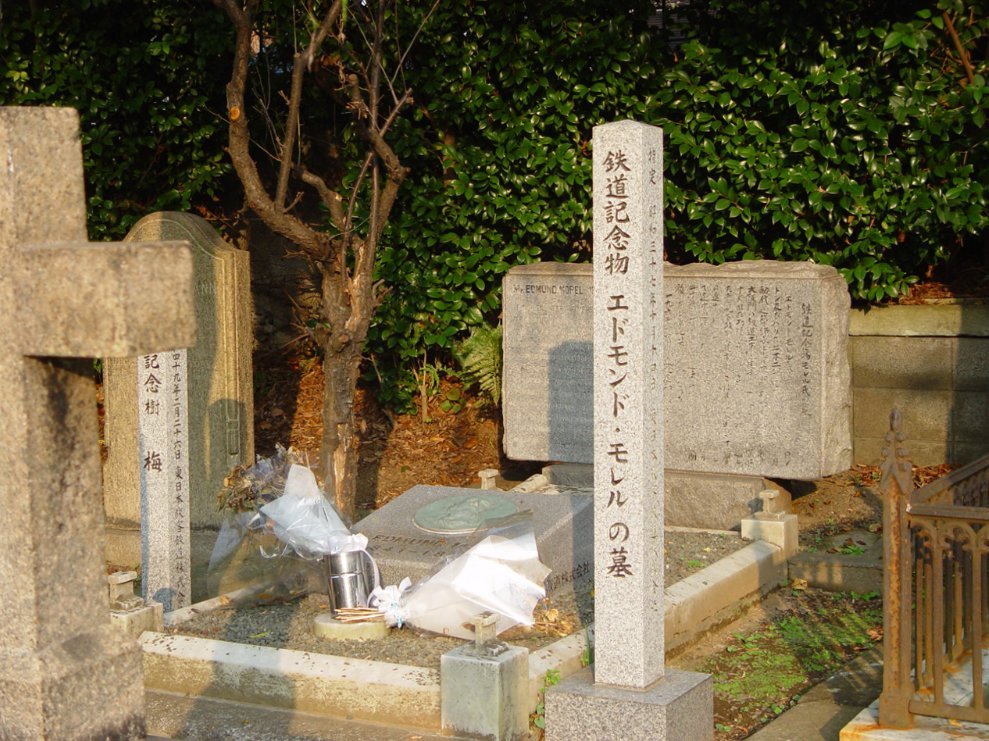
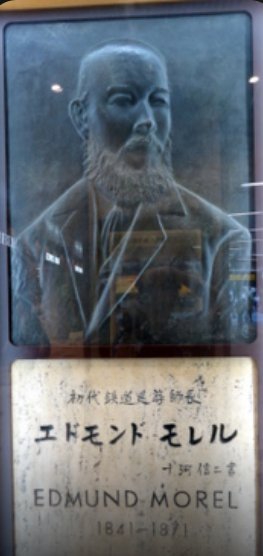
Japan did not forget him. His grave in the Yokohama Foreign General Cemetery is designated a national railway memorial, and a bronze bust stands outside Sakuragichō Station, the Yokohama terminus of the line he laid out. When he lay dying, the Meiji Emperor — hearing of his illness — sent a letter of condolence, together with a gift of £1,000, through the Vice-Minister of Works within a week, and the government offered to defray the whole cost of his funeral. (The condolence letter, gift, and funeral offer are recorded in his 1873 obituary in the Institution of Civil Engineers; see Sources.) His obituary in the Institution of Civil Engineers caught the man in a sentence: he had “an extreme antipathy” to those who “turned his profession into a trade, and tended to make it the instrument of injustice to governments and the public.” He built honestly, for the public good, and refused to let the work become a racket.