Herod the Great, Just Who Was He?
The building program — works, dimensions, methods, materials, and what survives
Sources. The main literary source is Josephus (first century CE, writing about a century after Herod); his manpower figures and timelines run high and are flagged in the text. Archaeology has confirmed most of the buildings while trimming the figures. Estimates and ranges are given as such; claims resting on Josephus alone are marked.
1. The scale of the program
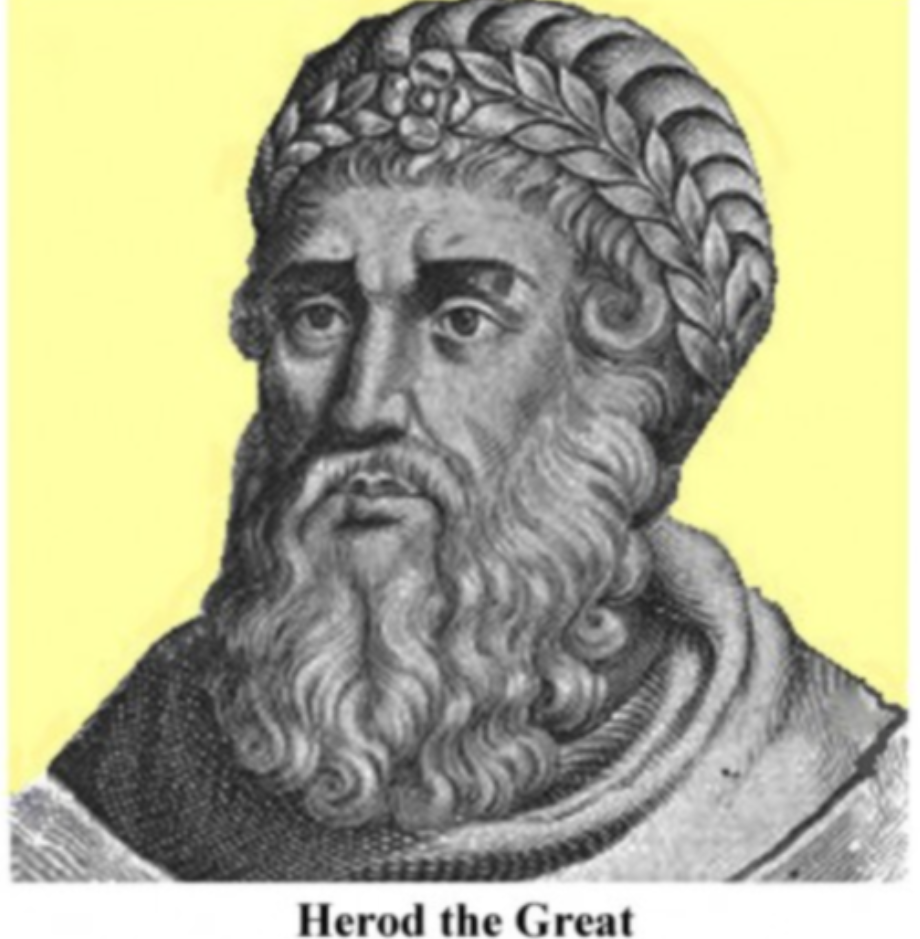
Herod ruled Judea as a client king of Rome from 37 to 4 BCE; the building ran from roughly 35 to 10 BCE.
He directed more than thirty distinct projects across roughly 800 km: Caesarea sits 120 km from Jerusalem, Antioch about 500 km north, and the work credited to him at Rhodes some 800 km across the Mediterranean. Materials moved between sites by sea and overland.
2. The Temple Mount, Jerusalem
The largest of the works, and the one Herod is remembered for. On the enlarged platform he raised a new sanctuary faced in white stone with a gold-plated front that, by Josephus's account, threw back the sun so fiercely that onlookers had to look away, and stood out like a snow-covered peak from a distance. Its façade rose about 100 cubits — roughly 45 m — and was as wide, fronted by a tall gateless porch. The building was new and far grander, but the holy core kept the old measure: the innermost room, the Holy of Holies — empty since the Babylonian destruction, holding no Ark — stayed the size it had always been while everything around it was enlarged.
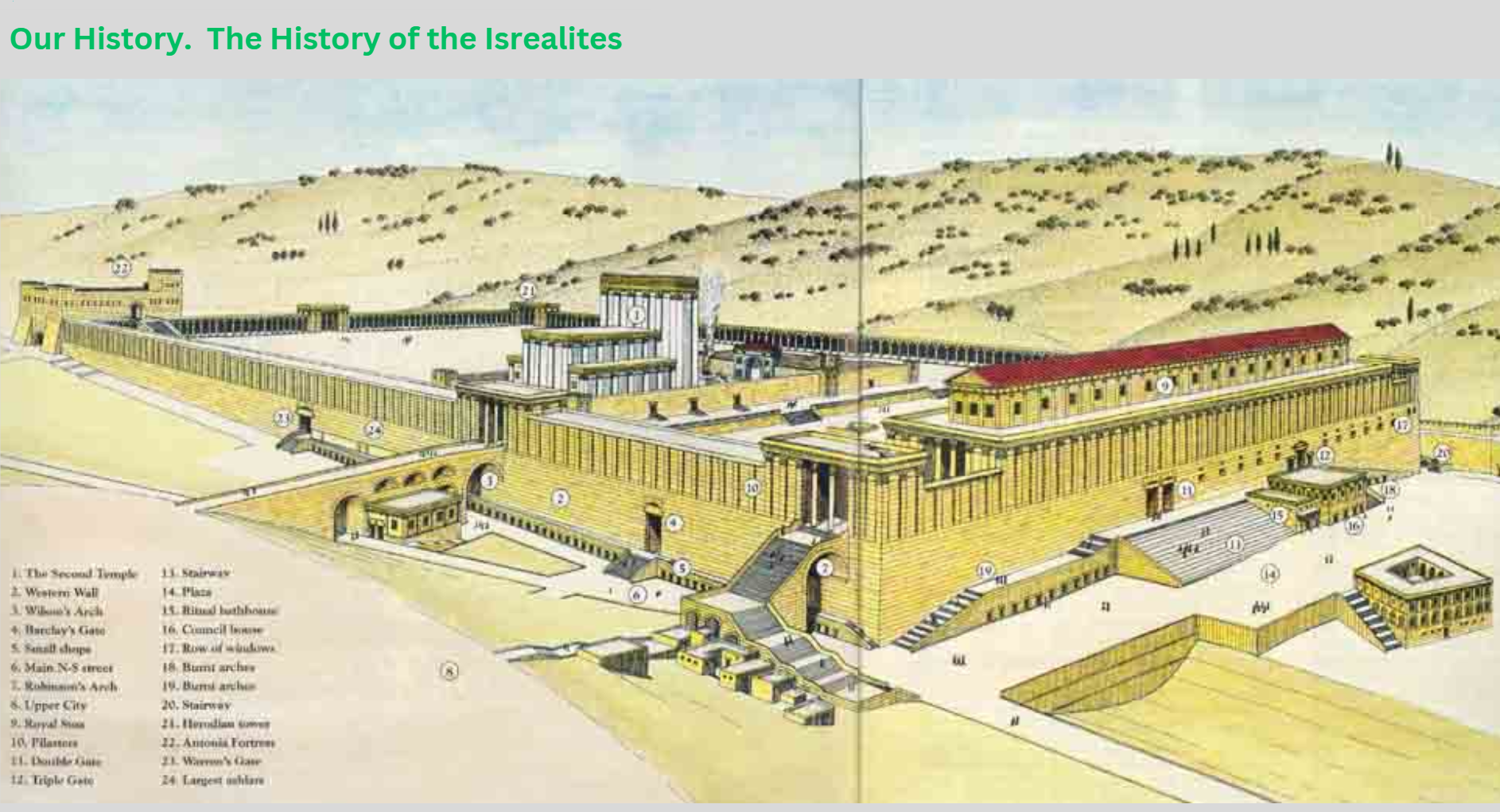
The sanctuary stood at the centre of nested courts of rising sanctity. The outermost, the Court of the Gentiles — the great paved esplanade — was open to all. A low stone screen, the soreg, drew the line non-Jews could not pass; set along it were notices in Greek and Latin warning that any foreigner who went further answered for it with his life. Two of those warning blocks have been found — one intact, now in Istanbul, the other a fragment — among the few tangible survivals of the Temple itself. Beyond the soreg came the courts of the Women, of Israel, and of the Priests, and then the sanctuary. The Western Wall, the focus of prayer today, is not part of the Temple building at all — it is a surviving stretch of the western retaining wall that held up the platform; the Temple itself was thrown down completely in 70 CE.
2.1 Doubling the mountain
The Second Temple — the sanctuary the returning exiles had built under Zerubbabel around 516 BCE — already stood on Mount Moriah. Herod's project, begun around 20–19 BCE, was twofold: he demolished and completely rebuilt the sanctuary itself on a larger, taller plan, and he roughly doubled the platform beneath it. He doubled the usable summit by building a vast rectangular retaining box around the hill and filling the gap between box and bedrock, then decking the whole with a paved esplanade carried on vaults where the fill ran out. The finished platform covers about 144,000 m² — on the order of 480 by 300 m — which made it the largest sacred enclosure in the ancient world. It is still the footprint of the Temple Mount today, the platform that now carries the Dome of the Rock and al-Aqsa.
The retaining walls were taken down to bedrock, in places some 20 m below the surrounding ground, and built thick. Josephus credits the sanctuary building itself to a furious 18-month sprint by a thousand priests trained as masons and ten thousand labourers; the figures are his and run high. The work was staged so the sacrificial service never stopped and only priests handled the sacred core — which is why, although the sanctuary was rebuilt from the ground up, scholars and Jewish tradition do not count it as a Third Temple but as a rebuild of the Second, the institution running unbroken from 516 BCE to 70 CE. The complex as a whole was not finished in Herod's lifetime — work continued under his successors until roughly 64 CE, a few years before Rome destroyed it.
2.2 The stones
The signature of Herodian masonry is the ashlar block with a smooth, flat boss framed by a finely chiselled drafted margin. It is how excavators tell an original Herodian course from later repairs along the same wall.
The blocks reach exceptional scale. In the so-called "Master Course" exposed in the Western Wall tunnels, the largest single stone — the "Western Stone" — is about 13.6 m long and 3.3 m high. Weight estimates have ranged from roughly 500 to 570 tonnes in older work; the Western Wall Heritage Foundation has since moderated its public figure to "several hundred tonnes" as the buried depth was re-measured. Either way the point holds: the heaviest cranes in service today lift around 250 tonnes. How a stone of that mass was quarried, moved, and seated without modern lifting gear is genuinely unsettled — the leading ideas are a quarry uphill of the wall and movement on timber rollers, but no method has been demonstrated to everyone's satisfaction.
Each course is set back a few centimetres from the one below it — an optical correction. On a tall, dead-straight face the recession cancels the illusion that the top is leaning outward.
2.3 The rest of the complex
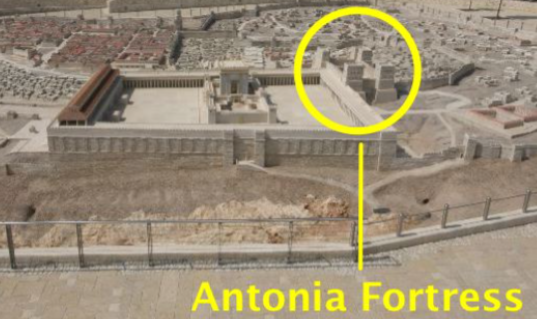
Around the plaza ran roofed colonnades. The Royal Stoa along the south side was a basilica-scale hall. Monumental stairs and bridges — the springers survive as Robinson's Arch and Wilson's Arch — let pilgrims climb to the platform without crossing the markets and the main road below. The Hulda Gates on the south fed rising tunnels up through the platform, and the Double Gate passage was roofed with domes, an advanced touch for the place and date. At the north-west corner Herod set the Antonia Fortress to watch over the whole enclosure.
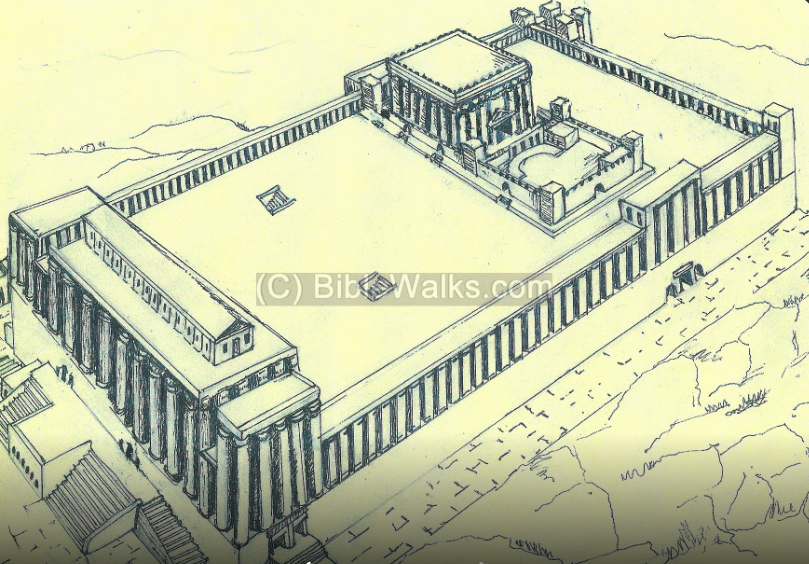
Significance and afterlife. In the Gospels the Temple is where Jesus taught and drove out the money-changers, and where he foretold that not one stone would be left on another. In 70 CE Titus's legions burned the sanctuary and threw down the upper walls. The platform and its retaining walls survived; the western retaining wall is now the holiest site of Jewish prayer. On the platform the Dome of the Rock was completed around 691 CE, with the al-Aqsa Mosque beside it, making the enclosure the third-holiest site in Islam. It is among the most contested religious sites today, sacred to two faiths.
3. The Cave of the Patriarchs, Hebron
The enclosure over the Cave of Machpelah at Hebron, about 30 km south of Jerusalem, is the only Herodian building still standing largely intact to its original height.
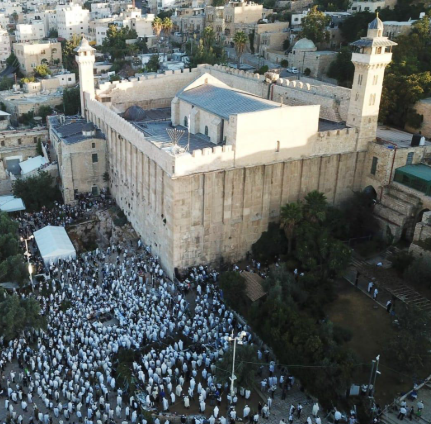
Herod did not build the cave. Machpelah — the word means "double" — is a natural twin cave that had been venerated for centuries as the burial place of Abraham and Sarah, Isaac and Rebecca, Jacob and Leah. What Herod built was the monument over it: a single rectangular enclosure of dressed stone, roughly 59 by 34 m, its walls about 2.5 m thick and rising some 12 m, with no roof — an open paved court sealing the cave below behind a wall no one could climb. There is no identifiable original doorway; access was deliberately restricted. The point was enclosure and monumentality, not a building to walk through.
The masonry is the Temple Mount's, exactly: the same large limestone ashlars laid in regular courses without mortar — stability from precise cutting and weight, not bonding — and the same Herodian signature of a smooth raised boss inside a finely chiselled drafted margin. The homogeneous Herodian stonework runs unbroken up to the cornice; only the courses above it are later, Muslim and Crusader.
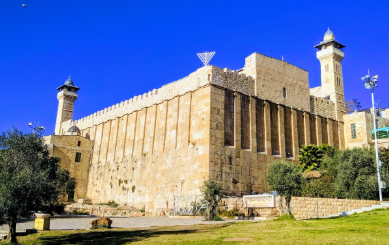
Hebron preserves the exterior decoration the Temple Mount has lost. From about 4.5 m up (floor level inside) the outer face is articulated with flat pilasters: shallow vertical strips left standing proud where the wall is recessed about 25 cm between them, each roughly 1.1 m wide and spaced about 2 m apart, running the full circuit under a cornice. It is the only surviving example of how the upper wall of a great Herodian enclosure was finished. The same articulation once ran around the upper Temple Mount walls but does not survive there. In plan and proportion the enclosure is a smaller version of the Temple Mount.
Inside, it was originally a paved open court — Herod's pavement survives beneath the present floor — open to the sky, with a gutter round the perimeter to carry off rainwater. The cenotaphs marking the six burials stood in symmetrical pairs, an arrangement still broadly kept today. Over two thousand years the empty box was roofed and re-roofed by whoever held Hebron — a Byzantine basilica, a mosque, a Crusader church, a mosque again — and the Herodian shell carried every one of them. It still stands, now divided between a mosque and a synagogue. Josephus knew it, noting that the monuments at Hebron were still shown in his own day.
Significance and afterlife. The enclosure has never gone out of use. Revered by Jews, Christians, and Muslims as the burial place of the patriarchs, it is the second-holiest site in Judaism after the Temple Mount and, as the Sanctuary of Abraham (the Ibrahimi Mosque), a major Islamic one. Since 1967 it has been divided between Muslim and Jewish worship and remains one of the most contested religious sites in the region. Through every change of hands the Herodian shell has stood, which is why it is the only building of Herod's still standing to its original height.
4. Caesarea Maritima and the harbour of Sebastos
Herod's largest engineering work, built with imported Roman technology.
4.1 A harbour where there was no harbour
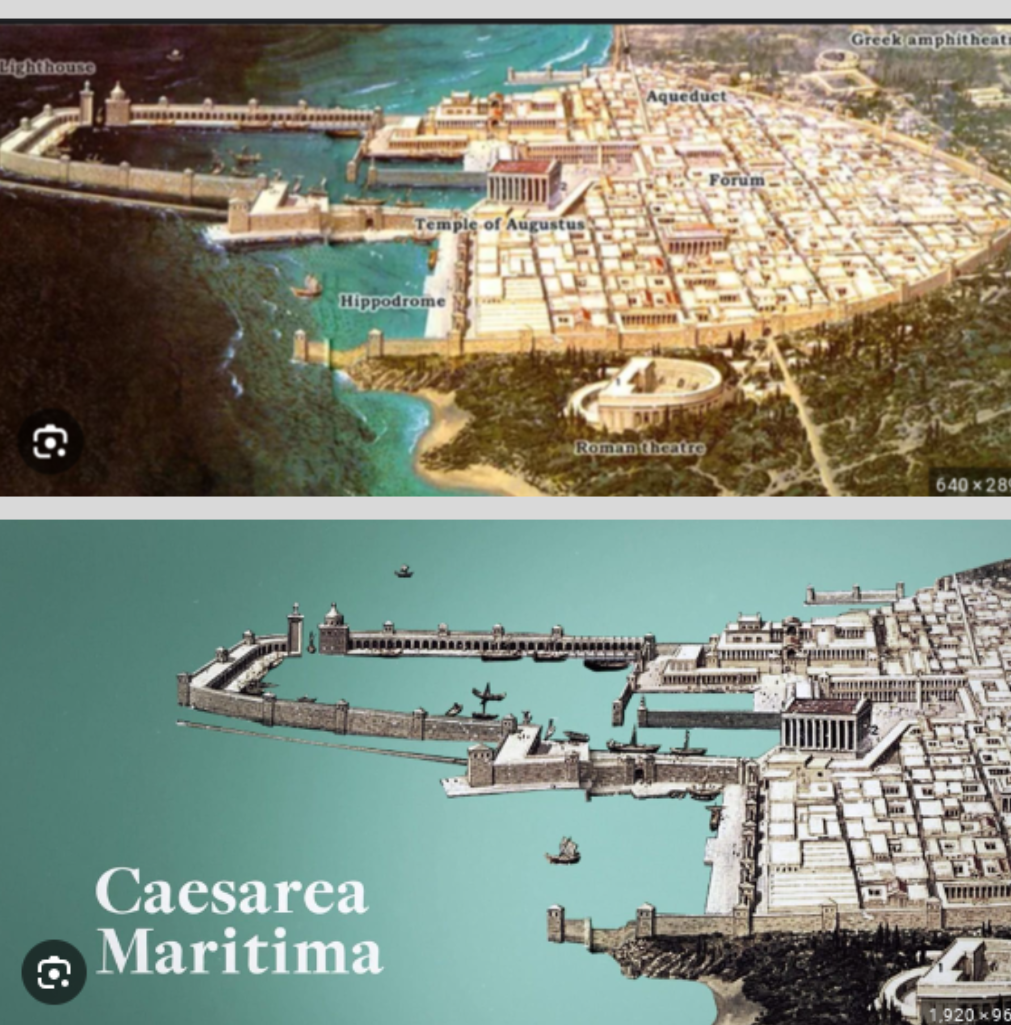
The central coast of Judea had no natural harbour — a straight, exposed shelf with nowhere for ships to shelter. On the site of an old Phoenician anchorage called Straton's Tower, between about 22 and 10/9 BCE, Herod built one from nothing and named it Sebastos ("Augustus" in Greek). Underwater archaeology has confirmed it enclosed roughly 100,000 m² of protected water — the largest artificial harbour yet built in the open sea, a rival to the great ports at Alexandria and Piraeus.
Two breakwaters formed it: a long southern mole of about 500 m curving round to meet a straight northern mole of about 275 m, with a roughly 18 m entrance between them. The moles were wide enough — on the order of 45 to 60 m — to carry warehouses and quays on their backs. Concrete islands at the mouth bore monumental statues that doubled as navigation markers for ships coming in off the sea.
4.2 Concrete that sets underwater
The breakwaters could not be built in masonry on that seabed. They were built in Roman hydraulic concrete — lime mixed with pozzolana, the volcanic ash that reacts chemically with lime and water to harden beneath the surface rather than merely drying. Judea has no pozzolana. Herod shipped it in: by one careful estimate, around 24,000 m³ of volcanic ash (roughly 52,000 tonnes) brought from Puteoli in the Bay of Naples, more than 1,000 km away — at least 44 voyages by 400-tonne ships, for one ingredient, on one project.
The placing method: crews built large wooden boxes — caissons up to about 15 m long, joined watertight with the mortise-and-tenon joinery used in shipbuilding — floated them out, ballasted them with a first layer of concrete to sink them onto the seabed, then hand-packed alternating lime- and pozzolana-based concrete into the form until it filled to the surface and became a block. Individual blocks ran to roughly 390 m³. Brandon's analysis puts the total concrete used at about 35,000 m³. The technique, and almost certainly the specialists who ran it, came from Italy — the Caesarea concrete is recognisably Roman, with the rougher finish of a workforce far from its usual materials.
4.3 The city behind the harbour
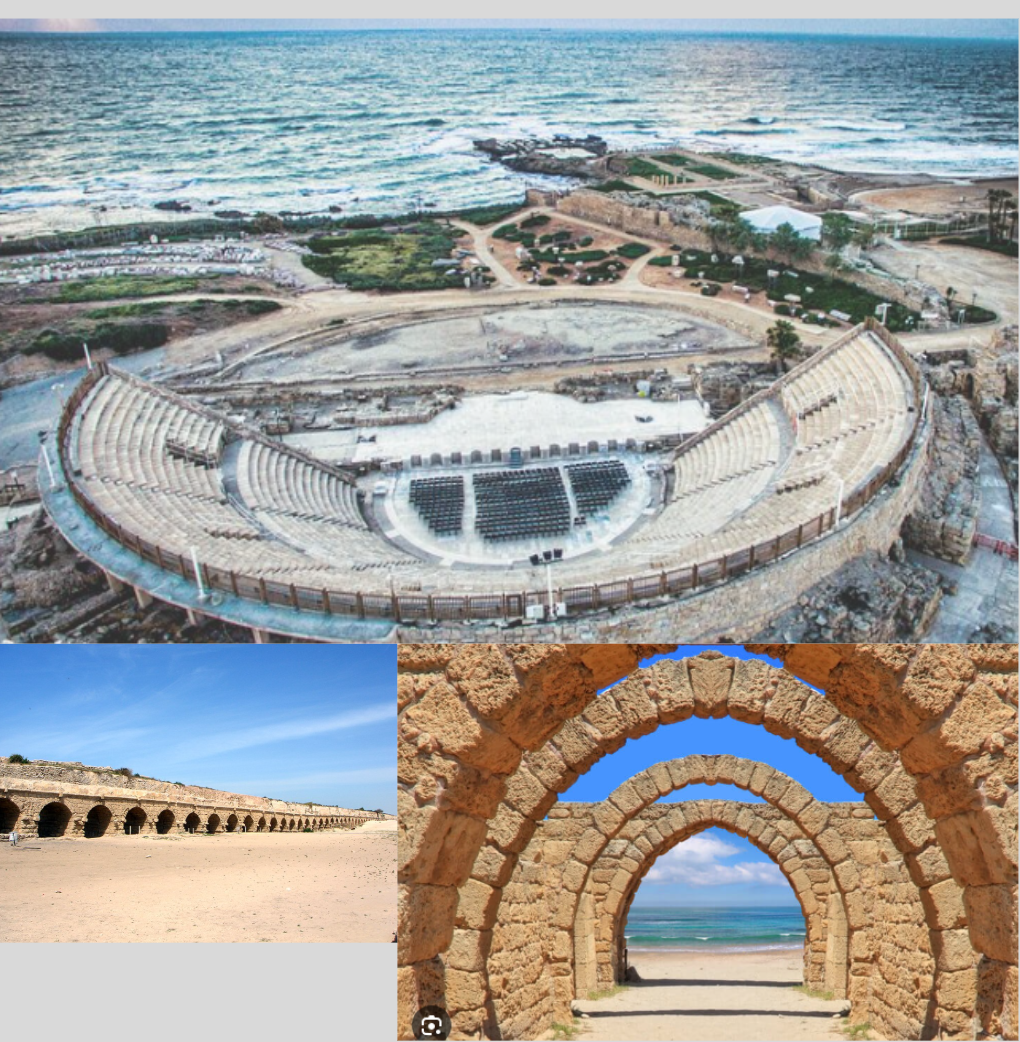
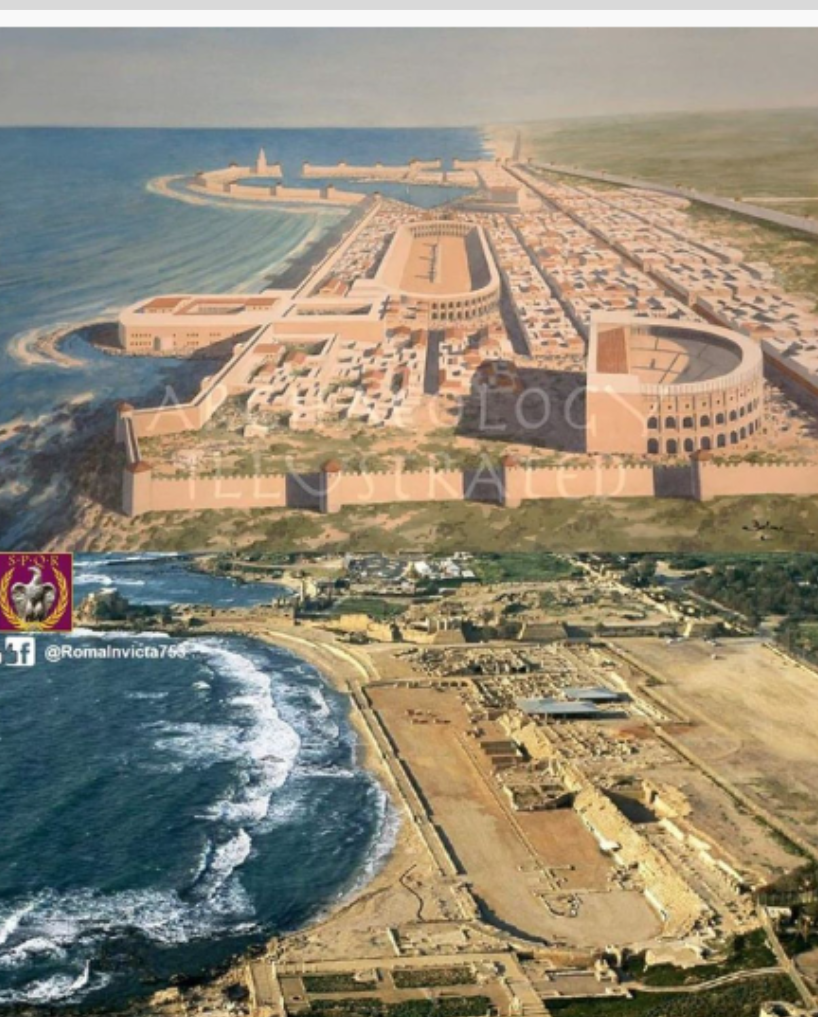
The harbour served a planned Greco-Roman city of about 164 acres on a street grid: a temple to Roma and Augustus on a raised podium (built, the excavators found, in local kurkar sandstone faced with stucco, not the marble Josephus implies), a theatre of about 4,000 seats — the oldest Roman theatre in the region and still in use for concerts — a hippodrome, around a hundred warehouses, and a sewer system that the tides flushed. Fresh water came down a raised, arcaded aqueduct from springs about 16 km to the north-east near Mount Carmel; Hadrian doubled it with a parallel channel a century and a half later, and the twin aqueducts watered the city for some 1,200 years. It was at Caesarea, in 1961, that the inscription naming Pontius Pilate as prefect of Judea turned up — set into the theatre as reused stone.
4.4 The seaside palace
On a rock promontory running out into the sea below the city, Herod set a palace on two levels. The lower terrace, just above the water, was laid out around a freshwater pool about 35 by 18 m with a pedestal for a statue at its centre, enclosed by rooms and a colonnaded portico open to the waves; the upper terrace was dominated by a colonnaded courtyard about 64 by 42 m. A pool of fresh water set in the sea on three sides was a deliberate piece of display. When Judea became a province the building served as the governor's residence — the praetorium — and is the most likely place of Paul's detention at Caesarea.
After Herod. When Judea became a Roman province in 6 CE, it was Caesarea, not Jerusalem, that was made the capital and the governor's seat; Pontius Pilate, Felix, and Festus all resided here. Its population reached around 100,000, larger than Jerusalem's. The only physical record of Pilate's existence ever found is a limestone block from Caesarea's theatre carved with his name and title, uncovered in 1961; a ring bearing his name has since turned up at Herodium. In 66 CE a riot between the city's Greek and Jewish populations was, by Josephus's account, the spark that lit the First Jewish Revolt — the war that ended with the destruction of Jerusalem and the Temple in 70.
A centre of early Christianity. Caesarea runs through the Book of Acts: Peter baptised the centurion Cornelius here, recorded as the first Gentile convert; Philip the Evangelist settled in the city; and Paul was held there about two years under Felix and Festus, was heard by Agrippa II, and sailed from its harbour to his trial in Rome. After 70 it became the principal city of Roman Palestine and a hub of early Christian scholarship — home to Origen's school and library, and later to Eusebius, the first church historian, who served as its bishop. It stayed a provincial capital into the Byzantine period, declined after the Arab conquest around 640, was briefly held by the Crusaders, and was finally abandoned — leaving the Herodian, Roman, Byzantine, and Crusader layers that excavators read today.
5. Masada
A palace-fortress on an isolated plateau above the Dead Sea, supplied by rainwater catchment and storage. Herod wrapped the rim in a casemate wall — two parallel walls partitioned into rooms — about 1.3 km long, studded with towers, and built two palace complexes inside it.
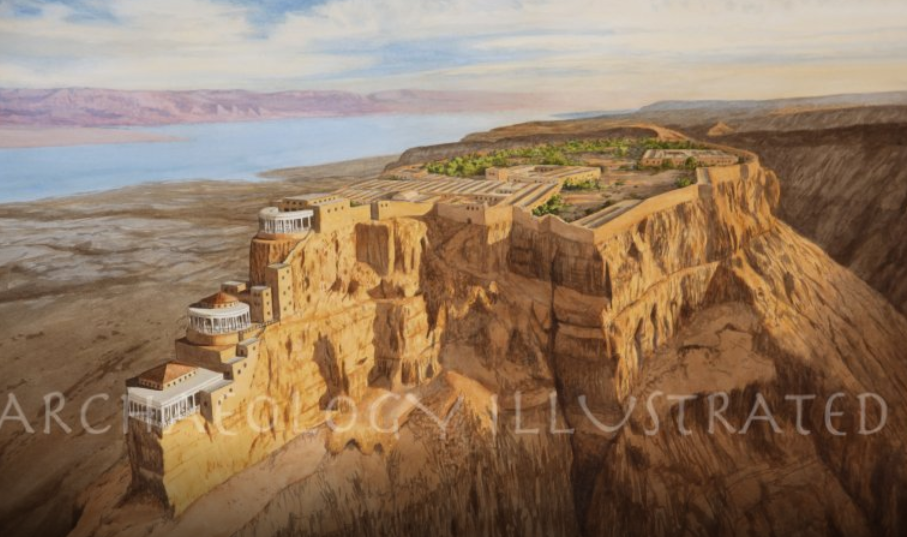
The Northern Palace is the engineering set-piece: three terraces cascading down the sheer northern nose of the rock, each held on retaining walls, stepping a royal residence down a cliff face for the air and the view. The lowest terrace carried a Roman-style bathhouse. The Western Palace held the throne room and the main residential rooms, with mosaic floors. The bathhouses ran on a hypocaust — a raised floor over a furnace-heated void — with the usual cold, warm and hot rooms; Herod's builders repeatedly adapted the Jewish ritual bath, the mikveh, to serve as the cold room.
Masada receives on the order of 15 mm of rain a year. Herod's engineers dammed the wadis below, ran the flash-flood water along channels into twelve large cisterns cut by hand into the north-western slope on two levels — a combined capacity of about 40,000 m³ — then had it carried up to storage cisterns on the plateau. That was enough to supply a large household, its baths, and a swimming pool of around 550 m³.
Significance and afterlife. After Herod's death the fortress held a Roman garrison; early in the First Revolt Jewish rebels, the Sicarii, seized it. After Jerusalem fell in 70 CE it was the last stronghold remaining, and the stored water and food let it hold out. The Tenth Legion under Flavius Silva besieged it in 73/74 CE, ringing the plateau with an 11 km circumvallation wall and eight camps and building an earth assault ramp up the western cliff — the most complete set of Roman siege works surviving anywhere. Josephus reports that the roughly 960 defenders chose death over capture; many historians doubt the mass-suicide account, which rests on his testimony alone. Masada is a UNESCO World Heritage site and a modern Israeli national symbol.
6. Herodium
About 12 km south of Jerusalem, on a natural hill, Herod raised an artificial cone about 758 m above sea level. It is the only site he named after himself.
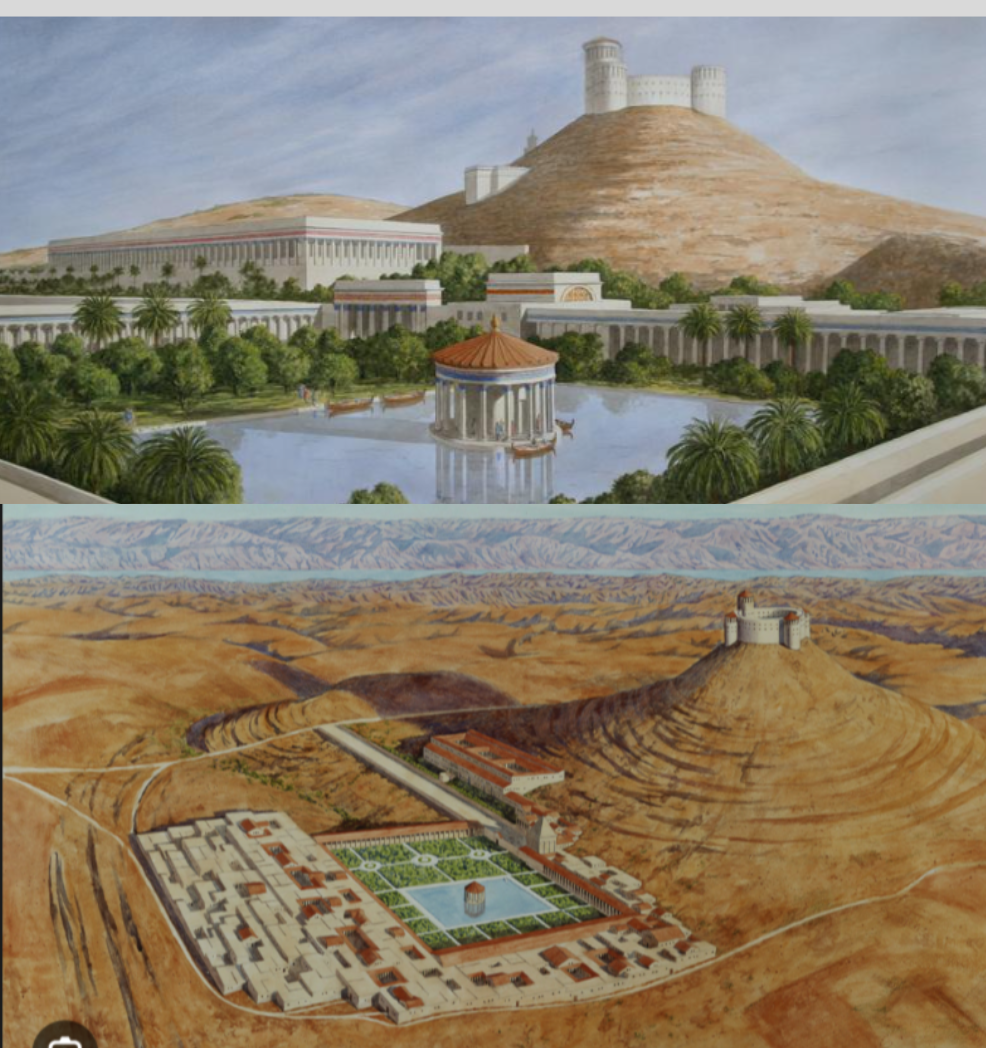
The core is a round palace-fortress: two concentric circular walls about 60 m across the outside, rising to roughly 30 m, with seven storeys inside and four towers on the ring. Three of the towers are semicircular; the fourth is a full cylinder on an 18 m base, almost certainly Herod's own apartment, floored in mosaic. Earth and gravel were then mounded against the cylinder until only its top third stood clear; the cone is fill.
At the foot lay a much larger "Lower Palace," more than twice the size of the fortress, with formal gardens, stables, and a large pool fed by an aqueduct running from the reservoirs known as Solomon's Pools. Recent excavation by the Hebrew University team has added a small theatre of 450–650 seats with a painted royal box (found 2008) and a monumental arched approach corridor about 20 m long and 6 m wide, preserved to a full 20 m of height, before it too was buried in the construction of the cone (found 2014).
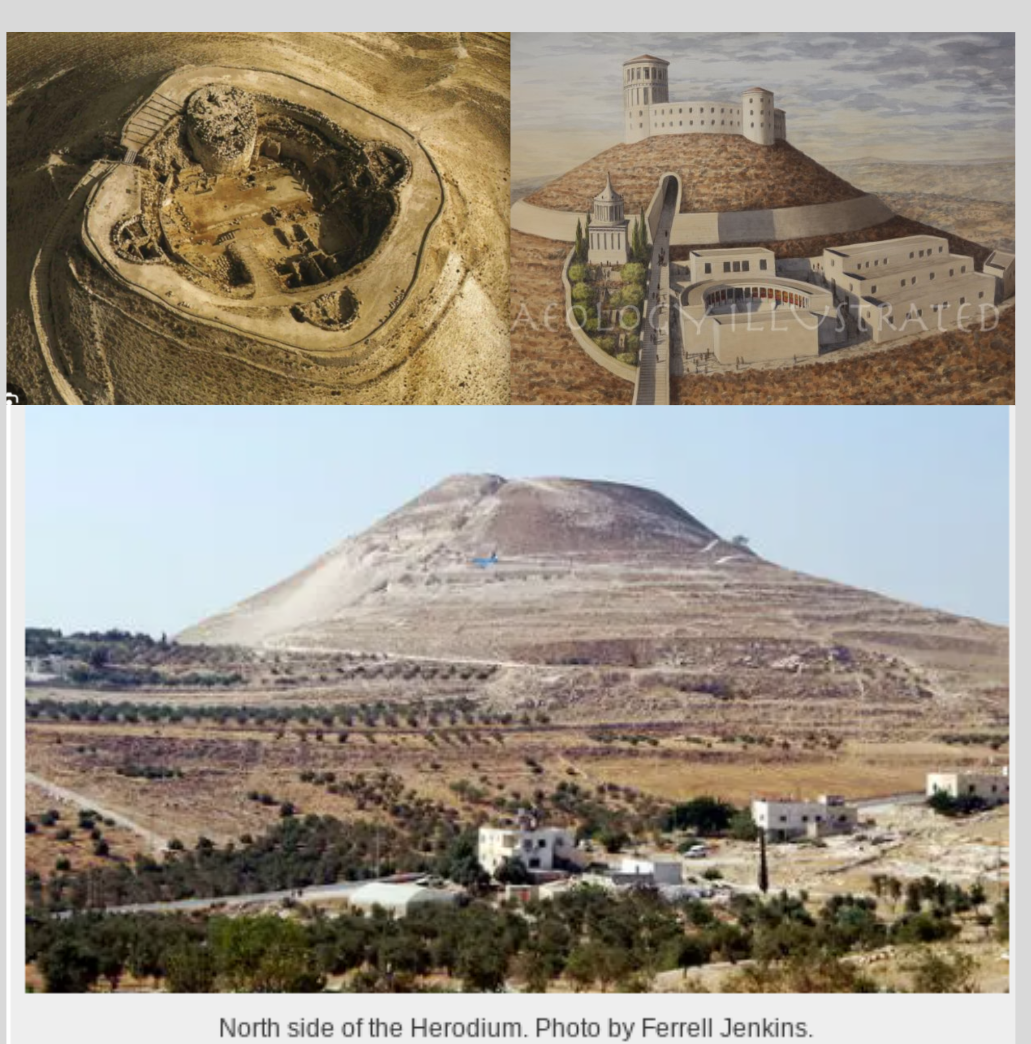
In 2007 Ehud Netzer, who had dug the site for decades, found a ruined two-storey mausoleum about 25 m high on the north-eastern slope and a smashed sarcophagus of pink limestone carved with floral motifs — and identified it as Herod's tomb, the burial place Josephus says he chose here. The identification is debated: the site was thoroughly looted in antiquity, and not every archaeologist accepts it. Netzer died in 2010 from a fall at the site.
Significance and afterlife. Herod was buried here. The site was reoccupied and refortified by rebels in both the First Revolt and the Bar Kokhba revolt of 132–135 CE, who cut tunnel systems through the hill that excavators still trace. It is the only one of his works that still carries his name.
7. Jericho, and the import of Roman technique
Herod's winter palaces at Jericho are where the Roman construction transfer is plainest in the masonry itself.
He built three palaces in the garden-city plain along the Wadi Qelt, the grandest — the third, around 15 BCE — spanning the wadi on a bridge and covering about 3 hectares. It held a sunken garden, a huge banqueting hall (a triclinium about 29 by 19 m) once floored in cut-stone opus sectile, peristyle courtyards, and a Roman bathhouse. The second palace combined the pools of the earlier Hasmonean palace into one basin about 32 by 18 m.
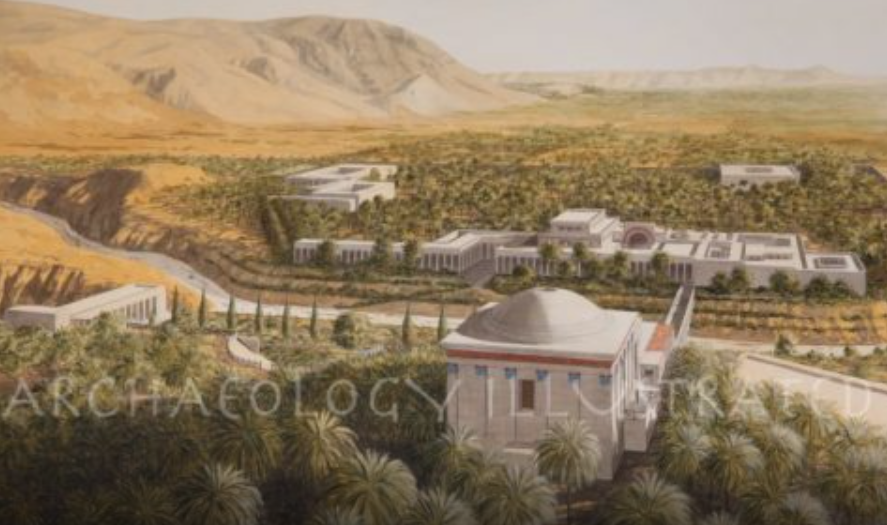
The walls were built partly in opus reticulatum — small pyramidal stones, around 10 cm square on the face, set point-inward into a concrete core in a diagonal net pattern — alongside conventional squared masonry, then plastered over to imitate the finish of buildings in Italy. Reticulate work is a distinctively Roman-Italian technique of this period, essentially unknown in the eastern Mediterranean except on a few of Herod's projects (the Jericho third palace, the so-called Herod's Monument in Jerusalem, and the palace at Banias), indicating that Italian builders were brought east to construct it.
The same plain held a hybrid hippodrome-and-amphitheatre and the aqueducts that irrigated the balsam plantations bankrolling much of the rest.
Significance and afterlife. Herod died at the Jericho palaces in 4 BCE. The estate and its waterworks decayed afterward. The opus reticulatum walls are the clearest physical evidence that Herod brought Italian builders and Roman technique east, and the excavated plans are a primary record of Herodian palace layout.
8. The Jerusalem palace and the towers
Herod's principal residence stood on the western hill of the Upper City, built around 25 BCE. Little of it has been excavated, so the account rests almost entirely on Josephus. He describes two great wings — named for Augustus and Agrippa — with banqueting halls that seated hundreds, guest rooms, colonnaded courtyards, groves, and channels feeding pools and fountains. Only scattered substructures survive, beneath the present Armenian Quarter; a group of monumental Ionic columns and a carved lion's head found nearby are thought to have come from it. The palace was stormed and burned during the First Revolt.
On its northern side stood three towers Herod raised in massive ashlar — Phasael, Hippicus, and Mariamne, named for his brother, a friend, and his wife. Josephus makes them the tallest structures in the city, built as solid stone bases carrying upper chambers. The lower courses of one survive at the Jaffa Gate, inside the citadel later called the Tower of David — among the few visible remains of Herodian Jerusalem outside the Temple Mount.
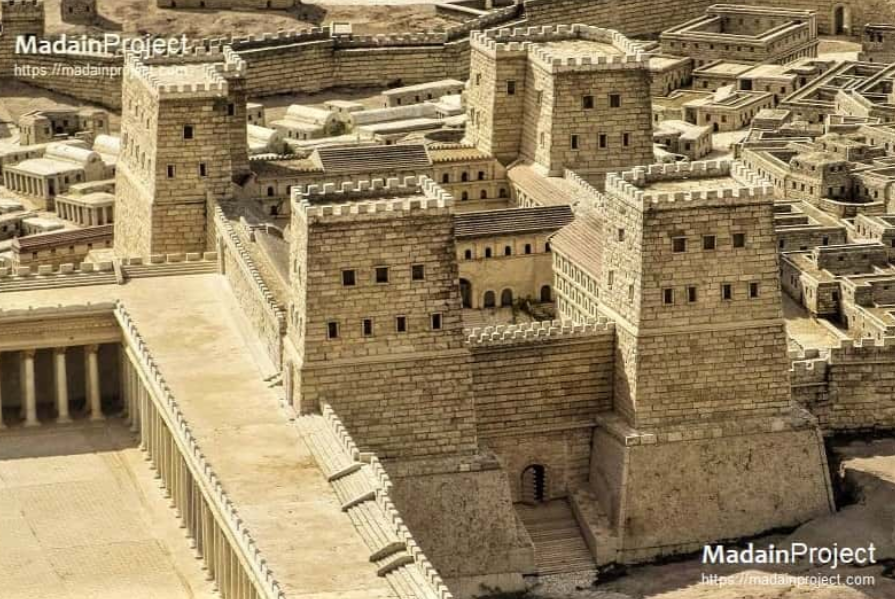
At the north-west corner of the Temple Mount he rebuilt an older Hasmonean fort as the Antonia, named for Mark Antony: a stronghold with four corner towers set on a scarped rock, holding a garrison that overlooked the Temple courts. With the palace on the western hill, the Antonia by the sanctuary, and the towers between, the works fixed his hold on the capital.
9. The wider catalogue
Herod also rebuilt or fortified a string of inland strongholds — Sebaste (Samaria), which he refounded as a city; the Hasmonean fortresses at Alexandreion, Hyrcania and Machaerus, several rebuilt with palaces inside the walls; and Cypros, the fortress-palace above Jericho he named for his mother.
He built three temples to the imperial cult of Roma and Augustus: at Caesarea, at Sebaste, and a third near Paneion (Banias) by the springs of the Jordan. The site of the northern temple is unresolved — the candidates are a building at Banias itself (one of the few eastern structures faced in opus reticulatum) and the temple excavated at Omrit, about 4 km to the south-west.
Beyond his own kingdom, Josephus lists benefactions to other cities. These are credited to Herod by the literary record and are not all confirmed archaeologically, so treat the catalogue as Josephus's:
| Place | Work credited to Herod |
|---|---|
| Antioch | A colonnaded, polished-stone main street about 4 km long — counted by historians as the first monumental colonnaded avenue of the Roman East |
| Rhodes | Rebuilt the temple of Pythian Apollo; funded shipbuilding |
| Tyre, Berytus (Beirut) | Halls, porticoes, temples, markets |
| Sidon, Damascus | Theatres |
| Damascus, Tripolis | Gymnasia |
| Byblos | City walls repaired |
| Laodicea (Latakia) | Aqueduct |
| Nicopolis | Public buildings for Augustus's victory city |
| Olympia | Endowed the Olympic Games and was named their perpetual president — a benefaction that propped up the failing Games |
The Antioch street is credited by historians as the first monumental colonnaded avenue of the Roman East, a form that became standard in Roman cities over the following centuries.
10. Common features across the works
- Sites engineered against their constraints. A harbour in open sea, water storage in desert, a platform over an undersized hill, a monument raised as an artificial hill.
- Mass and precision in stone. Foundations carried to bedrock; multi-hundred-tonne ashlars; the drafted-margin finish; the optical course-recession; and, at Hebron, mortarless walls intact after two thousand years on cutting precision alone.
- Imported technology. Hydraulic concrete and pozzolana, the floated-caisson method, opus reticulatum, hypocaust heating — Roman techniques, and in several cases Roman tradesmen, in a region that had neither.
- Water infrastructure. Arcaded aqueducts, wadi dams feeding cistern cascades, and rock-cut storage of tens of thousands of cubic metres.
- Logistics. More than thirty simultaneous projects across 800 km; the Caesarea harbour alone required over forty shiploads of imported pozzolana.
References
- Josephus, Flavius. The Jewish War and Jewish Antiquities (Books 14–17). First-century narrative source for the building program; treated here as evidence requiring corroboration, not as settled fact, given its known tendency to exaggerate figures.
- Ritmeyer, L. Reconstructions of the Herodian Temple Mount; Biblical Archaeology Society, The Temple Mount in the Herodian Period.
- Western Wall Heritage Foundation, on the "Great Course" and the Western Stone dimensions and revised weight estimate.
- On the Cave of the Patriarchs / Cave of Machpelah enclosure at Hebron: comparison of its ashlar work and surviving pilaster scheme with the Temple Mount (the basis for its attribution to Herod); dimensions and survival as the only intact Herodian building, per the Madain Project survey, the International Standard Bible Encyclopedia entry on Machpelah, and Britannica.
- Hohlfelder, R. L., Brandon, C., Oleson, J. P., et al. — the ROMACONS project and related studies on the hydraulic concrete and construction sequence of the Sebastos harbour at Caesarea; Raban, A., on the harbour's plan and subsidence.
- Netzer, E. The Architecture of Herod, the Great Builder (Mohr Siebeck / Baker Academic) — the foundational synthesis of the Herodian sites; and the Hebrew University Herodium Expedition reports (Porat, Kalman, Chachy) on the tomb, theatre, and entry corridor.
- Excavation and survey reports on Masada (Yadin and successors), the Jericho winter palaces (Netzer), and the opus reticulatum evidence at Jericho, Jerusalem, and Banias.
- World History Encyclopedia, "Herod the Great's Building Program," for the consolidated project count, distances, and the catalogue of overseas benefactions drawn from Josephus.
- On the Temple and its reception: Babylonian Talmud, Bava Batra 4a and Sukkah 51b (the praise of "Herod's building"), and the tradition of the priest-masons; the Royal Stoa figures (162 columns, four rows) from Josephus, Antiquities 15, and the Jewish Encyclopedia, "Temple of Herod."
- On Caesarea's afterlife: the New Testament, Acts 10 (Cornelius), 21 (Philip), and 23–26 (Paul); the Pilate inscription (theatre, found 1961) as the sole secular record of Pilate, with the later Herodium ring; the 66 CE riot as trigger of the First Revolt (Josephus); and the city's role as provincial capital and Christian centre (Origen, Eusebius), per Britannica and the Judaea (Roman province) record.
- On the siege of Masada (73/74 CE), the Tenth Legion siege works and assault ramp, the ~960 figure, and the scholarly doubt over the mass-suicide account: Josephus, The Jewish War 7; Britannica, "Siege of Masada"; and the UNESCO World Heritage listing (the siege works as the most complete surviving Roman example).
- On the later use of Herodium in the First and Bar Kokhba revolts: Biblical Archaeology Society, "OnSite: Herodium," and the Hebrew University expedition reports.
- On the Jerusalem royal palace, the three towers (Phasael, Hippicus, Mariamne), and the Antonia Fortress: Josephus, The Jewish War 1 and 5; E. Netzer, The Architecture of Herod, the Great Builder; and recent reconstructions of the Western Palace drawing on the monumental Ionic columns and the carved lion's head found on the south-western hill (Electrum and related studies).
- On the Caesarea promontory palace (the two-tier seaside residence, its sea-set freshwater pool, and its later use as the provincial praetorium): World History Encyclopedia, "Herod the Great's Building Program," and the Promontory Palace excavation studies.
- On the three temples to Roma and Augustus (Caesarea, Sebaste, and near Paneion) and the unresolved site of the northern temple: Josephus, Antiquities 15.363–364 and The Jewish War 1.404; with the Banias-versus-Omrit debate (Overman and colleagues for Omrit; Maoz and Netzer for candidate buildings at Banias), per Biblical Archaeology Review.
- On the sanctuary's appearance and dimensions (the gold-plated façade about 100 cubits high, the white stone, the preserved Holy of Holies), the nested courts, and the soreg balustrade with its Greek and Latin warning to Gentiles — two tablets recovered, one in the Istanbul Archaeology Museums and a fragment in Israel: Josephus, The Jewish War 5.5; the Mishnah, Middot; the Jewish Encyclopedia, "Temple of Herod"; and the Temple Warning (Soreg) inscription.
Note: figures for stone weights, harbour area, and stored water capacity are archaeological estimates and are given as ranges where the sources disagree. Manpower and timeline figures originating with Josephus are flagged in the text and should be read as upper bounds.