The Israelites and Succession
Benjamin, the house of Saul, and the editing of the crown
Benjamin was the youngest of Jacob’s twelve sons, and the only one born in the land of Canaan, the Promised Land — the other eleven were born in Paddan-Aram. His mother Rachel died bearing him on the road near Bethlehem; she named him Ben-Oni, and his father Jacob renamed him Benjamin, “son of the right hand” (Genesis 35:16–18) — the right hand being the side of honour, power, and blessing.
The Hebrew Bible reached its final form under Judahite editors loyal to the house of David, and it shows. Across Genesis, Samuel, Kings, and Chronicles the same tendency recurs: the house of Saul — and with it the tribe of Benjamin — is lowered, and Judah and David are raised. The case is not one passage but a pattern: disqualified elder brothers, defamed Saulide names, a giant-killing reassigned from one man to David, a burial tradition pulled south, and a later book that deletes David’s crimes outright. This memo sets out that pattern as an evidence grid, separates deliberate editing from ordinary textual accident, and marks the line between what the seams prove and what they don’t.
Sources. The argument rests on the biblical text read against itself — Genesis, Samuel, Kings, and Chronicles — with the seams clearest where a later book preserves what an earlier one altered. Manuscript evidence (the Septuagint, the Dead Sea Scrolls) and named scholarship are cited at the foot. Where a reading is contested, or rests on inference rather than a hard manuscript variant, it is flagged in the text.
1. Judah’s pledge for Benjamin
In the famine the brothers cannot buy grain in Egypt again unless they bring Benjamin, and Jacob refuses to send him — “his brother is dead, and he alone is left” (Genesis 42:38). Reuben offers the lives of his own two sons as forfeit and is refused (42:37). Then Judah pledges himself, before his father: “I will be surety for him; of my hand shalt thou require him: if I bring him not unto thee, and set him before thee, then let me bear the blame for ever” (43:9). Jacob consents, and Benjamin goes down to Egypt.
Joseph’s cup is planted in Benjamin’s sack, and Joseph rules that the man it is found with shall be kept as his servant (Genesis 44:2, 44:12, 44:17). Judah’s answer — the longest speech in Genesis — recounts the surety made before his father (“thy servant became surety for the lad unto my father,” 44:32) and ends by offering himself in Benjamin’s place: “let thy servant abide instead of the lad a bondman to my lord” (44:33). At that offer Joseph breaks and reveals himself (45:1).
Judah’s bond to Benjamin, sworn in front of Jacob, is personal and unlimited in time — “let me bear the blame for ever.”
2. The claim, stated precisely
The claim of this memo: the biblical text carries a sustained pro-Davidic, pro-Judahite editorial tendency that lowered the house of Saul, and Benjamin with it, while raising Judah, and the editors left their seams visible. It does not claim that Judah was disinherited; the text gives Judah the largest allotment and the scepter.
The contest the text manages is the house of David against the house of Saul. Saul was a Benjaminite; Benjamin was the King’s Tribe, the first to hold the throne, before David of Judah displaced it. The material that subordinates Benjamin attaches to it as the house of Saul’s tribe.
“Editing” also needs splitting into three kinds, because they carry different weight:
- Deliberate ideological editing — names changed to defame, crimes deleted, motives rewritten. This is tampering in the full sense, and it is provable where a later text preserves what an earlier one altered.
- Textual transmission — the same passage surviving at different lengths in different manuscript traditions. Evidence the text grew, not necessarily that anyone lied.
- Source-stitching — two older traditions anthologised side by side, seams showing. Less “tampering” than assembly.
The three kinds carry different evidential weight. Deliberate editing is established where a later text preserves what an earlier one altered. Transmission growth and source-stitching are established by the manuscript record. The arguments below that depend on inferred intent are weaker than those resting on a surviving contradiction or a manuscript variant, and are marked as such.
3. The blessing that clears the path (Genesis 49)
Jacob’s deathbed blessing disqualifies his first three sons in sequence and lands the rule on the fourth. Reuben, the firstborn, loses pre-eminence for defiling Bilhah (Genesis 35:22; 49:3–4). Simeon and Levi are cursed and scattered for the massacre at Shechem (Genesis 34; 49:5–7). The scepter passes to Judah (49:8–12), in explicit royal language read ever after as the Davidic and messianic line.
Judah’s own record carries comparable material, handled differently. He proposed selling Joseph (Genesis 37:26–27). His own chapter has him fathering children on his daughter-in-law Tamar after wronging her, then conceding she was in the right (Genesis 38:26), and he later offers himself in Benjamin’s place (44:18–34). Reuben, Simeon, and Levi receive offences that disqualify; Judah’s are recounted without loss of the scepter.
The same blessing gives a large portion to Joseph (49:22–26), father of Ephraim and Manasseh, the leading tribes of the northern kingdom. Chronicles states the division directly: the birthright — the double portion — went to Joseph, the rulership to Judah (1 Chronicles 5:1–2). The crown is assigned to Judah, the fourth son; Benjamin, the youngest, is not in the line.
4. Benjamin’s claim, and what kind of claim it is
The pointers are real. He is the son of Rachel, the beloved wife (Genesis 29:30). He is the only son born in the land — all eleven others in Paddan-aram. His name, given by Jacob over Rachel’s dying “Ben-oni,” is Binyamin, “son of the right hand” (Genesis 35:18) — the place of honour. He alone is innocent of selling Joseph, not yet born or not present. Moses’ blessing calls him yedid YHWH, “beloved of the LORD,” with God dwelling “between his shoulders” — read throughout the tradition as the Sanctuary resting in Benjamin’s portion (Deuteronomy 33:12). And in the allotment, Jerusalem (Jebus) is listed among Benjamin’s cities (Joshua 18:28), with the city sitting on the Judah–Benjamin border. The first king, Saul, was a Benjaminite.
These are texts of favour and of sacred standing: the beloved son, the tribe in whose land the Sanctuary stood. Benjamin’s deathbed blessing is the wolf — “in the morning devouring the prey, at evening dividing the spoil” (Genesis 49:27).
The portions in Egypt. The favour is acted out in the Joseph story in measured quantities. At Joseph’s table “Benjamin’s mess was five times so much as any of theirs” (Genesis 43:34). At the parting gifts, each brother receives a change of garments — Benjamin receives five changes, and three hundred pieces of silver besides (45:22). And the one object Joseph plants to bring the brothers back is his own silver divining cup, placed in Benjamin’s sack (44:2, 5, 12). Within the narrative the youngest is singled out, repeatedly and by number.
Pointers toward the kingship. Beyond Saul himself, the following bear on Benjamin and the crown. The textual items first:
- At Bethel, immediately before Benjamin’s birth, God promises Jacob: “kings shall come out of thy loins” (Genesis 35:11). The journey resumes, Rachel goes into labour, and Benjamin is born (35:16–18) — the only son born after the promise. The sequence is the text’s; the royal reading of it is the rabbis’ (Genesis Rabbah).
- Psalm 68:27 places Benjamin at the head of the festal procession into the sanctuary: “little Benjamin, rodem” — from the root “to rule”; translations divide between “their ruler” and “leading them.” Either way the smallest tribe walks first.
- Saul’s kingship is presented as divinely selected twice over: anointed by Samuel as prince (1 Samuel 10:1), then taken by lot, tribe by tribe, family by family — the lot falling on Benjamin, then on Saul (10:20–21), with the people’s acclamation (10:24). Saul himself protests the choice: “Am not I a Benjamite, of the smallest of the tribes of Israel?” (9:21).
- A gate of Jerusalem carried the tribe’s name — the Benjamin Gate, on the north wall, the road out toward Benjamin’s land (Jeremiah 37:13, where Jeremiah is stopped leaving for the land of Benjamin; 38:7, where the king sits in it; Zechariah 14:10, spanning the north wall to the Corner Gate). The temple, too, had its “upper Benjamin Gate, by the house of the LORD” (Jeremiah 20:2). Only one other tribe is written on the city’s walls — the Ephraim Gate (2 Kings 14:13; Nehemiah 8:16; 12:39) — so the only two tribal gates of the historical city belong to Rachel’s line; there is no Judah Gate in Judah’s own capital. And in Ezekiel’s visionary city, where all twelve tribes receive gates (48:30–35), Benjamin’s gate stands on the east, beside Joseph and Dan — Rachel’s two sons and the son of her maid Bilhah, born on Rachel’s knees (Genesis 30:3–6): the entire east face of the ideal city is Rachel’s household, while Judah’s gate sits on the north.
- After Saul’s death the crown of Israel stayed in his house: Abner made Ish-bosheth “king over all Israel” (2 Samuel 2:9), and Benjamin held its allegiance — “the greatest part of them had kept the ward of the house of Saul” (1 Chronicles 12:29). The Saulide claim is voiced on the page: Shimei son of Gera, a Benjaminite, curses David — “the LORD hath returned upon thee all the blood of the house of Saul, in whose stead thou hast reigned” (2 Samuel 16:8) — and Sheba son of Bichri, a Benjaminite, raises the secession cry, “we have no portion in David” (2 Samuel 20:1).
And the traditional items, flagged as tradition: the Talmud holds that the altar of the Temple stood in Benjamin’s portion, reading “he dwells between his shoulders” (Deuteronomy 33:12) of the Sanctuary (b. Yoma 12a; Megillah 26a); that Benjamin’s tribe entered the Red Sea first, earning the merit of hosting the Divine Presence (b. Sotah 37a); and that the wolf of Jacob’s blessing is Saul in the morning of the kingdom and Mordecai and Esther at its evening (Genesis Rabbah 99).
The tribe's prominence runs on past Saul. Ehud, the judge who freed Israel from Moab, was a Benjaminite (Judges 3:15). Benjamin was cut down to six hundred men at Gibeah (Judges 19–21) and rebuilt. At the division of the kingdom Benjamin stayed with Judah (1 Kings 12:21), so the surviving southern kingdom — and the people later called Jews — was Judah and Benjamin together.
Mordecai is introduced with a Saulide pedigree: “Mordecai, the son of Jair, the son of Shimei, the son of Kish, a Benjamite” (Esther 2:5) — Kish being the name of Saul’s own father (1 Samuel 9:1). His adversary Haman is “the Agagite” (Esther 3:1) — Agag being the Amalekite king whom Saul spared against command, the act that cost him the kingdom (1 Samuel 15). The book stages the rematch: a Benjaminite of the house of Kish destroys the house of Agag — and where Saul fell by seizing the spoil (1 Samuel 15:9, 19), the text states three times over that the Jews “did not lay their hands on the plunder” (Esther 9:10, 15, 16). Mordecai ends the book second only to the king (Esther 10:3), and he and Esther save the whole people.
Saul of Tarsus bears the first king’s name and claims the tribe outright: “of the tribe of Benjamin, a Hebrew of Hebrews” (Philippians 3:5; Romans 11:1) — and in his Antioch speech he himself recalls “Saul the son of Kish, a man of the tribe of Benjamin” who reigned forty years (Acts 13:21). As Paul he became the foremost apostle of Jesus and wrote much of the New Testament — from the tribe named “son of the right hand,” the man at the right hand of the new King.
Benjamin gave Israel its first king and held Jerusalem and the Sanctuary in its portion; the enduring dynasty, by the record, descended from Judah.
5. The defamation of Saul’s house (the clearest tampering)
The most direct evidence of deliberate editing targets Saul’s family by name. Several members carried names ending in -baal (“lord,” an old and originally acceptable divine title): Saul’s son Esh-baal, his grandson Merib-baal. Later editors changed these to -bosheth, “shame” — Ish-bosheth, Mephi-bosheth.
This is provable rather than inferred, because Chronicles preserves the original baal forms (1 Chronicles 8:33–34; 9:39–40) while Samuel carries the bosheth forms. We can watch the same names alter between books. The alteration is not random: it lands on the house of Saul, the Benjaminite royal line, and turns “man of the lord” into “man of shame.” Targeted, ideological, and documented. (The same hand also rewrote Gideon’s name Jerubbaal to Jerubbesheth — 2 Samuel 11:21 — so the practice was a pattern, not a one-off.)
6. The defence of David (an apology in narrative form)
The king’s death is told three ways. In 1 Samuel 31:3–6, Saul, wounded by the archers on Gilboa, asks his armour-bearer to thrust him through; the man refuses, and Saul takes his own sword and falls on it — suicide, the narrator’s own account. One chapter later, in 2 Samuel 1:6–10, an Amalekite arrives at Ziklag and tells David a different death: he found Saul leaning on his spear, Saul begged him to finish it, “so I stood upon him, and slew him” — and he hands David the crown and the bracelet. David has him executed for slaying the LORD’s anointed (1:14–16). Chronicles repeats the suicide and then adds a third frame: Saul died for his transgressions, “therefore he slew him” — God as the killer (1 Chronicles 10:4, 13–14); and 2 Samuel 21:12 says in passing that “the Philistines had slain Saul in Gilboa.” The standard harmonisation is that the Amalekite lied for a reward — but the text never says so; that is an inference supplied to close the gap. What the page itself carries is a doublet — two source-versions of the first king’s death set side by side — and the second version does double apologetic work: it is the one that delivers the royal regalia into David’s hands, and it supplies the killer for David to punish, putting David’s grief and innocence on display in the same scene. Note also what each version does to Saul: the surviving accounts give Israel’s first king the rarest and most inglorious of biblical deaths — by his own hand, then beheaded, his armour in the temple of Ashtaroth and his body nailed to the wall of Beth-shan, retrieved at night by the men of Jabesh-Gilead, the town his first act as king had saved (1 Samuel 31:8–13; 11:1–11). David dies in his bed, in his palace, of old age (1 Kings 1–2).
The books of Samuel record David as innocent in each death that cleared his path to the throne — Saul, Jonathan, Abner, and Saul’s heir Ish-baal. Each time the text insists David was elsewhere, innocent, or actively grieving. Saul dies on Gilboa and David executes the man who claims to have finished him (2 Samuel 1). Abner is killed by Joab and David curses Joab’s house and mourns publicly (2 Samuel 3). Ish-baal is assassinated and David has the assassins killed (2 Samuel 4).
The sequence functions as an apology — a defence against the charge that David eliminated the house of Saul and took its kingdom. The analysis is established in scholarship as the “History of David’s Rise” and the “Apology of David” (McCarter; Halpern — verify references before citing). Each death that cleared David’s path is narrated with David absent, innocent, or punishing the killer; the charge the defence answers is the one this section documents.
The seven hanged at Gibeah. 2 Samuel 21:1–14 carries the apology’s heaviest case. A three-year famine is laid by oracle on “Saul, and his bloody house” for a slaughter of the Gibeonites that is recorded nowhere else in the Bible — an off-stage crime, cited but never narrated. David asks the Gibeonites — the Hivite enclave of Benjamin’s own allotment (Joshua 9; 18:25) — what atonement they require; they ask for seven men of Saul’s line, and David delivers them: Armoni and Mephibosheth, the sons of Saul’s concubine Rizpah, and five sons of Saul’s daughter, hanged “before the LORD in Gibeah of Saul” — the king’s own town — at the start of barley harvest. Jonathan’s son alone is exempted, for David’s oath. Rizpah keeps vigil over the bodies on sackcloth from harvest until the rains fall, beating off the birds by day and the beasts by night (21:10); only after that does David gather the bones of Saul and Jonathan from Jabesh-gilead — left unburied by him until then — and lay them, with the seven, in the tomb of Kish at Zela in Benjamin. The narrative gives David impeccable motives at every step: famine, oracle, treaty-atonement, an oath honoured, a burial performed. The effect it records is the execution of seven Saulide heirs at a stroke, the surviving claimant a lame man who eats at David’s table under his eye (9:13). Two seams attach. The verse naming the five (21:8) is broken in the standard text: it reads “Michal,” who was childless (2 Samuel 6:23) and never married Adriel — 1 Samuel 18:19 gives him Merab — and two Hebrew manuscripts with the Septuagint read Merab, as translations now do; another corruption sitting exactly on the house of Saul (§7). And the book’s order conceals a sequence: David’s question that opens the Mephibosheth story — “Is there yet any that is left of the house of Saul?” (9:1) — reads most naturally after such a purge, and 21:1–14 sits in Samuel’s undated appendix; on that reading the famous kindness to Jonathan’s son follows the hanging of seven of his kin. Deuteronomy’s own law — children shall not be put to death for the fathers (24:16) — stands against the execution; the text does not raise it.
7. A southern record, and the issues in the texts
The Hebrew Bible is, by broad scholarly agreement, a product of the southern kingdom — compiled, edited, and preserved in Judah and at the temple in Jerusalem. The northern kingdom of Israel was destroyed by Assyria in 722 BC, its people deported and scattered, and it left behind no scripture, chronicle, or literature of its own that survives. What reaches us of the north — its prophets, its shrines, its founding stories — comes down only because southern scribes, many of them refugees who carried northern traditions south, preserved and re-edited that material. There is no northern canon to set beside the southern one, and no independent text to check it against. A record edited in Judah’s favour is therefore not a surprise to be proved verse by verse; it is the character of the only record that reached us.
The witnesses. Claims that the text changed can be tested, because it survives in more than one form. The standard Hebrew text (the Masoretic Text) was fixed by medieval scribes; its oldest complete manuscript, the Leningrad Codex, dates to 1008 AD. The Septuagint is a Greek translation made from older Hebrew copies in the third and second centuries BC — over a thousand years closer to the events. The Dead Sea Scrolls (third century BC to first century AD) preserve about two hundred biblical manuscripts in Hebrew, and they do not all agree: some match the Masoretic Text, some match the Hebrew that lay behind the Septuagint, some match neither. The Samaritan Pentateuch carries the Torah in a separate line of transmission with roughly six thousand differences, most small. Where these witnesses diverge, the differences are the evidence: each divergence marks a place where the text was altered, lost, or grew after the copies separated.
The book of Samuel in particular. The book that carries Saul, David, and the whole house-of-Saul story is, by common scholarly judgment (Wellhausen, Driver, McCarter), among the most textually damaged books of the Hebrew Bible — the Qumran Samuel scroll (4QSama) and the Septuagint repeatedly preserve readings the standard text has lost or garbled. The documented issues that follow sit disproportionately in this book, on this story.
Saul’s accession formula is broken. 1 Samuel 13:1, the verse that should give Saul’s age and length of reign — the standard regnal formula every king receives — reads literally: “Saul was a year old when he became king, and he reigned two years over Israel.” The numbers have dropped out. Most Septuagint manuscripts omit the verse entirely; modern translations either leave blanks or supply conjectures. Of all the kings of Israel and Judah, the one whose regnal record is corrupt beyond recovery is Saul. The figure survives only outside the Hebrew text: forty years — in the mouth of Paul the Benjaminite, naming “Saul the son of Kish, a man of the tribe of Benjamin” (Acts 13:21), with Josephus carrying the same total (Antiquities 6.378, against his own twenty at 10.143). The reign the text of Samuel lost is preserved by a son of the same tribe bearing the same name.
A missing paragraph about Saul’s first war. The Qumran scroll 4QSama carries a paragraph before 1 Samuel 11 — also known to Josephus — explaining that Nahash the Ammonite had been gouging out the right eyes of the Israelites of Gad and Reuben, which is why his siege of Jabesh-Gilead triggers Saul’s first royal act. The standard text lacks the paragraph, and the story opens abruptly. Several modern translations (NRSV) now restore it. A piece of the narrative that establishes Saul’s kingship demonstrably fell out of — or was dropped from — the text that became standard.
The David and Goliath story grew. The Septuagint version of 1 Samuel 17–18 is roughly forty verses shorter than the Hebrew: no stone-by-stone expansion, no second account of David’s introduction to Saul. We hold two editions of the story at different lengths — direct evidence that the most famous episode in David’s rise was enlarged after the Greek translation was made.
The transferred giant. The text gives two different killers for Goliath. The famous account is David (1 Samuel 17). But 2 Samuel 21:19 states plainly that Elhanan, son of Jaare-oregim, a Bethlehemite, killed Goliath of Gath — and repeats the signature detail, the spear “like a weaver’s beam,” from the David story. Two men, one giant, same town. Then Chronicles repairs the contradiction: 1 Chronicles 20:5 rewrites the line so Elhanan kills Lahmi, the brother of Goliath. The harmonisation is visible on the page. The economical reading is that the deed was originally Elhanan’s and was transferred to the hero-king of Judah — or, at minimum, that the text contradicts itself and a later editor smoothed it. Either way it is a heroic act reassigned toward David, with the repair still attached.
The scribes’ own admitted changes. Rabbinic tradition itself records the tiqqunê sopherim, the “emendations of the scribes” — a list (usually eighteen) of places where the scribes state that the text was deliberately altered, mostly to protect the dignity of God (e.g. Genesis 18:22; Habakkuk 1:12). The list is small and the motive reverence rather than politics, but it establishes the practice from inside the tradition: the scribes who transmitted the text record that the text was changed on purpose.
Two editions of a whole book. The Septuagint’s Jeremiah is about one-eighth shorter than the Hebrew and arranges the chapters in a different order — and two Qumran fragments (4QJerb,d) preserve the short Hebrew edition it was translated from. A complete biblical book circulated in two different editions, both ancient. Smaller cases point the same way: the acrostic Psalm 145 is missing its nun line in the standard text; the Qumran Psalms scroll and the Septuagint preserve it.
Numbers that disagree. Where Samuel–Kings and Chronicles report the same event, the figures often differ: David’s census returns 800,000 and 500,000 in 2 Samuel 24:9 but 1,100,000 and 470,000 in 1 Chronicles 21:5; Solomon’s stables hold 40,000 stalls in 1 Kings 4:26 but 4,000 in 2 Chronicles 9:25; the Aramean casualties of 2 Samuel 8:4 and 1 Chronicles 18:4 disagree. Whether by copying error or revision, parallel texts of the same events do not carry the same data.
Two further cases are treated in their own sections because they bear directly on the house of Saul: the renaming of Saul’s heirs, where Chronicles preserves the original names Samuel’s text defamed (§5), and the Chronicler’s systematic deletion of David’s crimes (§8).
What this evidence establishes, before any argument about motive: the text changed in transmission — it grew, lost passages, was harmonised, and was on occasion deliberately emended, by the scribes’ own account. And the documented damage is not evenly spread: it clusters in the book of Samuel, and within it, on the record of Saul.
8. The Chronicler’s whitewash
Chronicles, the latest retelling, is the cleanest demonstration of tendentious editing because we can lay it beside its source. It deletes David’s worst material wholesale: no Bathsheba, no murder of Uriah, no rape of Tamar, no Absalom’s revolt, and it minimises the long war against Saul’s house. It centres everything on Judah, David, and the Temple.
It also rewrites motive directly. 2 Samuel 24:1 says the LORD incited David to take the census; the parallel at 1 Chronicles 21:1 changes the instigator to Satan — a theological revision to lift the blame off both God and David. Same event, edited cause. Editing by subtraction and by substitution, both observable against the earlier text.
9. The anti-Saulide polemic (Gibeah)
Judges 19–21 tells of an atrocity at Gibeah — the gang-rape and murder of a Levite’s concubine — that triggers a war nearly exterminating Benjamin, the King’s Tribe. Gibeah is Saul’s hometown (later “Gibeah of Saul”). A narrative that brands Saul’s own city as a place of rape and civil war, preserved in a book edited under Judahite auspices, reads as anti-Saulide polemic dressed as history. It is softer evidence than the name-changes — it depends on reading intent — but it fits the pattern exactly. The scale recorded is large: Judges 20 reports tens of thousands killed on both sides and the tribe of Benjamin reduced to six hundred men at the rock of Rimmon (20:46–47). For an event of that magnitude — a tribe of Israel all but destroyed — the account stands alone: it is told only here, is referred to nowhere else in the Hebrew Bible, has no external or archaeological corroboration, and the text gives no cause beyond the single atrocity at Gibeah.
10. The tomb pulled south (Rachel)
The burial of Rachel, mother of Benjamin, shows the same southward pull. Genesis places it “on the way to Ephrath, that is, Bethlehem” (35:19; 48:7). But two other texts put her tomb in the north, in Benjamin’s own territory: 1 Samuel 10:2 (“in the territory of Benjamin, at Zelzah”) and Jeremiah 31:15 (Rachel weeping at Ramah). The contradiction was noticed early — the Tosefta (Sotah 11:11) debates it, and Rashi and Ramban both worked to reconcile it.
The scholarly reading is that the northern location is older and the “that is, Bethlehem” identification is a Judahite gloss. R. A. S. Macalister (1912) argued the Bethlehem identification was a copyist’s addition; the view that the grave lay in the north and was appropriated southward to enhance Judah’s prestige is held by some as effectively certain (S. H. Hooke set out the two-traditions case). This is the same maneuver as the rest of the memo, applied to a grave: a Benjaminite tradition relocated into Judah’s Bethlehem.
A philological thread runs alongside it. The place-name Ephrath has a genuine twin in Ephraim — “Ephrathite” is used both for people of Bethlehem (Jesse, 1 Samuel 17:12) and for Ephraimites (1 Samuel 1:1; 1 Kings 11:26), suggesting the names were interchangeable, and 1 Samuel 10:2 points to a northern Ephrath near Bethel rather than the southern Bethlehem. Ephraim is Rachel’s own descendant line (through Joseph) and the leading northern tribe — so the name attached to Rachel’s death-place has a northern twin running through her own bloodline.
The physical tomb at Bethlehem cannot serve as a second witness. The structure is Crusader-to-Ottoman (with Montefiore’s nineteenth-century work), the earliest record of the site is early-fourth-century Christian pilgrims, and no burial has ever been verified beneath it. The site was identified from the Genesis verse — pilgrims went where scripture pointed. A monument built on a reading cannot then confirm the reading; it only proves the southern tradition won the shrine.
11. What it adds up to
The exhibits, summarised: elder brothers disqualified in sequence, leaving Judah; Saul’s heirs renamed with bosheth (“shame”) where Chronicles keeps baal; David narrated as absent or innocent at each death in Saul’s house; the killing of Goliath assigned to David in 1 Samuel 17 and to Elhanan in 2 Samuel 21:19, with the Chronicles repair at 1 Chronicles 20:5; Chronicles omitting David’s census-order from God (2 Samuel 24:1 / 1 Chronicles 21:1) and his other crimes; Rachel’s grave tradition placed in Benjamin in Samuel and Jeremiah and at Bethlehem in Genesis.
12. The author’s view
The thirteen sections above stand on the documented record. This one does not. It is the author’s reading of where that record points — stated as belief, marked off from the evidence, with what stands against it noted alongside.
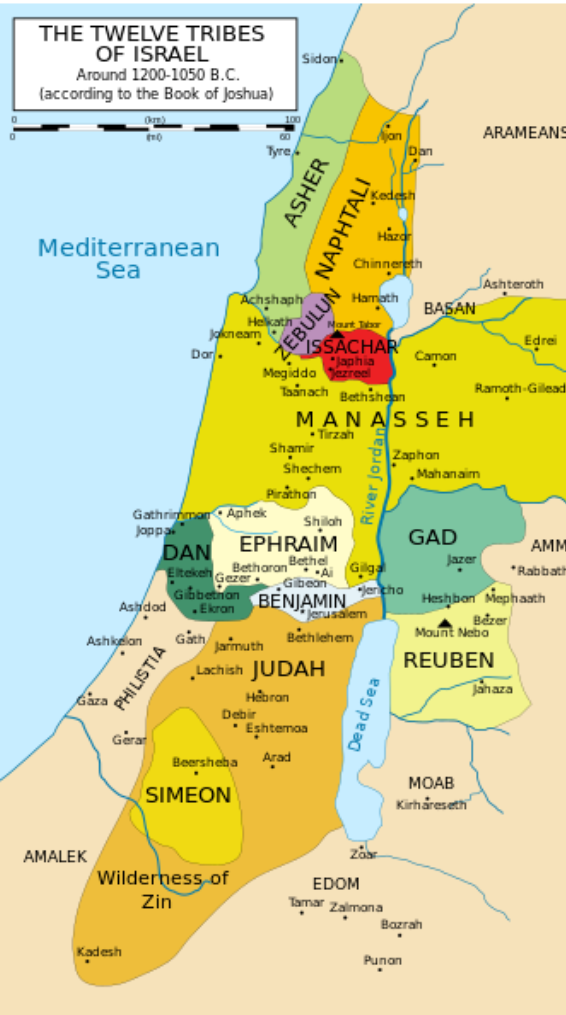
The map is Judah’s map. The tribal allotments of Joshua 13–19 — the familiar twelve-tribes picture — are dated by mainstream scholarship (Albrecht Alt and his successors; N. Na’aman) not to the conquest but to the era of the monarchy: boundary and town lists drawn from the administrative files of the kingdom of Judah and projected back. The map of the tribes, like the rest of the record (§7), is a southern document. The borders are the borders as Judah’s scribes drew them.
The barred brothers are visible on that map. Jacob’s deathbed words struck the three eldest (Genesis 49:3–7), and the map displays it: Levi holds no territory at all; Simeon holds only an enclave inside Judah (Joshua 19:1–9) — the scattering fulfilled — and was absorbed; Reuben’s portion lies outside the land proper, across the Jordan, his loss being the firstborn’s preeminence rather than ground. Of the brothers Jacob barred, none holds the western heartland.
The author’s reading. The author holds that Benjamin’s portion originally ran further south than the narrow strip the lists allow it, taking in the Bethlehem district — that the country around Rachel’s grave was Benjamin’s before it was Judah’s, and that the southern presentation of it is the editors’ work, of a piece with the pattern this memo documents. The indicators that survive: 1 Samuel 10:2 and Jeremiah 31:15 place Rachel’s grave in Benjamin; Genesis carries the suspected gloss “that is, Bethlehem” that pulled it south (§10); Eusebius’s Onomasticon — the one ancient text to assign the town a tribe directly — files Bethlehem under Benjamin, drawing on an older Jewish source-list, before Jerome’s correction; and Nehemiah 7:26–32 groups Bethlehem among Benjaminite towns. The author extends the same reading to Hebron, as Benjamin’s before David took the south. On the author’s view, this is why the locations of Benjamin’s birth and Rachel’s burial are the most contested ground in the patriarchal record: an honest geography exposed what the editing had done, so the geography was obscured.
The name under the name. The older name of the place, by the text’s own concession, is Ephrath / Ephrathah: Rachel dies “on the way to Ephrath, which is Bethlehem” (Genesis 35:19; 48:7) — the formula translates the old name into the current one. Ruth is blessed “in Ephrathah… in Bethlehem” (Ruth 4:11); Micah writes “Bethlehem Ephrathah” (5:2); Psalm 132:6 uses Ephrathah alone. The Chronicler turns the name into a person — Ephrath, a wife of Caleb (1 Chronicles 2:19), whose line then fathers Bethlehem (2:50–51; 4:4) — the old toponym absorbed into Judah’s genealogy. The gentilic cuts two ways: “Ephrathites of Bethlehem-judah” (Ruth 1:2; 1 Samuel 17:12), but everywhere else “Ephrathite” means a man of Ephraim (Judges 12:5; 1 Samuel 1:1; 1 Kings 11:26) — the older name of the Bethlehem district is the word that otherwise marks Rachel’s other line. And the town is written with its tribe insistently attached — “Bethlehem-judah” again and again (Judges 17:7–9; 19:1, 2, 18; Ruth 1:1–2; 1 Samuel 17:12). The standard reading of the qualifier is disambiguation, a second Bethlehem lying in Zebulun (Joshua 19:15); the author reads the insistence itself as a tell — a label that did not need defending would not be defended.
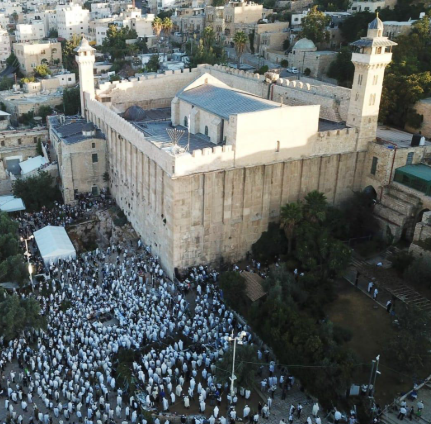
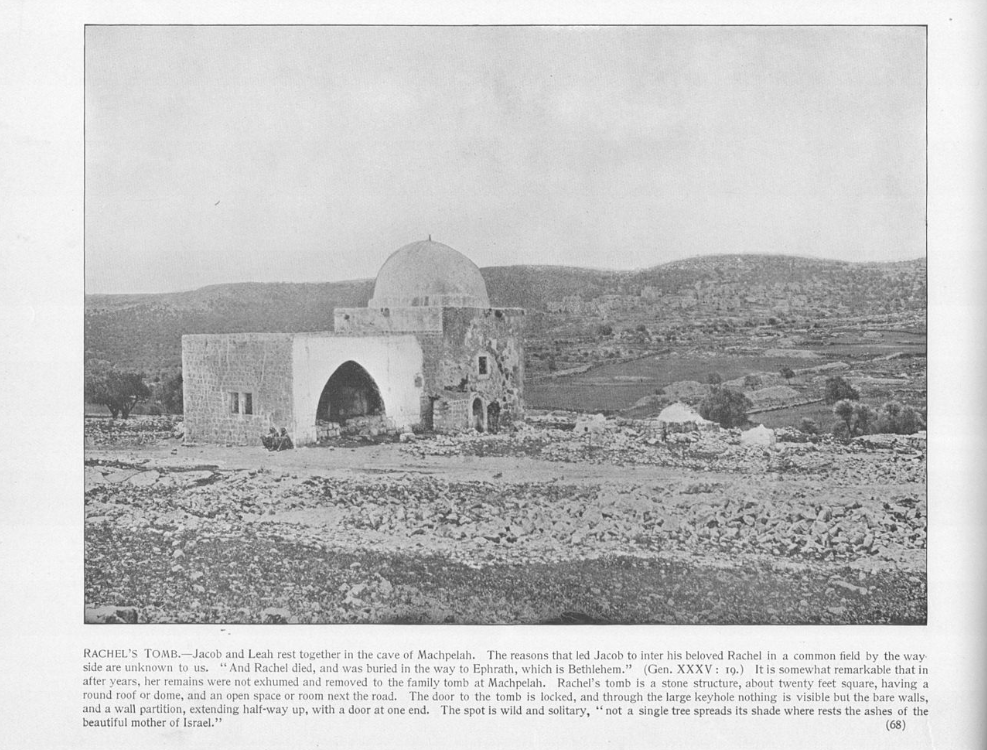
The grave outside the tomb, and the birth without a place. The cave of Machpelah holds Abraham and Sarah, Isaac and Rebekah, Jacob and Leah (Genesis 49:29–32; 50:13). Rachel alone of the matriarchs lies outside it — buried where she fell, in open ground by the road. Reburial was practised in this family: Jacob’s body was carried from Egypt to Machpelah, and Joseph’s bones from Egypt to Shechem, generations after his death, under his own oath. For Rachel it was never done, and no text gives a reason. The anomaly needs no thesis to be seen: a popular photo-book of the Holy Land, c. 1900, affectionate toward “the beautiful mother of Israel,” still records that the reasons for the wayside burial are unknown and finds it remarkable that her remains were never moved to the family tomb — the spot itself “wild and solitary.” And Benjamin’s birthplace is never named at all. Genesis 35:16 sets the birth at kibrat ha-aretz — “some distance” — before Ephrath, a measure no one can translate (the Septuagint simply transliterates it; Genesis 48:7 repeats it): expressly not at the town, at a spot with no name, no shrine, and no commemoration in scripture or tradition. The mother’s grave received a marker, disputed ever since; the son of the right hand received no birthplace. Its location is recoverable only by inference — and on the Migdal Eder sequence (§10), the inference lands inside Benjamin’s own later territory. The author reads these with the relocation as one pattern: the matriarch of the rival line kept out of the dynastic tomb, her grave-tradition moved into Judah’s town, the founder’s birthplace left nameless — exclusion, appropriation, and silence falling on the same family. Held to the method: the exclusion and the silence are textual facts; the southward relocation is the documented case of §10; whether her remains were ever physically moved is unevidenced in any direction; and deceit as motive is the author’s conjecture, not a finding. The site’s own trajectory closes the frame — from an unlocked dome in an empty field, photographed c. 1900, to today’s fortified enclave and the third-holiest site: the reverence is real, and it is modern in scale.
The Egyptian thread. The author extends the reading into Egypt, where the indicators and the difficulties are both substantial; it is sketched here and reserved for a memo of its own. The Hyksos — the dynasty of West Semitic, Canaanite-origin rulers who held Lower Egypt from Avaris — are mainstream Egyptology, and the identification of them with Israel’s ancestors is ancient: Josephus himself equated Manetho’s Hyksos with the Israelites. Genesis sets Jacob’s family in exactly that position — Semites from Canaan elevated over Egypt, Joseph given rule of the land under Pharaoh (Genesis 41:40–44) and styled by the unique title shallit (42:6), which some match to Manetho’s first Hyksos king, Salitis. Manetho’s second Hyksos king is Bnon, read on this argument as Benjamin — Joseph’s only full brother, the son publicly honoured at the Egyptian court (43:34; 45:22). A Hyksos-era king named Yaqub-Har — “Jacob” — is attested on scarabs; and the Mari tablets (18th century BC) record kings of the Binu-Yamina, “sons of the right hand,” the same construction as Benjamin’s name. Against it, stated as the method requires: the Hyksos dynasty is dated c. 1650–1550 BC against patriarchal dates near 1900–1800 BC, a gap the author holds reconcilable by revised chronology but which is unresolved; Manetho wrote in the 3rd century BC and survives only in corrupted quotation, with Egyptologists matching his Bnon to the attested kings Bebnum or Sheshi, not to any Benjamin; Salitis is unattested on the monuments; and the Mari Yaminites are read by current scholarship as “southerners” in name only. The thread is the subject of a planned companion memo on the Israelites and the Hyksos.
What would settle it. A document from the northern kingdom; an inscription fixing Ephrath or Zelzah; excavation under the contested tombs. None is currently available. Until one is, the reading above is the author’s — the evidence sections stand on their own without it.
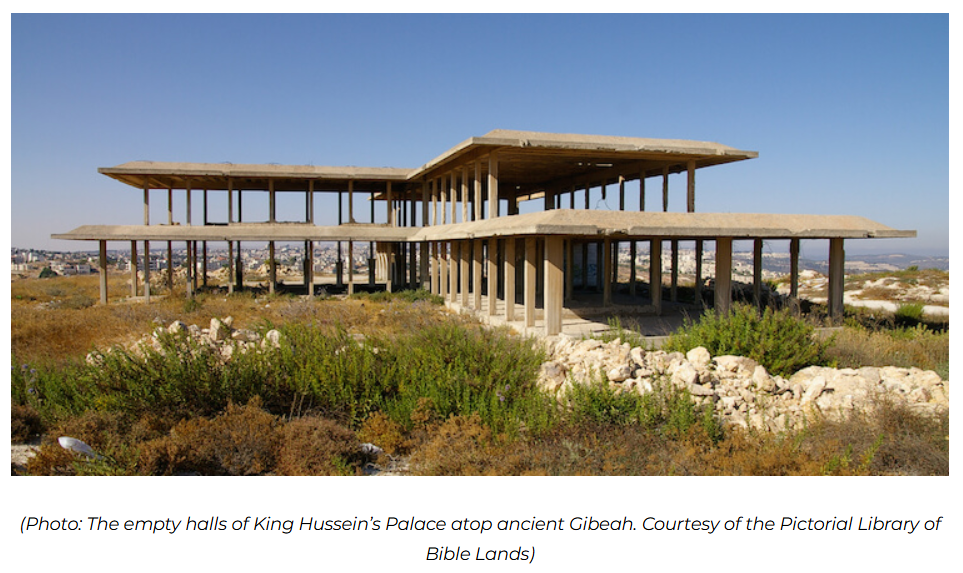
Gibeah today. The capital of the first kingdom — where Saul was raised and reigned (1 Samuel 10:26; 11:4; 15:34), and the town of the massacre that nearly ended the tribe (Judges 19–21) — has been identified since Edward Robinson (1838) with Tell el-Ful, on the watershed ridge five kilometres north of Jerusalem’s Old City. The Arabic name means the mound of beans. Albright excavated it (1922–23, 1933) and attributed the Iron Age corner-fortress on the summit to Saul; Paul Lapp dug it again in 1964; the identification is the majority view, though contested (Finkelstein argues for nearby Geba). The first royal capital of Israel today is bare ground — no shrine, no monument, no marker of the first king. The one attempt to build on it was another king’s: Hussein of Jordan began a royal palace on the summit in the 1960s, the Six-Day War halted it in June 1967, and the unfinished concrete skeleton has stood on Saul’s hill ever since. While Rachel’s wayside grave grew a fortress of reverence, the royal city of her son’s tribe kept nothing but an abandoned shell — the hill of the first kingdom, called the hill of beans. So who are the people of Joseph and Benjamin today?
References
Primary texts: Genesis 29, 34, 35, 37, 38, 44, 48, 49; Deuteronomy 33; Joshua 15, 18; Judges 12, 19–21; Ruth 1, 4; 1 Samuel 1, 10, 16, 17; 2 Samuel 1, 3, 4, 7, 11, 21, 24; 1 Kings 11, 12; 1 Chronicles 2, 5, 8, 9, 20, 21; Jeremiah 31; Micah 5.
Traditional/rabbinic: Tosefta Sotah 11:11; Rashi and Ramban (Nahmanides) on 1 Samuel 10:2 / Genesis 35.
Modern scholarship (verify specific references before publishing): A. Alt and N. Na’aman on the monarchic dating of the Joshua boundary/town lists; on EA 290 Bit-dNIN.URTA: Albright (1936), Kallai and Tadmor (1969), Na’aman (1990), Koch (2016); the Bethlehem fiscal bulla (City of David, 2012); S. H. Hooke on the two Rachel-tomb traditions; R. A. S. Macalister (1912) on the Bethlehem gloss; the “Apology of David” / “History of David’s Rise” analysis (P. K. McCarter; B. Halpern, David’s Secret Demons); the Deuteronomistic History framework (M. Noth) for the editorial layers; Abarim Publications and a standard lexicon (HALOT / BDB) for the Ephrath–Ephraim overlap.
Manuscript evidence: the Septuagint of 1 Samuel 17–18 (shorter text); the 4QSamuel scrolls. Material: the Bethlehem fiscal bulla (Kingdom of Judah, 8th–7th c. BC, City of David) as the earliest certain attestation of the name; the contested Amarna reading EA 290 Bit-dNIN.URTA (decoded as Bethlehem, Beth-Horon, Beth-Anat, or Kiriath-jearim).