The Governor Atom Model
A deterministic, fully classical model of the atom as a self-regulating mechanical governor — a rotating neutron core, protons orbiting as flyweights, electrons tidally locked to protons — with no wavefunctions, no probability and no strong nuclear force.
“The atom works because it is brilliantly engineered. This model reveals that engineering in classical clarity.”
— Conclusion
1. The proposal
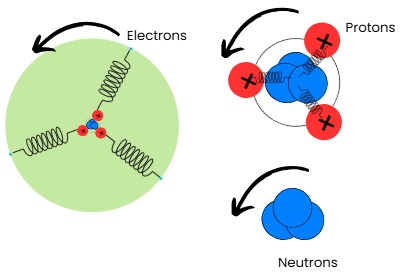
GAM treats the atom as a centrifugal governor — the same feedback device that regulated steam engines. A central rotating neutron core is the shaft. Protons orbit it like the governor’s flyweights, swinging outward as the system spins faster. Electrons are tidally locked to individual protons, each held face-on like the Moon to the Earth. The whole assembly is self-regulating: more energy means faster rotation, wider orbits, and a stronger field that grips the larger configuration without letting it fly apart.
The model is a deterministic alternative to the probabilistic Standard Model. It keeps three particles — neutron, proton, electron — and three principles: rotation, geometry and classical electromagnetism. Discrete energy levels emerge from mechanical balance points rather than wavefunctions. Chemical bonding emerges from charge geometry rather than orbital hybridisation. The strong nuclear force, quarks, gluons, probability clouds and the Pauli machinery are not invoked; where their results are needed (two electrons per orbit, single-filling before pairing, closed-shell stability) GAM reproduces them as consequences of balanced currents and symmetry.
The companion document is the Aether model (A Classical Aether Model). In that framework the Aether lattice is the elastic medium the governor runs in — the lossless substrate that lets the toroidal field propagate and knot without dissipating. The two are designed to be read together: the Aether supplies the medium, GAM supplies the engine.
2. Core assumptions
The model is built on a fixed set of mechanical assumptions:
- Neutrons form the central rotating shaft, powering the atom through axial spin-generated magnetic moments.
- All particles are classical solid spheres with fixed radii (neutrons and protons ≈ 0.84 fm; electrons point-like).
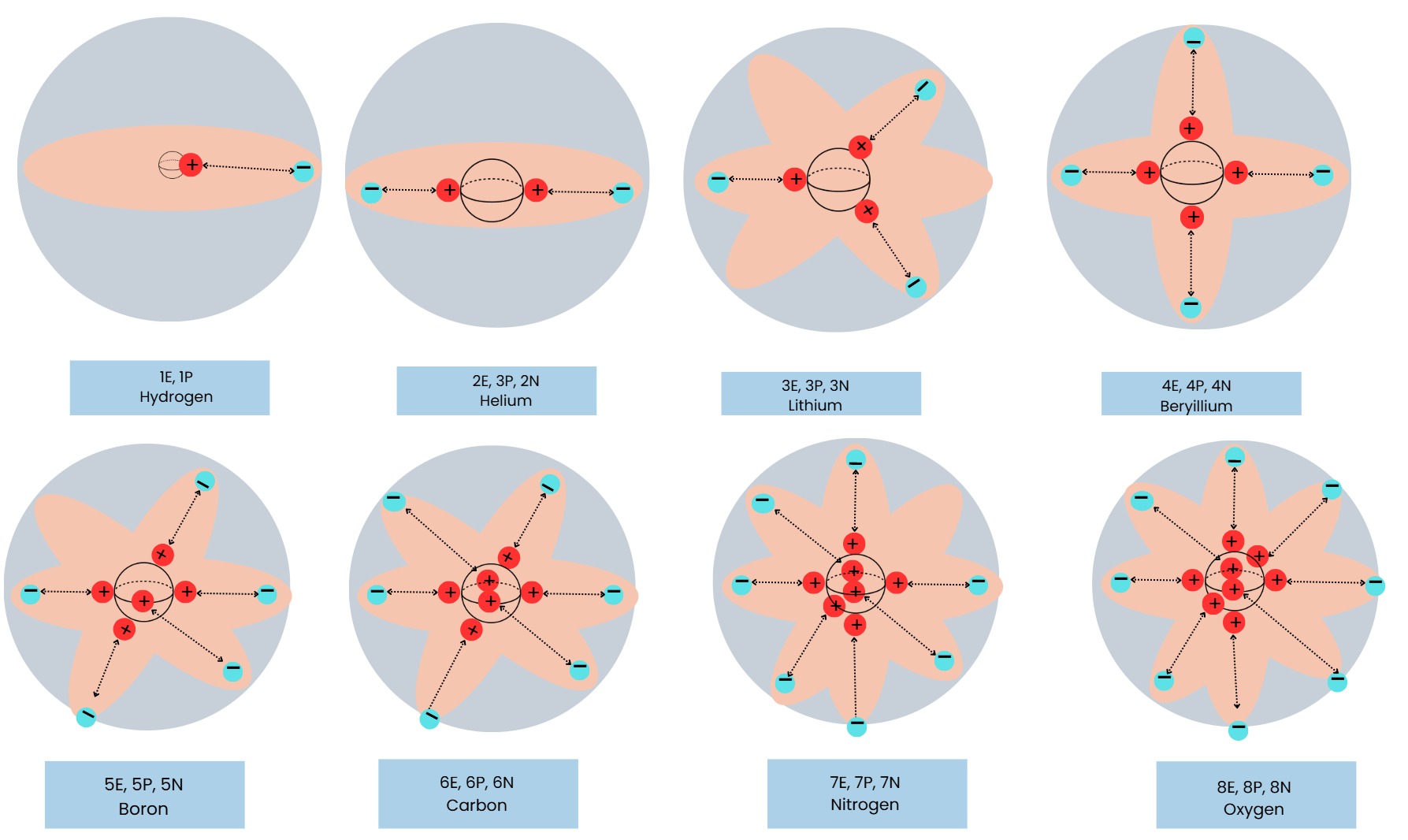
- Protons orbit the neutron core at a fixed radius (typically 2–15 fm, scaling with mass number), spaced on a sphere by mutual repulsion.
- Electrons are tidally locked one-to-one to protons by electrostatic and magnetic coupling.
- Two electrons per orbit (balanced currents and shielding); separate orbits fill singly before pairing; maximum pairing gives a closed, noble-gas shell.
- A self-sustaining toroidal magnetic field, generated by the collective rotation, confines and drives all particle motion.
- Binding is purely electromagnetic — no strong force, quarks or gluons.
- Energy input increases neutron rotation, expanding orbits; radii grow as r ∝ n².
- Stability comes from geometric symmetry: even Z balanced, odd Z imbalanced.
Against these, the paper is candid about where the model performs well. It claims good agreement for noble-gas inertness (even Z, fully paired, no reactive gaps), odd-Z reactivity and basicity (one unpaired orbit, one primary gap), bond angles in simple molecules from proton-repulsion geometry, paramagnetism in odd-Z atoms, hypervalent stability (SF₆, PF₅) as shell expansion under repulsion, Van der Waals scaling with atomic size, and isotope shifts in atomic spectra.
3. The mechanical architecture
The picture is a steam-engine governor scaled to the atom. The neutron clump is the spinning shaft; the protons are flyweight arms that extend outward as the shaft spins faster; the electrons are the regulators at the outer edge. The system is self-stabilising — spin faster, arms extend, the configuration settles at a larger radius.
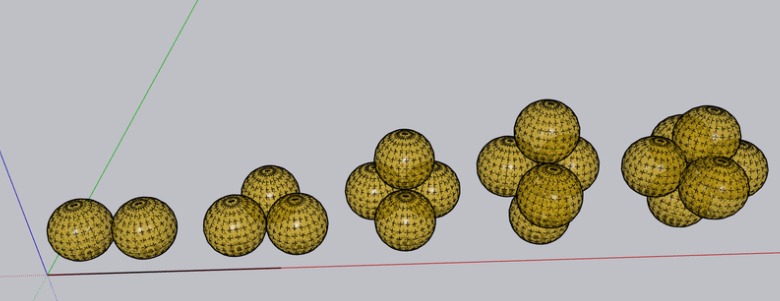
The shaft. Neutrons pack into a near-spherical lattice (HCP/FCC-like, packing fraction ≈ 0.74). The clump rotates as a unit; individual neutron spins align into a net magnetic moment, and faster rotation seeds a stronger toroidal field. This is the energy reservoir.
The arms. Protons distribute on a spherical shell by charge repulsion at fixed radius (~4–15 fm), in multiple inclined orbital planes. A stronger toroidal field sustains a larger proton radius; faster proton spin raises the proton magnetic moment, which feeds back into the field. Like governor arms, they extend with energy but gain the grip to stay stable.
The shell. Each electron follows a helical path around its proton at a much larger radius (picometre scale), guided by the extended field. Proton expansion drags the electrons outward (rₑ ∝ n²); the electron shell is the atom’s chemical boundary and bonding surface.
4. Neutron clump formation
Formation is the first step in building an atom, and in GAM it is a classical aggregation rather than a strong-force process. Under stellar pressure and temperature — supernova core collapse, stellar burning — free neutrons snap together like magnetic balls. Opposite-spin neutrons attract end-to-end; external stellar fields polarise the clump and accelerate alignment; isotropic pressure packs the incompressible spheres to ~74% efficiency.
Clumping conserves angular momentum, so the shrinking core spins up like a skater pulling in their arms, and magnetic torque adds to the bulk spin. The result is a dense, rotating energy reservoir carrying a net magnetic moment — the seed of the toroidal field, ready for protons to attach.
5. Proton–electron tidal lock
Protons and electrons are not independent in GAM — they are paired one-to-one. Each electron is bound to a specific proton through Coulomb attraction and the magnetic interaction of the toroidal field, following a helical path tied to its proton’s orbit, exactly as the Moon keeps one face to the Earth. The electron does not roam or occupy a probability cloud.
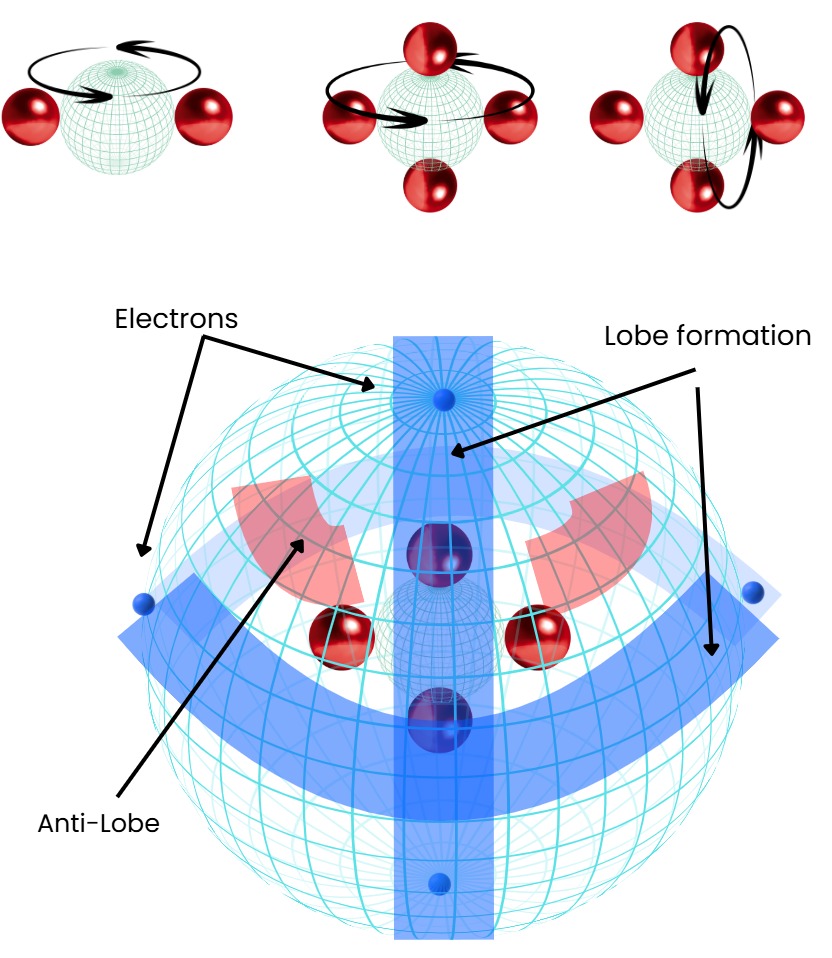
This 1:1 pairing does three things: it keeps the atom neutral and stable; it projects each electron outward into a lobe — a high-density zone on the shell that governs bonding; and it links nuclear structure (proton count and arrangement) directly to chemical behaviour, unifying the nucleus and the outer shell in one classical picture.
6. Orbital planes
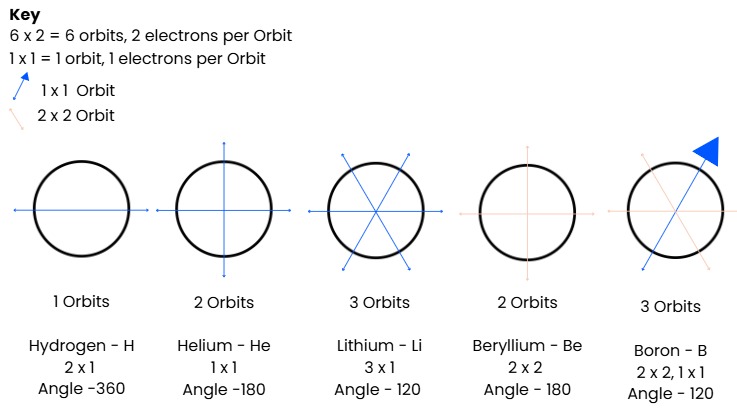
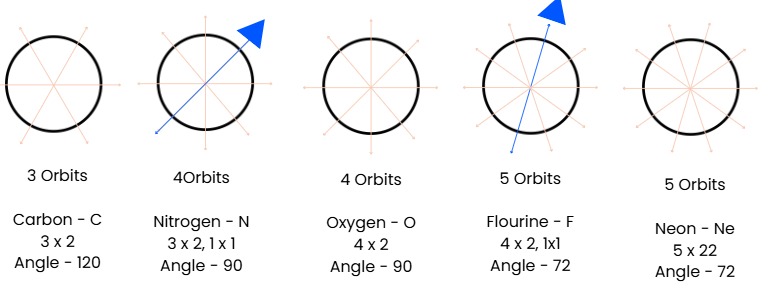
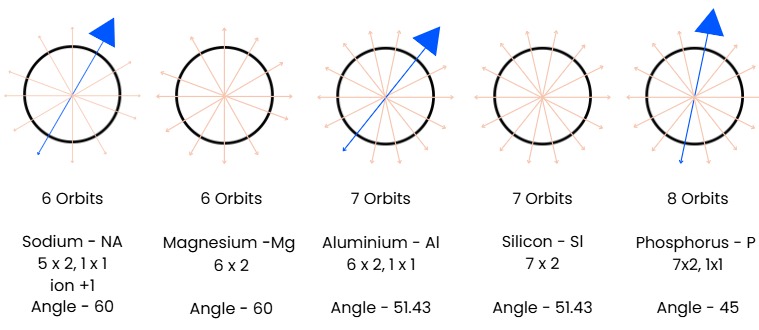
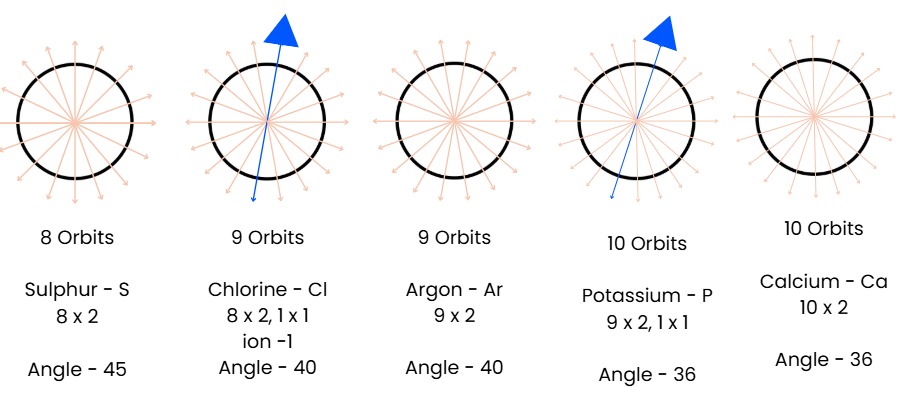
Protons occupy fixed positions on a spherical shell around the neutron clump (radii ~2–15 fm), arranged to minimise electrostatic repulsion — like magnets pushing as far apart as possible on a sphere. They sit on multiple inclined great-circle planes, typically one or two protons per plane, often ~180° apart for equilibrium. Even-Z atoms pair their protons in fewer planes (high stability); odd-Z atoms carry at least one unpaired proton, the source of reactivity and paramagnetism.
The arrangement maps onto the periodic table: the orbit count and inclination angle for each element follow from the number of protons and the requirement of even spacing.
7. Orbit stiffness and alignment
Stiffness is the resistance of the orbits to deformation, and in GAM it comes from the toroidal field acting as a magnetic spring. Protons are stiffened by mutual repulsion and by the Lorentz force, which is always perpendicular to velocity and so curves their paths tightly along the field lines, resisting radial drift. Higher shaft rotation means a stronger field and a stiffer confinement; paired protons (two per orbit, 180° apart) cancel each other’s wobble, giving even-Z atoms high stiffness.
Electrons are held by a combination of the tidal lock and the weaker outer field, so they are more flexible than protons. In higher energy states their expanded, faster orbits wind more stiffly; electron spin runs antiparallel to the proton for a stable lock. That moderate stiffness is what lets electron paths form lobes — the bonding zones — without collapsing.
8. Energy states and excitation
GAM reproduces quantised levels through the governor mechanism. Absorbing energy — a photon or a collision — adds kinetic energy to the neutron clump and speeds the shaft. Faster rotation strengthens the proton orbital currents and the toroidal field, which lets centrifugal force expand the orbits; the proton radius grows and drags the locked electron with it, scaling as r ∝ n² — the Bohr-model radii, derived mechanically.
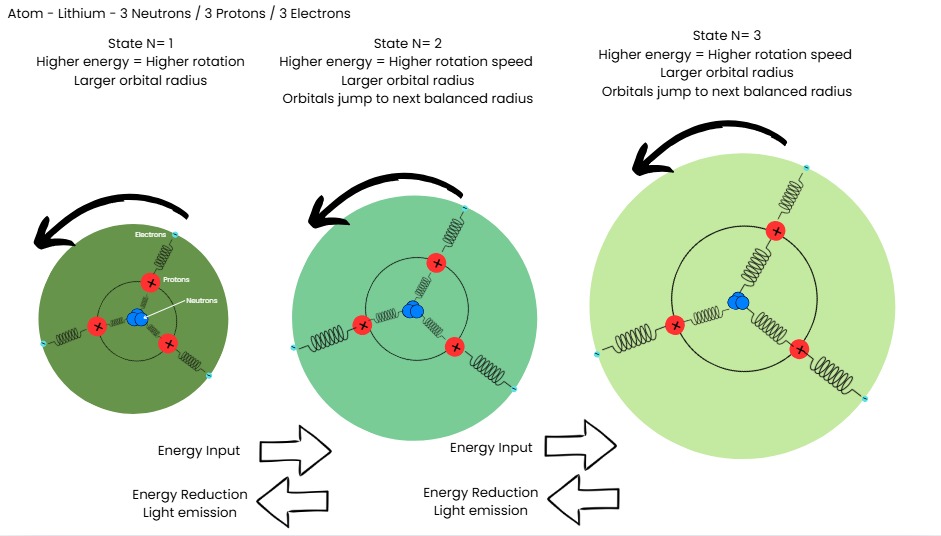
De-excitation runs in reverse. The expanded state is metastable; the system loses energy by classical radiation, the shaft slows, the field weakens, and the orbits contract back toward the ground state. The discrete n-levels are the specific spin speeds where the centrifugal, Lorentz, dipole and toroidal forces balance — mechanical balance points, like a governor unwinding to set heights, with no wavefunction required.
9. Magnetic moments and spin
In GAM the magnetic moment of a particle rises with its spin. For a rotating charged sphere the classical relation is µ = γ × I × ω, with the gyromagnetic ratio γ and moment of inertia I fixed for incompressible spheres — so µ tracks the spin ω directly. Energy input speeds the neutron clump, strengthening the toroidal field; that field torques the protons and electrons and accelerates their spin, which raises their moments, which strengthens the field again. This positive feedback is the ‘power-up’ that sustains the larger, higher-energy orbits without collapse.
| State | Proton spin ωₙ | Magnetic moment µₙ | Orbital radius |
|---|---|---|---|
| n=1 (ground) | Base ωₙ | ≈ +2.793 µₙ (calibrated) | rₙ base |
| n=3 (excited) | ~1.7× base (field torque) | ≈ +4.75 µₙ | rₙ × 9 (n²) |
Worked example: helium, n=1 to n=3.
10. Nuclear stability
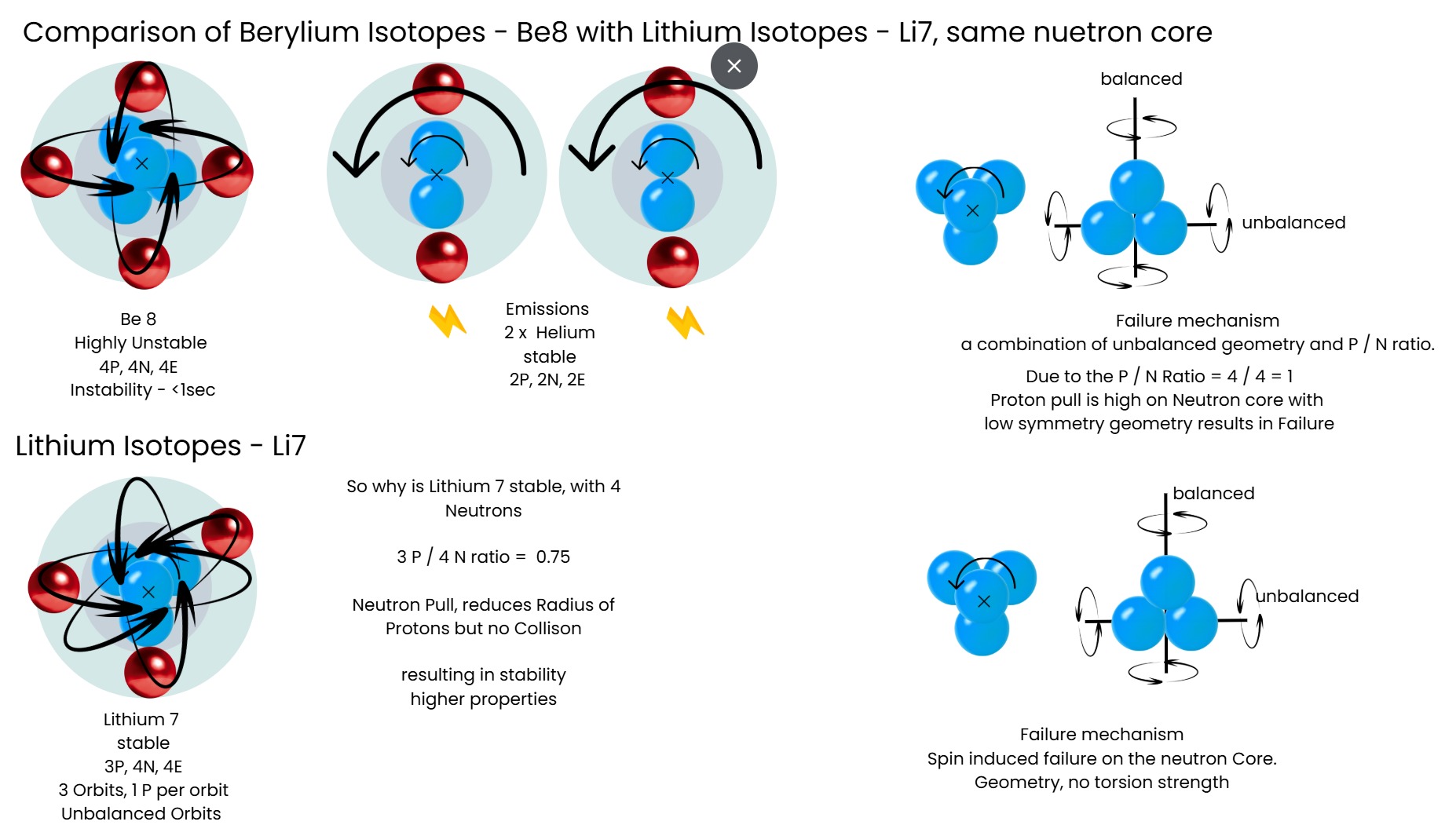
Stability is explained by neutron-packing symmetry and the proton-to-neutron ratio, with no quantum shell closures or strong force. The nucleus is a mechanical system that is stable when its configuration minimises energy — repulsion balanced by magnetic attraction and toroidal confinement.
| Condition | Effect | Stability |
|---|---|---|
| P/N = 1 (balanced) | Balanced pull — optimal field confinement | Strong |
| P/N > 1 (proton-rich) | Loss of neutron pull — proton orbits widen as centripetal force overcomes attraction | Unstable |
| P/N < 1 (neutron-rich) | Higher neutron pull — proton orbits shrink — risk of collision | Moderate — risk of decay |
| Even–even (even Z, even N) | Perfect pairing — cancels torque — circular orbits | Strongest |
| Odd Z or odd N | Asymmetry — wobble — higher reactivity | Weaker |
| 2 protons per orbit | Balanced — cancels repulsion wobble | Stronger |
| 1 proton per orbit | Unbalanced — orbital eccentricity | Weaker |
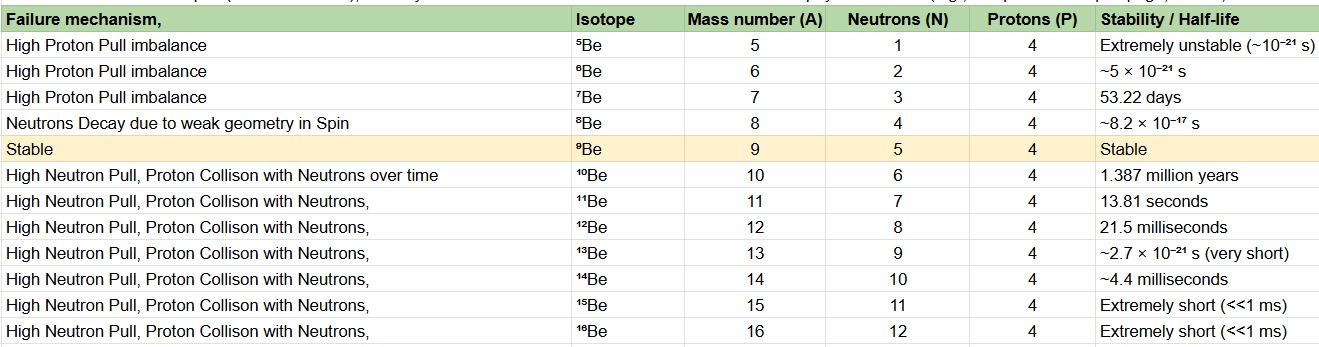
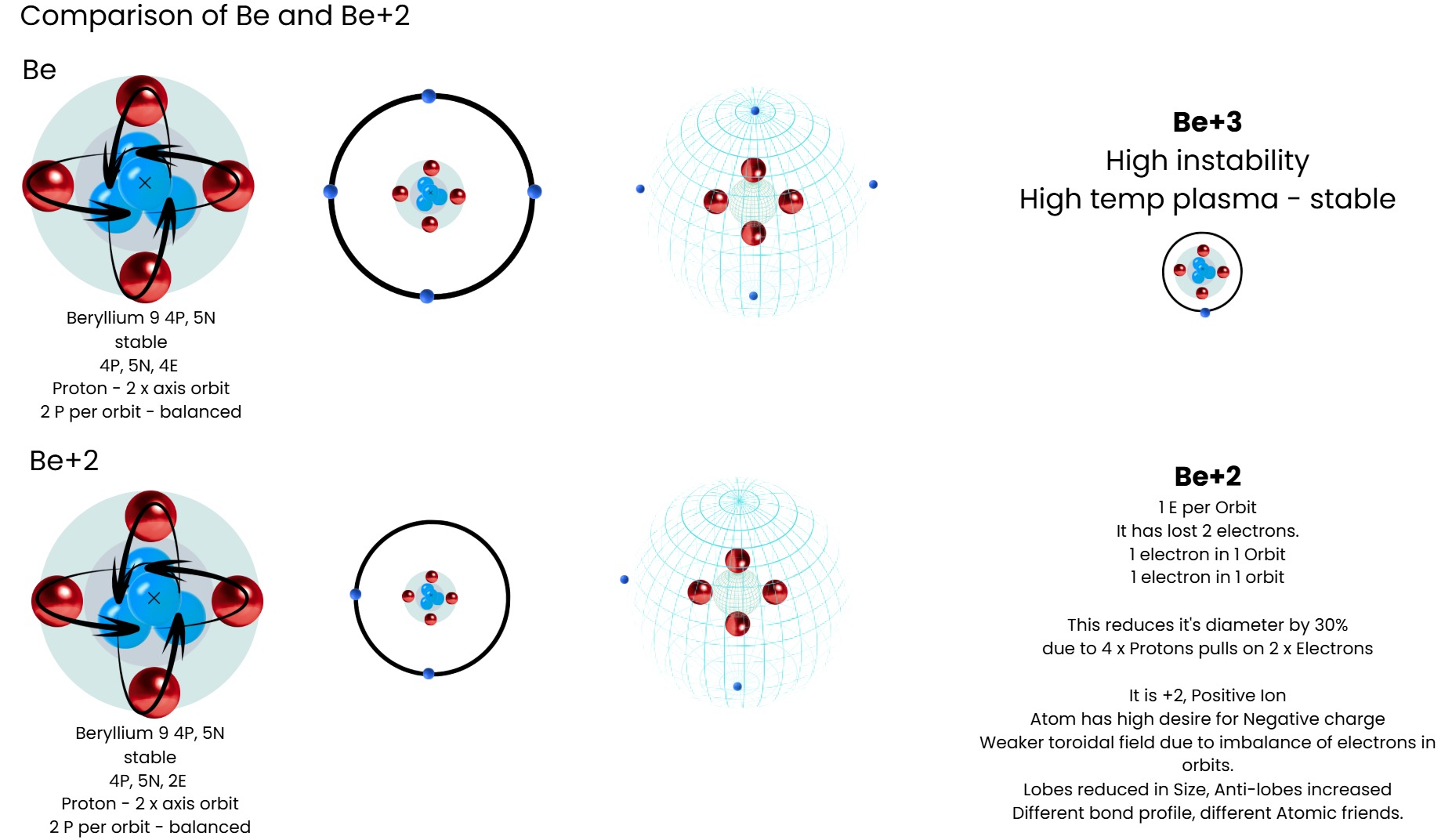
The paper works these rules through the light isotopes. The stability charts below read each isotope’s half-life off its proton-to-neutron ratio and orbit symmetry rather than off a shell model.

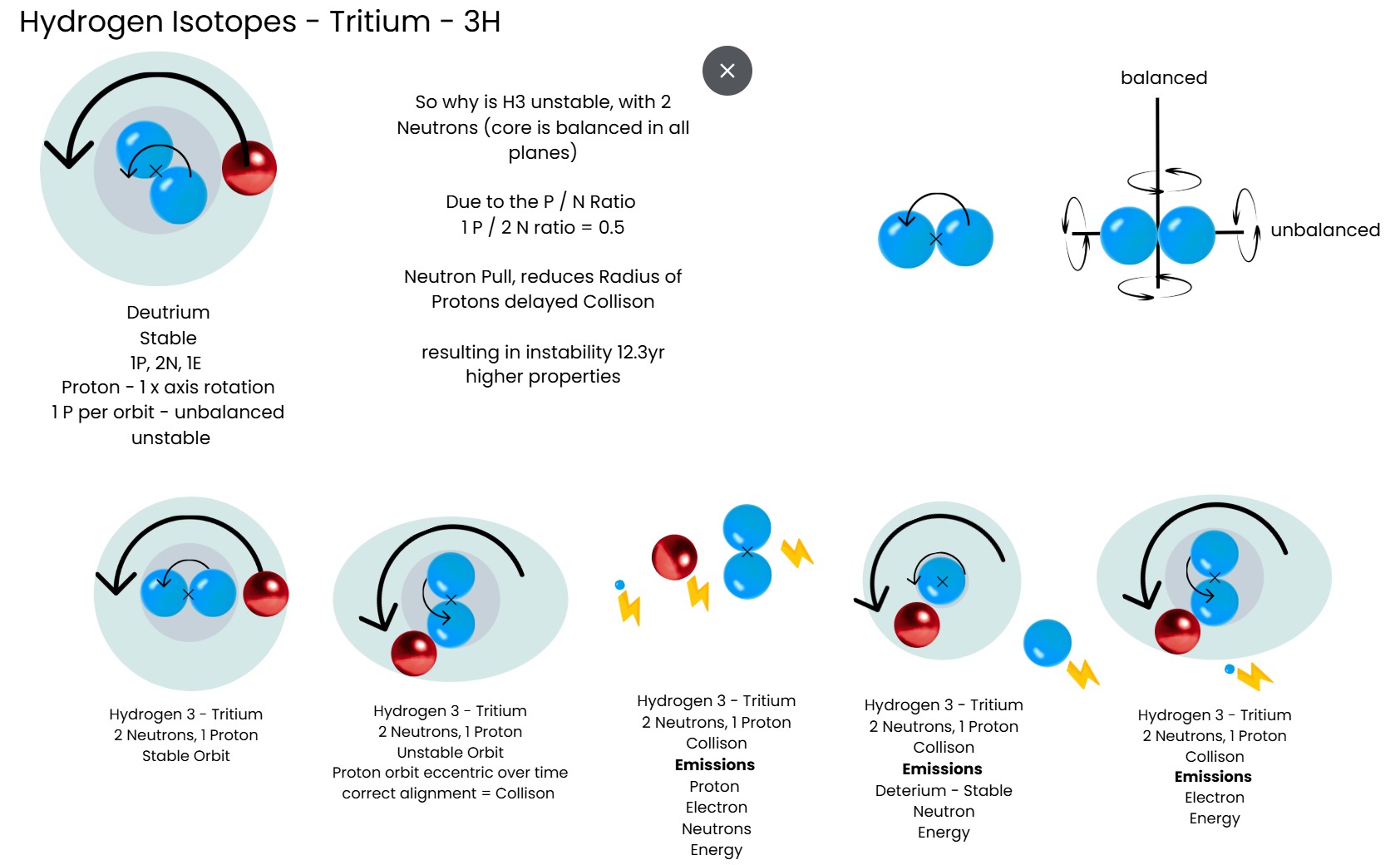
Tritium (³H, one proton and two neutrons) is the worked case of an unstable light nucleus: the extra neutron gives short-term pull but a long-term mechanical imbalance, read as a slow ‘collision decay’ to ³He over ~12.3 years.
11. Atom diameter
Atomic size is defined classically as the radius of the outer electron shell — the distance from the centre to where the locked electron paths form the interaction boundary. It is set by proton orbital radius plus the electron tidal-lock distance, with higher energy states scaling as n² and heavier isotopes contracting slightly as the larger clump tightens the field.
| Element | Z | Model ground rₑ (pm) | Covalent radius (pm) | vdW radius (pm) | Model error (pm) |
|---|---|---|---|---|---|
| H | 1 | 53 | 31 | 120 | +71 |
| He | 2 | 26 | 28 | 140 | −7 |
| Li | 3 | 55 | 128 | 182 | −57 |
| Be | 4 | 56 | 96 | 153 | −42 |
| B | 5 | 57 | 84 | 192 | −32 |
| C | 6 | 57 | 76 | 170 | −25 |
| N | 7 | 58 | 71 | 155 | −18 |
| O | 8 | 31 | 66 | 152 | −53 |
| F | 9 | 59 | 57 | 147 | +4 |
| Ne | 10 | 60 | 58 | 154 | +3 |
The model runs slightly compact: classical electron paths have a sharp extent and the toroidal field squeezes them inward, where real atoms are a little larger. The paper reads that difference as quantum diffuseness emerging from the Aether-lattice interaction, and proposes it as testable through precision radius measurements in different Aether-density environments.
12. Spectral emissions
Spectral lines are explained as a mechanical ‘gear downshift’ rather than electron jumps. A perturbation disrupts an excited state; the shaft slows, the field weakens, and the orbits contract. The contracting, accelerating charges radiate — weak Larmor radiation from the protons, the dominant visible/UV photon from the electrons — and the helical paths’ natural harmonics in the toroidal field produce discrete series lines, giving a Rydberg-like ΔE ∝ (1/m² − 1/n²).
| Parameter (He, n=3 → n=2) | Value |
|---|---|
| n=3 proton orbital radius rₙ | ~36 fm |
| n=3 electron radius rₑ | ~238 pm |
| Transition energy ΔE | ~2.47 eV |
| Predicted wavelength | ~502 nm |
| Observed (real) | ~501.6 nm (green line) |
| Error | <0.1% |
The paper is explicit about where this holds and where it fails:
| Feature | GAM result | Standard result |
|---|---|---|
| Series pattern (Balmer-like) | Matches — resonance harmonics | Exact via QM |
| Isotope shifts (H/D/T) | Exact — from mass and clump moment | Exact via reduced mass |
| Line positions | 1–10% error | Exact |
| Fine-structure splitting | 100% error — not reproduced | Exact to 12 significant figures |
| Hyperfine structure | Qualitative only | Exact via QED |
The honest assessment in the paper: GAM gets the gross structure — series patterns, isotope shifts, line positions within 1–10% — but does not reproduce fine structure (the small spin-orbit splitting). That is named as the model’s clearest current limitation.
13. Bonding: lobes, anti-lobes and key-lock docking
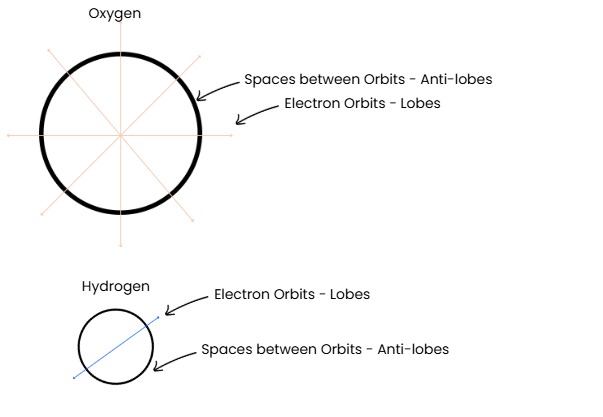
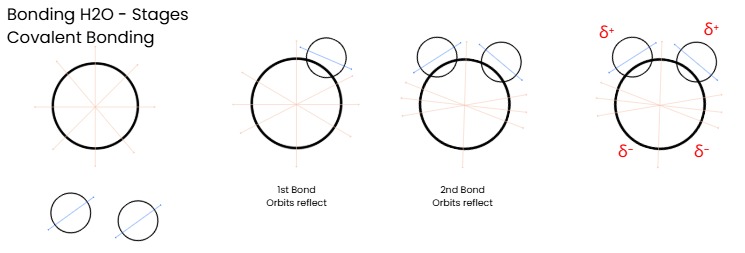
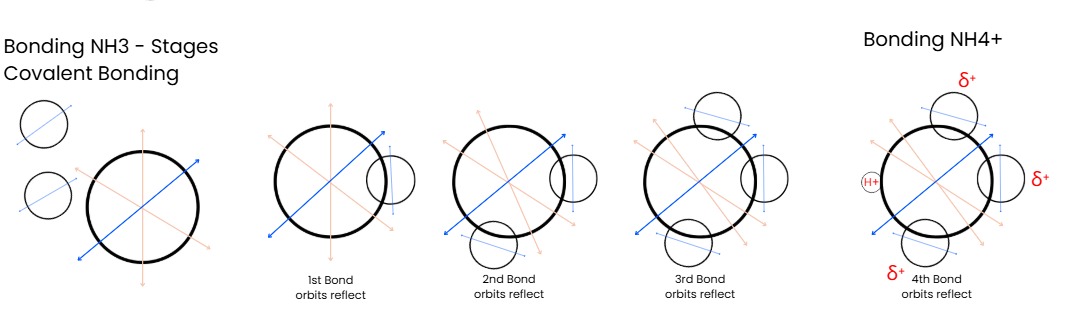
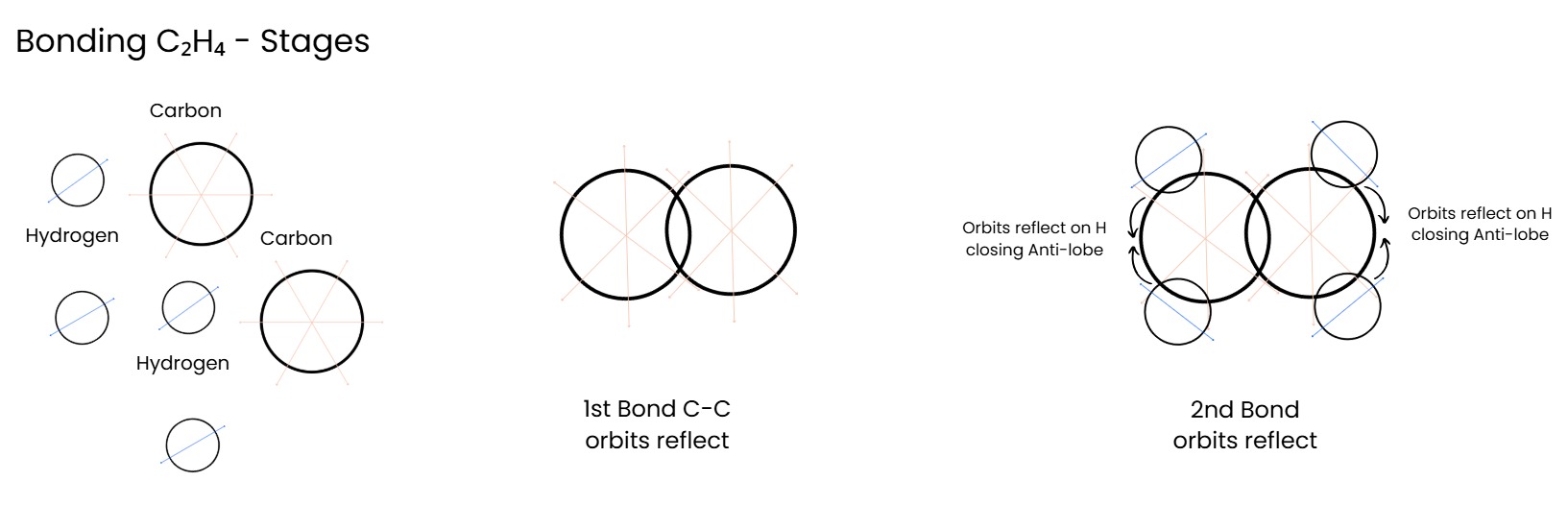
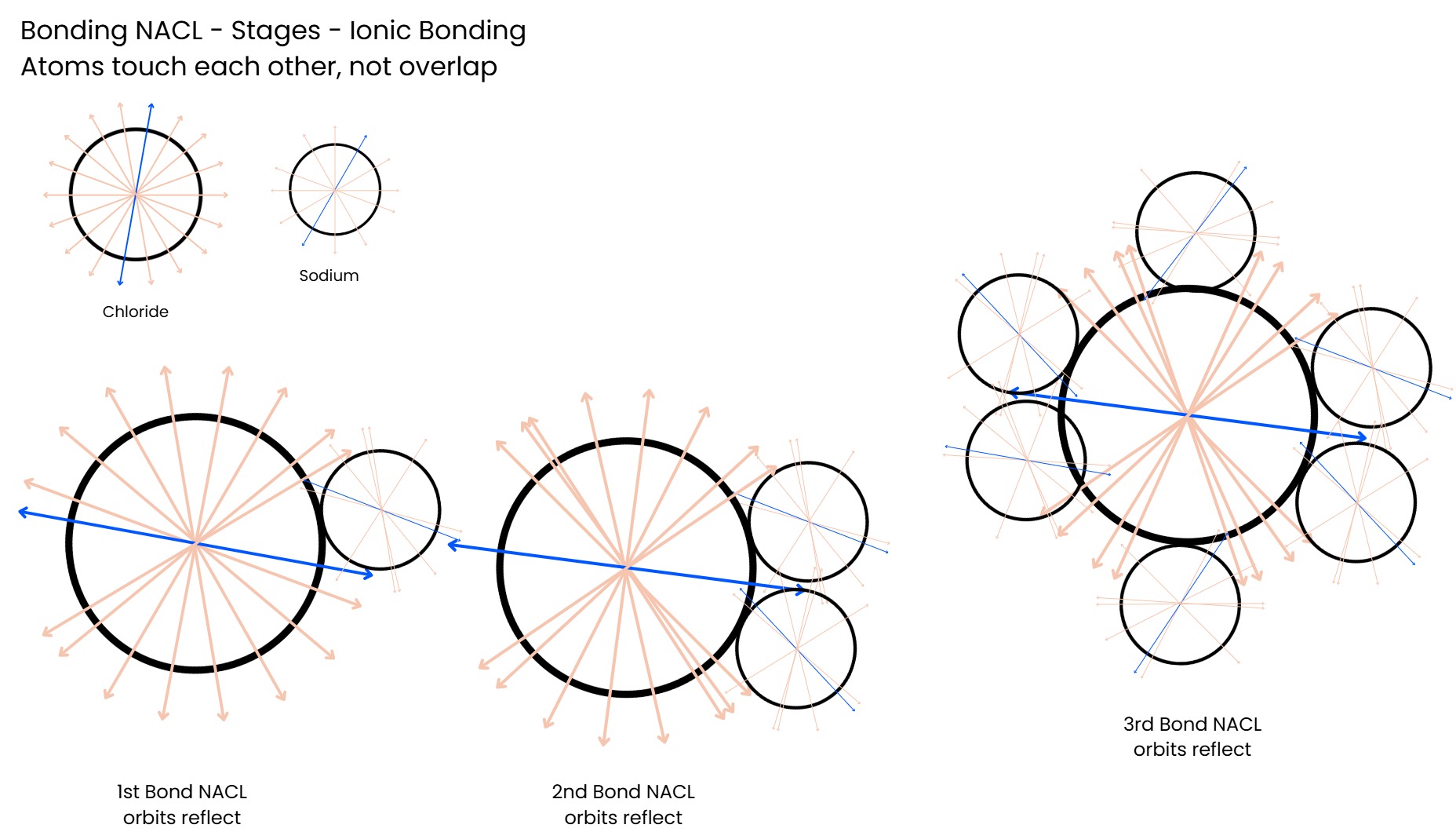
Bonding in GAM is not electron sharing or orbital overlap. It is key-lock docking. The atom’s surface carries high-electron-density zones (lobes, the keys) and low-density gaps where the proton charge shows through (anti-lobes, the locks). A key from one atom docks into a lock on another.
Paired orbits (two electrons) give strong symmetric lobes; an unpaired orbit gives a weak lobe and, opposite it, a strong primary anti-lobe — the focused lock that makes odd-Z atoms reactive. Adjacent lobes merge when their angular separation is 90° or less, so close orbits give a few strong keys and wide spacing gives many diffuse ones.
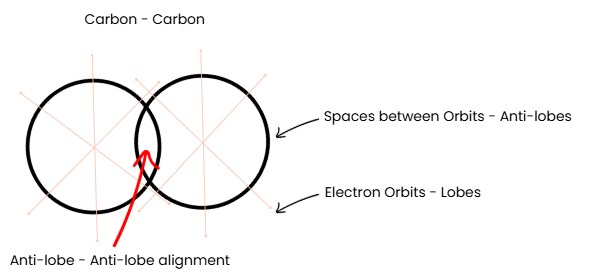
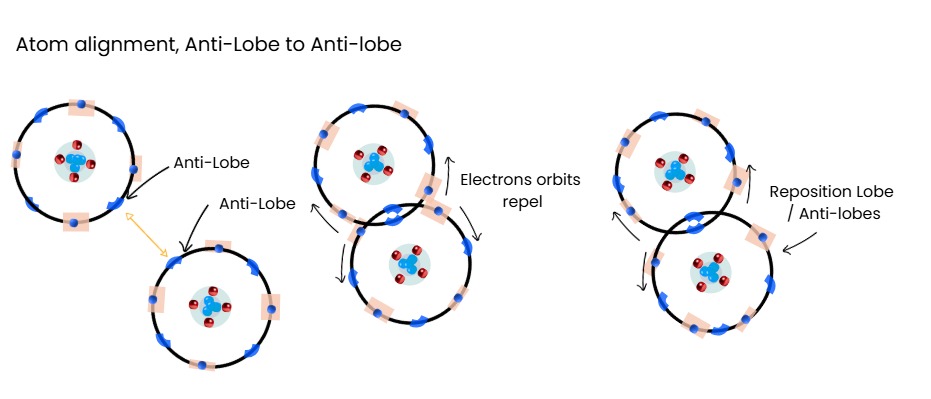
The docking sequence opens the bond angle by repulsion, then closes and neutralises the anti-lobe gap as incoming negative charge fills it. Multiple dockings (for example the triple bond in N₂) close every gap and maximise stability. Run through the simple molecules, the geometry lands close to the measured angles:
| Molecule | Initial GAM angle | After repulsion opens | Real angle | Match |
|---|---|---|---|---|
| NH₃ (ammonia) | 90° | ~107° | 107.8° | Excellent |
| H₂O (water) | 90° | ~104.5° | 104.5° | Exact |
| CH₄ (methane) | 120° | 109.5° | 109.5° | Exact |
| SF₆ (sulfur hexafluoride) | 45° | 90° octahedral | 90° | Excellent |
| PH₃ (phosphine) | 90° | ~93.5° | 93.5° | Very good |
Even-Z atoms merge their lobes into one uniform shell with no strong locks — inert or balanced. Odd-Z atoms keep one weak key and one strong lock, which drives reactivity and weak-base behaviour. The paper walks the docking through worked examples:
14. Van der Waals forces
Van der Waals attraction — the weak pull behind gas liquefaction and surface tension — is read classically as induced asymmetry in electron paths. Isolated atoms have symmetric shells and no permanent dipole; when two approach, their toroidal fields interact and distort each other’s electron paths, bulging toward the neighbour and receding opposite, making a temporary dipole. Positive end meets negative end, and the field alignment holds the attraction without any permanent dipole.
| Element | Z | Electron planes | vdW radius | Boiling point | GAM reading |
|---|---|---|---|---|---|
| Helium | 2 | 1 | 140 pm | −269°C | Small induced dipole — weak |
| Neon | 10 | 5 | 154 pm | −246°C | More planes — stronger |
| Argon | 18 | 9 | 188 pm | −186°C | Many planes — moderate |
| Xenon | 54 | 27 | 216 pm | −108°C | Many planes — strong |
Larger atoms carry more electron planes and polarise more easily, giving larger induced dipoles and stronger Van der Waals attraction — the trend the boiling points follow through the noble gases.
15. GAM vs the Standard Model
The clearest way to read the model is against the conventional quantum account, phenomenon by phenomenon. GAM does not claim to replace the Standard Model; it offers a classical, mechanical reading of the same observations.
| Aspect | Conventional quantum model | Governor Atom Model |
|---|---|---|
| Bonding | Electrons shared or transferred; lone pairs on one atom | No electron sharing; bonding from charge-lobe docking, electrons stay locked to protons |
| Role of electrons | Occupy atomic/molecular orbitals; bonding from orbital overlap | Tidally locked to protons; helical paths projecting high-density lobes |
| Lone pairs | Two electrons in a non-bonding orbital that compress angles | Confined, inward-retracted lobes — classical path density, no ‘pair’ concept |
| Bond angles | Electron-domain repulsion (VSEPR) | Proton-plane symmetry projecting lobes — matches VSEPR results geometrically |
| Hypervalency | Expanded octet via d-orbitals or 3-centre bonds | Energy raises speed and radius, activating more lobes |
| Polarity | From electronegativity and lone pairs | From asymmetric lobe distribution — classical charge imbalance |
| Ion formation | Electron transfer (Na → Na⁺ + e⁻) | Proton addition to an unpaired lobe; electron loss is rare and high-energy |
| Overlap | Atomic orbitals overlap into molecular orbitals | Shells interpenetrate with offset; toroidal fields mesh without collision |
16. Conclusion
GAM presents the atom as a self-regulating mechanical system built from three components and three principles: a rotating neutron shaft, orbiting proton flyweights, tidally locked electrons; rotation, geometry and electromagnetic confinement. From that it claims to reproduce a wide span of behaviour classically — binding energies within roughly 1–15%, even–even nuclear magnetic moments, atomic sizes and isotope shifts, valence geometries (tetrahedral carbon, bent water, hypervalent sulfur), excitation states and series lines, bond angles to better than 1° for the key molecules, and Van der Waals scaling across the noble gases.
The paper is equally clear about the limits. Spectral fine structure is not reproduced (100% error). Odd-Z nuclear magnetic moments need tuning. The classical-radiation lifetime problem is not yet fully quantified and needs a formal calculation of toroidal radiation suppression. Atomic radii come out slightly small against Van der Waals measurements.
The model points to one piece of recent experimental support: the 2024 report of a candidate toroidal electric-dipole mode in the spherical nucleus ⁵⁸Ni (Afanasjev et al., Physical Review Letters), a vortical current pattern of the kind GAM’s toroidal-confinement mechanism describes — an unexpected result not foreseen by the Standard Model. As the paper frames it, GAM is offered not as a replacement but as a classical heuristic: a lens through which the atom appears as an engineered machine of three parts scaling to the whole periodic table.
17. Addenda
The white paper carries four addenda tying the atomic model back to the Aether framework and to its historical roots.
A — Integration with the Aether model. The Aether lattice is the medium that makes the governor possible: without a lossless elastic substrate the toroidal field would radiate away. After formation, matter repels Aetherons outward, leaving a trapped internal density that lubricates the dynamo, with a slightly denser envelope just outside the shell anchoring the field lines. In compressed neutrons the shell traps and densifies Aether, adding literal rest mass — the 0.782 MeV/c² neutron mass excess, derived in the companion document from three measured quantities with no free parameters.
B — Toroidal knots. The self-sustaining fields embed as knots in the Aether lattice — closed, twisted loops that cannot untangle without breaking lattice bonds. Only certain integer twist numbers fit without strain, which the paper maps onto magic numbers and closed-shell stability: an octet as a clean double-trefoil knot.
C — Why Aether is necessary. Toroidal systems need a medium for lossless propagation and stable knotting. Without it, classical electrodynamics has the atom radiate and collapse in ~10⁻¹¹ s — the very problem quantum mechanics was invented to solve by fiat. GAM’s answer is the Aether: a real elastic medium supplying the support that classical fields need.
D — Kelvin’s vortex atoms. The historical core. Lord Kelvin proposed in 1867 that atoms were knotted vortex rings in an elastic Aether, with different knots for different elements. He lacked compressibility, repulsion and self-regulation. GAM supplies those three, casting itself as the completion of Kelvin’s programme — the topology he had right, with the dynamics he was missing.
18. References
- Boh Morel (Brett Murrell). The Governor Atom Model (GAM), v7.0, April 2026. The full white paper this memo summarises, including all sections and addenda A–D. Developed with research assistance from Grok / xAI. PDF.
- Brett Murrell. A Classical Aether Model (White Paper: Aether), v6.4. The companion cosmology — the lattice medium in which the governor runs. HTML memo. PDF.
- A. V. Afanasjev et al. Candidate Toroidal Electric Dipole Mode in the Spherical Nucleus ⁵⁸Ni, Physical Review Letters, 133(23) (2024). Cited as direct experimental support for the toroidal-confinement mechanism.
- J. J. Thomson. On the Structure of the Atom, Philosophical Magazine, Series 6, 7(39) (1904), 237–265. Inspiration for the proton-sphere configurations.
- N. Bohr. On the Constitution of Atoms and Molecules, Philosophical Magazine, Series 6, 26(151) (1913), 1–25. Semi-classical source of the n² radius scaling.
- J. Larmor. On the Theory of the Magnetic Influence on Spectra, Philosophical Magazine, Series 5, 44(270) (1897), 503–512. The classical radiation formula the model must mitigate.
- M. G. Mayer & J. H. D. Jensen. Elementary Theory of Nuclear Shell Structure, Wiley (1955). The quantum shell model, for comparison.
- R. J. Gillespie. The VSEPR Theory of Directed Valency, Journal of Chemical Education, 40(6) (1963), 295. Standard bond angles GAM reproduces geometrically.
- V. M. Dubovik & V. V. Tugushev. Toroidal Multipoles in Electrodynamics, Physics Reports, 187(4) (1990), 145–202. Theoretical foundation for toroidal moments.
- W. Thomson (Lord Kelvin). On Vortex Atoms, Proceedings of the Royal Society of Edinburgh, 6 (1867), 94–105. The historical precursor — vortex atoms in an elastic Aether.