The Herod Question
Part of the claimants thread. Everything the record holds on Herod the Great, and then the question of what it can support about him — and what it cannot.
Reading note. This memo holds the whole of the record on Herod himself. Two companions carry the rest: The Julii of Judaea, which follows the dynasty across five generations and the Julian name it carried to the consulship of Rome, and Herod the Builder: The Programme, Work by Work, which sets out the building programme work by work. Numbers in brackets are entries in the master source register. Dot chips grade attestation: one amber dot means one channel carries the claim, two or more green dots mean independent sources cross.
1. What is actually being asked
The question is not whether Herod was a good man. It is a narrower and more answerable one: how much of what is said about him can the surviving evidence carry? That distinction governs everything below. A claim can be false, true, or unsupportable, and the third is a different condition from the first two. This memo argues that a great deal of the received portrait falls into the third category, and it does not therefore assert the opposite portrait, which would fall into the same category for the same reasons.
What follows is in two halves. The first sets out the condition of the channel the portrait travels on. The second sets out four bodies of evidence that do not travel on it, and what they show.
2. The man: the dated record
The mechanism was neither adoption nor descent, and the founding event of this whole memo needs its evidence stated before its story.
What Caesar was given. In the winter of 48–47 BC Caesar was pinned in Alexandria with a small force. The relief came overland from Syria under Mithridates of Pergamum, and Antipater the Idumaean — chief minister of Judaea under the high priest Hyrcanus II — marched with it, bringing three thousand Jewish troops and having talked the Arab chieftains and the rulers of Lebanon into joining. At Pelusium, the gate of Egypt, the town held out; Josephus says Antipater was first over the wall and opened the way for the rest. Then the column stalled: the Jews of the district of Onias, settled in Egypt, barred the road. Antipater talked them across — he was of their people, and he carried letters from Hyrcanus the high priest urging friendship with Caesar and the supply of his army with money and provisions. The Jews about Memphis then came over too, and the relief force went through. In the battle in the Delta, Mithridates’s wing broke; Antipater, having cleared the enemy on his own side along the river, came along the bank and rescued him, then took the enemy camp. He was wounded doing it. Caesar came out of Alexandria alive.
How well that story is attested. Better than most of this memo, and Josephus takes trouble over it. He does not simply assert it: he cites Strabo as an external witness, and Strabo in turn quoting Asinius Pollio and Hypsicrates — that Mithridates invaded Egypt and with him the Jewish high priest, and that Antipater was summoned to Ascalon to join the march. Those are named non-Jewish authorities of the period. The qualification is that all of them reach us through Josephus, since Strabo’s historical work is lost; so this is a citation of independent authorities rather than independent survival. Even so, the service in the Alexandrian war is the best-supported claim about Antipater in existence.
How well the reward is attested — and here the memo must be blunt. The grant itself rests on Josephus alone. Twice: that Caesar bestowed on Antipater the citizenship of Rome and freedom from taxes everywhere, and that he received citizenship, tax exemption and formal friendship for his valour. No inscription records the grant. No Roman source mentions it. No named authority is cited for it, as one is cited for the campaign. And there is a further problem inside the text: the Roman decrees Josephus quotes in the same book — documents presented as archival copies, opening in Caesar’s own voice as Imperator, Pontifex Maximus and Dictator for the second time — reward Hyrcanus, the high priest, naming his loyalty and the fifteen hundred soldiers of the Alexandrian war. They do not name Antipater. The narrative credits the minister; the documents credit the priest. The two accounts also diverge on who was permitted to rebuild the walls of Jerusalem — Hyrcanus in one, Antipater in the other.
The reason that divergence matters is stated at the head of this memo. The narrative source beneath Josephus here is Nicolaus of Damascus, and Nicolaus wrote at the court of Antipater’s son — a court that had displaced the Hasmoneans and had every reason to move credit from the priest to the minister. This memo does not claim the grant is fiction; the family’s Roman citizenship and Julian name are independently attested elsewhere, and something gave them both. It states that the founding story of the house travels on the same single channel as the stories about its character, and is graded the same way. Consistency in grading is the only thing that makes either grade worth anything.
The mechanism, and what is solid. Roman convention did the rest. An enfranchised provincial took the family name — the gentilicium — of the patron who obtained his citizenship. Antipater’s house took Caesar’s: Julius. That the family carried the name is not in doubt and does not depend on Josephus: Herod’s grandson reigned as Marcus Julius Agrippa on his own coins and in inscriptions, his great-grandson likewise, and the Kos statue base has been read as attesting Herod’s own citizenship (59). The name is in the stone. Only the story of how it was acquired is in one man’s hands.
The scale of the mechanism should be stated once, because it frames everything after: Julius was the gentilicium of every family enfranchised by Caesar, Augustus or Tiberius, and of every family freed by them; by the end of the second century hundreds of thousands of people carried it (register 42, note). The house of Herod is not remarkable for holding the name. It is remarkable for how far it carried it — to the consulship of Rome, under Trajan.
Herod: the first patron, and the first trial. Appointed governor of Galilee by his father in 47 BC at a young age, he put down the brigand chief Hezekiah and executed him and his men without trial. For that he was summoned before the Sanhedrin at Jerusalem — the first documented clash of his career. His protector was Sextus Caesar, governor of Syria and a kinsman of the dictator, who had made him governor of Coele-Syria and who wrote to Hyrcanus requiring his acquittal. Herod left the court alive and, by the account, returned with troops before being talked out of taking the city. The detail belongs in a memo about the name of Caesar: the first Roman who protected this house bore the name itself, five years before the house was given it.
Herod: the reign. Governor of Galilee from 47 BC; declared king of Judaea by the Senate late in 40 BC, on Antony’s motion with Octavian supporting — Josephus records the new king walking from the Senate house to the Capitol between the two of them; took Jerusalem in 37 BC; confirmed by Octavian after Actium — and his standing as a client king of Antony in that war is one of the few things about him corroborated outside Josephus, since Plutarch, listing the subject kings on Antony’s side, names Herod the Jew among them beside Polemon of Pontus and Malchus of Arabia (register 8); died 4 BC, aged about sixty-nine — the birth year, c. 73–72 BC, is a standard reconstruction, not an attested date. His will divided the kingdom among three sons, subject to the emperor’s ruling; the heirs argued it before Augustus in Rome.
The ten wives, and the issue, as Josephus registers them.
The high priesthood, and the wife who came with it. One of the ten marriages was also an act of state, and it is the clearest surviving example of how Herod restructured what he inherited. The high priesthood had been hereditary and Hasmonean; Herod made it appointive, and appointed at will. For Mariamme II he went outside Judaea altogether: her father Simon son of Boethus was a priest of an Alexandrian family whom Herod raised to the high priesthood at about the time of the marriage — by the account, in part to make the match socially possible. Simon held the office some eighteen or nineteen years and was deposed when Herod set the marriage aside near the end of the reign. The family remained: the “house of Boethus” supplied high priests into the following century, sat on the Sadducean side of the religious argument, and is remembered with hostility in the later rabbinic tradition for its closeness to Herodian and Roman power. Two things follow for this memo. Herod displaced the old Hasmonean and Zadokite priestly lines and installed a line of his own choosing; and he sourced it from Alexandria — the same city that supplies the other enfranchised Julian house of section 7, and Philo, whose testimony crosses Josephus at two points in these pages.
The dated deaths inside the family — Mariamme I in 29 BC, her sons Alexander and Aristobulus IV in 7 BC, Antipater II in 4 BC, days before Herod’s own death — are events of record and are entered as dates. The narratives attached to them are the single-channel material of the source condition above, and stay with it.
3. What happened when he died
The reign is usually measured by what he built. It can also be measured by what followed him, and that evidence does not come through the character tradition at all — it comes through the narrative of events, which is the better-attested part of Josephus and is corroborated in outline by the later Roman record. Within weeks of Herod’s death the country rose, and Rome crucified two thousand people to put it down.
3.1 The golden eagle, and the dispute over it
As Herod lay dying at Jericho, two teachers of the law — Judas son of Sepphoraeus and Matthias son of Margalus — told their students that the moment had come to pull down what had been set up against the laws of their fathers. A golden eagle stood over the great gate of the Temple. Their disciples cut it down in daylight. Herod had the ringleaders burned alive.
The memo carries this with its dispute attached, because the dispute is substantial. Bourgel argued in 2021 that the episode is a martyrdom narrative rather than a historical event, on four grounds: the practical difficulty of the act as described; Josephus’s silence on whether the eagle was ever replaced, which suggests it may never have stood there; the mismatch with Herod’s recorded care not to offend Jewish law in the Temple precinct itself; and the close structural parallels with the martyrdoms of 2 Maccabees. The story is single-channel and now contested. It is reported here as reported, not as established.
If it did happen, it bears on section 13 in a way worth naming: the one occasion on which Herod is said to have placed a figural image on the Temple, it was torn down within days and cost lives. That is a datum about the conditions he built under, whichever way it cuts.
3.2 The Passover, 4 BC
Herod died, and his son Archelaus inherited a crowd rather than a kingdom. It demanded three things: lower taxes, the release of prisoners, and the punishment of the men who had advised the burning of the two teachers. Archelaus temporised, the crowd grew through the Passover pilgrimage, and he sent in troops. Josephus gives about three thousand killed in the Temple courts — at Passover, in the building his father had spent a lifetime raising.
3.3 Pentecost, and the Temple burned
Archelaus sailed for Rome to have the will confirmed, with his brother Antipas following to contest it. In their absence Augustus’s procurator Sabinus occupied Jerusalem and began seizing the royal property. At Pentecost the city rose against him. The fighting reached the Temple, the porticoes were set alight, and Sabinus’s soldiers went through the flames into the treasury and took four hundred talents. The colonnades Herod had finished a decade earlier burned while his sons argued in Rome over the estate.
3.4 Three men who made themselves king
The rising spread out of Jerusalem into the country, and three separate men took the diadem — which is the detail that matters, because it shows what the Herodian settlement had left behind.
- Judas son of Ezekias, in Galilee, broke open the royal armoury at Sepphoris and armed his following. His father had been a bandit chief executed by the young Herod forty years earlier; the family reappears twice more in this record.
- Simon, a royal slave — tall, handsome, and by Josephus’s account entirely unknown before this — crowned himself, burned the palace at Jericho and several other royal houses, and was hunted down and beheaded by the Roman officer Gratus.
- Athronges, a shepherd of great size, put on a diadem and, with four brothers, ran a guerrilla campaign against Romans and Judaeans alike for months before being taken.
Two thousand of Herod’s own disbanded soldiers took the field against the royal troops as well. None of them could have won. What the episode records is that within a season of the king’s death, a slave and a shepherd could each put on a crown and find men to follow them.
3.5 The war of Varus
Publius Quinctilius Varus, governor of Syria — the same man who would lose three legions in Germany nine years later, and who had presided over the trial of Herod’s son Antipater — came south with two legions and auxiliaries, including troops sent by Aretas IV of Nabataea. He burned Sepphoris and sold its inhabitants into slavery, relieved Sabinus in Jerusalem, hunted the ringleaders through the country, and crucified two thousand men.
That figure is the hardest number in this memo. It is not a character judgement, not a court historian’s flourish and not a hostile reworking. It is a Roman military operation, of a scale Rome recorded, conducted to restore order in a kingdom whose king had been dead a few months.
3.6 What it cost the settlement
Augustus divided the kingdom and gave Archelaus ethnarch, not king — the title Herod had held was not passed on. Ten years later Archelaus was deposed and exiled to Gaul on complaints from his own subjects, and Judaea passed to direct Roman rule. The census that followed produced the revolt of Judas the Galilean — on the record, the son of the Judas who had broken open the Sepphoris armoury in 4 BC — and the movement that ran from him to the Sicarii who held Masada in AD 73.
The reading the memo takes from this is narrow and it is not about his character. Herod held a difficult kingdom for thirty-three years without losing it, which on the evidence of what happened the moment he was gone was not easy and was not inevitable. And the settlement did not survive him: what he had built politically came apart in a season, and what he had built in stone was burning within months of the funeral. Both halves belong in an assessment of the reign, and neither requires deciding what kind of man he was.
4. The building programme
One body of evidence about this house does not travel through Josephus at all. Between roughly 35 and 10 BC Herod directed more than thirty projects across some 800 kilometres, from Rhodes to Antioch, and a great deal of it is still standing, still measurable, and independently surveyed. Where the conduct tradition is a single filtered channel, the building record is stone: it can be dated by technique, sampled, and cross-checked against nothing but itself.
The scale, in summary. At Jerusalem the Temple Mount was doubled to a platform of some 144,000 square metres on walls founded on bedrock, with single ashlars estimated in the hundreds of tonnes. At Hebron the enclosure over the Cave of the Patriarchs still stands intact — the only Herodian building that does. At Caesarea he built Sebastos, the largest artificial open-sea harbour of its age, in hydraulic concrete using roughly 24,000 cubic metres of pozzolana shipped from the Bay of Naples — Italian volcanic ash, ordered by a client king, carried the length of the Mediterranean to set underwater on a coast with no natural anchorage. Then Masada, Herodium, the Jericho winter palaces with their Roman-technique bath suites, the Jerusalem palace and towers, and the wider catalogue abroad: Rhodes, Antioch’s colonnaded street, Nicopolis, Chios, Damascus, Ptolemais, and the coastal cities of Phoenicia. He endowed the Olympic Games and was made their perpetual president.
The naming is itself a record of the patron relationship: Caesarea for Caesar; Sebaste — Greek for Augustus — for the emperor; Agrippias for Marcus Agrippa; Antipatris for his father, Phasaelis for his brother, Herodium for himself. A client king wrote the Julian house across the map of his kingdom in stone. The full treatment, project by project, with the surveys and the engineering, is the companion memo Herod the Builder: The Programme, Work by Work, and the works are plotted and dated on The Building Programme, 40 BC – AD 64
That is the summary. The programme is set out work by work, with the dimensions, the engineering, the labour figures and the comparative scale, in the companion memo Herod the Builder: The Programme, Work by Work — and plotted, dated, on The Building Programme, 40 BC – AD 64, which shows what was running simultaneously with what.
5. The house at Rome
The dated record of how this house was held inside the Roman world, stated as events. 40 BC: Herod, a refugee from the Parthian invasion, arrives in Rome and is voted king of Judaea by the Senate on Antony’s motion with Octavian supporting — and walks from the Senate house to the Capitol between the two of them. 30 BC: after Actium, having backed the losing side, he meets Octavian at Rhodes; by the account he removes his diadem before speaking, argues the case of a loyal client rather than denying the loyalty, and leaves with the crown restored and his kingdom enlarged. 25 BC: famine; he melts down the gold of his own household to buy Egyptian grain through Petronius, prefect of Egypt, and distributes it — the one relief operation of the reign that is dated and specific.
Marcus Agrippa. The closest tie the house had was not with the emperor but with the man beside him — Augustus’s deputy, son-in-law and designated heir, the admiral of Actium, the second man in the empire. Josephus states the shape of it in one sentence: Herod stood in Caesar’s affection next after Agrippa, and in Agrippa’s, next after Caesar. It began about 23–21 BC, when Agrippa governed the East from Mytilene on Lesbos and Herod went to him there. It ran for a decade, and it ran both ways.
15 BC: Agrippa in Jerusalem. Invited by Herod after Agrippa returned to Asia in 16 BC, he came to Judaea as the king’s guest, was shown the new Temple, and sacrificed there — a hecatomb, a hundred oxen — then feasted the people of Jerusalem. Philo records the visit as well as Josephus, which is rare in this memo: two channels on one event. The second man in the Roman empire keeping the Feast of Tabernacles in a Judaean sanctuary, at a Judaean king’s invitation, is not a courtesy call.
14 BC: the voyage. The following spring Herod took a fleet north to help Agrippa on campaign at the Bosporus, and Josephus tracks the journey in unusual detail: past Rhodes and Kos to Lesbos, held up many days at Chios by a north wind — where he received callers, gave gifts, and paid to rebuild the city portico that had lain in ruins since the Mithridatic war — then Mytilene, then Byzantium, then, hearing Agrippa had already passed the Cyanean rocks, a hard chase up the Black Sea coast that caught him at Sinope in Pontus. Josephus says the ships’ crews saw him coming unexpectedly and were delighted; that Agrippa took it as the greatest mark of the king’s regard possible, since Herod had made so long a voyage at the right moment, leaving his own kingdom to do it; and then the line that matters most — that Herod was all in all to Agrippa in the management of the war, a great assistant in civil affairs, and his counsellor on particular matters. A client king serving as chief adviser to the second man of the empire on a Roman campaign.
The expedition resolved without the full campaign materialising, and the two of them travelled home together overland through a great part of Asia Minor. Two things happened on that road. Nicolaus of Damascus (register 5) pleaded the case of the Jews of Ionia before Agrippa — the Greek cities were moving against their civic and religious rights — and Agrippa, by the account probably at Herod’s urging, upheld them, writing to the Ephesians that the Jews throughout Asia might send their gifts to the Temple at Jerusalem and keep the Sabbath. The dating of that letter is given variously in the secondary literature and is flagged rather than fixed here. And Herod, going home, named the city of Anthedon Agrippias, and put Agrippa’s name on a gate of the Temple he had built — a detail Josephus reports with an audible edge, calling it an excess of goodwill toward his friend.
13–12 BC: the end of it. Herod sent his son Antipater to Rome and entrusted him to Agrippa, to be brought into Caesar’s friendship. The next year Agrippa died, at fifty-one. The friendship outlived him in the family’s own naming: Herod’s grandson, born about the year Agrippa died, was Marcus Julius Agrippa — the Agrippa I of the dynastic memo, raised in the imperial house, king of a reunited Judaea, and the man who brokered Claudius onto the throne. The name of Augustus’s deputy, carried by a Judaean king into the next century, on his coins.
And the children went to Rome. Alexander and Aristobulus were educated there, lodged first with Asinius Pollio and afterwards in Augustus’s own household; a generation later Agrippa I (26) was raised in the imperial house beside Drusus, son of Tiberius, and Claudius — the friendship that made him king. 12 BC: Herod brought his quarrelling sons before Augustus at Aquileia, and the emperor reconciled them — the first hearing, five years before the second one condemned them. The pattern across sixty years is consistent and worth stating plainly: this was not a subject ruler summoned and dismissed, but a house inside the Roman governing circle — hosting its second man, marrying into its provinces, educating its heirs in the emperor’s house, and being judged by the emperor in person when it failed.
6. The benefactions
The building programme of section 3 was only part of the outlay. Josephus records a second stream — cash, endowments, grain, remitted taxes and funded games — running from Judaea to cities that were not Herod’s subjects and owed him nothing. It is the least examined part of the record and it is worth setting out as its own subject, because a client king spending on that scale outside his own borders is doing something that needs explaining.
The Olympic Games, 12 BC. The clearest case, and the one with the best documentation. Sailing to Rome for the third time, Herod stopped at Olympia and found the games in financial collapse — by Josephus’s account come to nothing for want of money, with the last remains of ancient Greece going with them. He competed in them himself. Then he did the thing that mattered: rather than making a single gift he settled permanent revenues on them in perpetuity. The Eleans made him agonothetes for life — perpetual president of the games — a position that may have been created for the occasion, and an extraordinary honour for a ruler who was neither Greek nor Roman. Josephus calls it a donation not to Greece alone but to the whole inhabited earth, as far as the fame of the Olympics reached; the endowment is credited with carrying the festival on into the second century AD. And one detail belongs with section 11: Josephus says the title was recorded in their inscriptions — so somewhere in the stone of Olympia, a Judaean king was written in as the games’ perpetual president.
The cities that were not his. The catalogue of overseas benefactions is set out project by project in the companion memo Herod the Builder: The Programme, Work by Work and is summarised here only for its shape: a four-kilometre colonnaded main street at Antioch, counted as the first monumental colonnaded avenue of the Roman East; the temple of Pythian Apollo rebuilt at Rhodes, and shipbuilding funded there; halls, porticoes, temples and markets at Tyre and Berytus; theatres at Sidon and Damascus; gymnasia at Damascus, Tripolis and Ptolemais; walls at Byblos; an aqueduct at Laodicea; public buildings at Nicopolis, Augustus’s victory city; and at Kos a standing yearly endowment for the gymnasiarch. None of these places paid him taxes.
The games he founded. Herod established quinquennial games at Jerusalem and at Caesarea, the latter consecrated to Caesar and held every fifth year. Josephus gives a figure for the Caesarean foundation: the ornaments and furnishings sent for it, including a substantial contribution of her own valuables from Livia, were valued at five hundred talents. That is the one number attached to any of these benefactions, and it should be handled as Josephus’s.
At home: relief and remission. Two kinds of domestic outlay are on the record. The famine of 25 BC, treated in section 4: the gold of the royal household melted down, Egyptian grain bought through the prefect and distributed. And tax remissions to his own subjects on more than one occasion, granted outright. Against these stand the taxes that funded everything above, and the episode Josephus places immediately before his criticism of Nicolaus — the opening of the tomb of David in search of treasure to fund the building programme. The sequence is given as the text has it.
What the spending was for. Three readings are on the table and the memo does not choose between them. Haensch’s (55): the cities may have sensed that Herod pursued his own political aims in being so generous — it was no accident that he financed so much at Nicopolis, the monument to Octavian’s victory, and the promise of the Rhodes temple may date from the meeting there in 30 BC when his crown and his life were in question. Gruen’s, in the same volume as Toher and Sievers (60): that Herod presented himself as a patron rather than a client, projecting the regal qualities Hellenistic kings had cultivated — splendour and megalopsychia, greatness of soul. And the plainest: that a man who had backed the losing side at Actium spent the next thirty years buying goodwill in every city between Judaea and Rome, and largely succeeded.
Two facts should be held alongside all three. The overseas benefactions are known almost entirely from Josephus and are not confirmed archaeologically — the catalogue is his, not the ground’s. And Barrett’s finding from the same volume (60.3) belongs here: Augustus gave Herod authority over the financial administration of his own private estates, and Herod may have acted as the emperor’s private agent in Syria, advising the procurators on how to run it for return — a position, so far as is known, unprecedented for a client king. Whatever the spending was for, the man doing it was trusted with the emperor’s own money. Goodblatt’s reading of the documents (60.4) points the same way from another angle: Herod used regnal dating like a Hellenistic king, but did not style himself king of Judaea or of the Jews — a territorial title he could have taken and did not.
7. The channel: one source, filtered
Nearly everything known of Herod’s reign passes through Josephus (42), writing in Rome in the AD 70s to 90s on the patronage of the Flavians — the dynasty that had just destroyed Jerusalem — a century after the events. And Josephus, for the reign itself, depends substantially on Nicolaus of Damascus (5): Herod’s own court historian and diplomat, whose account was written at the king’s court, by his own report at the king’s urging, and whose 144-book Universal History is lost.
Josephus states the problem himself, in writing. At Antiquities 16.183–186 he pauses to criticise Nicolaus by name: living in Herod’s kingdom and in his company, Nicolaus wrote to please him, dwelling on what redounded to the king’s glory and covering over the rest. That is not a modern inference about bias. It is the transmitter of the tradition telling his readers that his own principal source was written to flatter.
And the channel is narrower than it looks. The transmission trail of Nicolaus’s History has four sightings in a thousand years: the original at Herod’s court; a copy under Josephus’s hand in Rome in the AD 90s; a copy quoted by Athenaeus around AD 200; and a copy before the excerptors of Constantine VII at Constantinople in the mid-tenth century, whose extracts are the largest fragments now surviving. Those extracts preserve the early books and the autobiography. The Herodian books are not among them. So far as the record shows, no eye after Josephus’s read the original account of the reign, and every century since has known Herod through the rework alone.
One complication, recorded because it cuts against the neat version. The obvious model — flattering courtier, hostile client reversing him — is too clean. The more anti-Herodian tone sits in the later Antiquities rather than in the earlier War, and it is precisely in the Antiquities that Josephus follows Nicolaus most closely (60.2). Some of his harshest remarks may therefore follow his source rather than reverse it, and the shifts between his two accounts may be his own changing judgement, or a second and hostile source woven in, or Nicolaus himself. Which of these is unsettled. What is not unsettled is that the channel is single and that its partiality is on the record.
8. The massacre: one text, eighty-five years later
The episode that defines Herod in popular memory rests on a single attestation, and the trail is short enough to state in full.
It appears in the Gospel of Matthew alone (48): an anonymous Greek text of about AD 80–90, written outside Judaea, whose traditional authorship is a second-century attribution. Mark (49), the earliest gospel and Matthew’s own base text, has no birth narrative at all. Luke (50) has an independent infancy account with no flight into Egypt and no massacre, and one that cannot be reconciled with Matthew’s in its itinerary. Josephus, who catalogues the alleged crimes of the reign in detail and had every reason to include this one, does not have it. No Roman source has it.
The story is built on a visible literary frame — a king killing infant boys, the chosen child carried into and out of Egypt, the pattern of Moses and Pharaoh — and is stitched with fulfilment citations. The physical trail runs: first external echoes around AD 150–160; earliest surviving manuscript witness of the massacre verses in Papyrus 70, about AD 250–300, three centuries after the event; continuous text only with the fourth-century codices. Macrobius (51), sometimes produced as independent confirmation, writes about AD 400, garbles the story by conflating it with the execution of Herod’s son, and plausibly draws on Christian tradition.
Within the story’s own terms, Bethlehem was a hamlet and the arithmetic yields perhaps a dozen children. Later tradition inflated the figure to fourteen thousand and beyond. The growth curve of the legend is itself documented, and it is the clearest single illustration of what happens to this material over time.
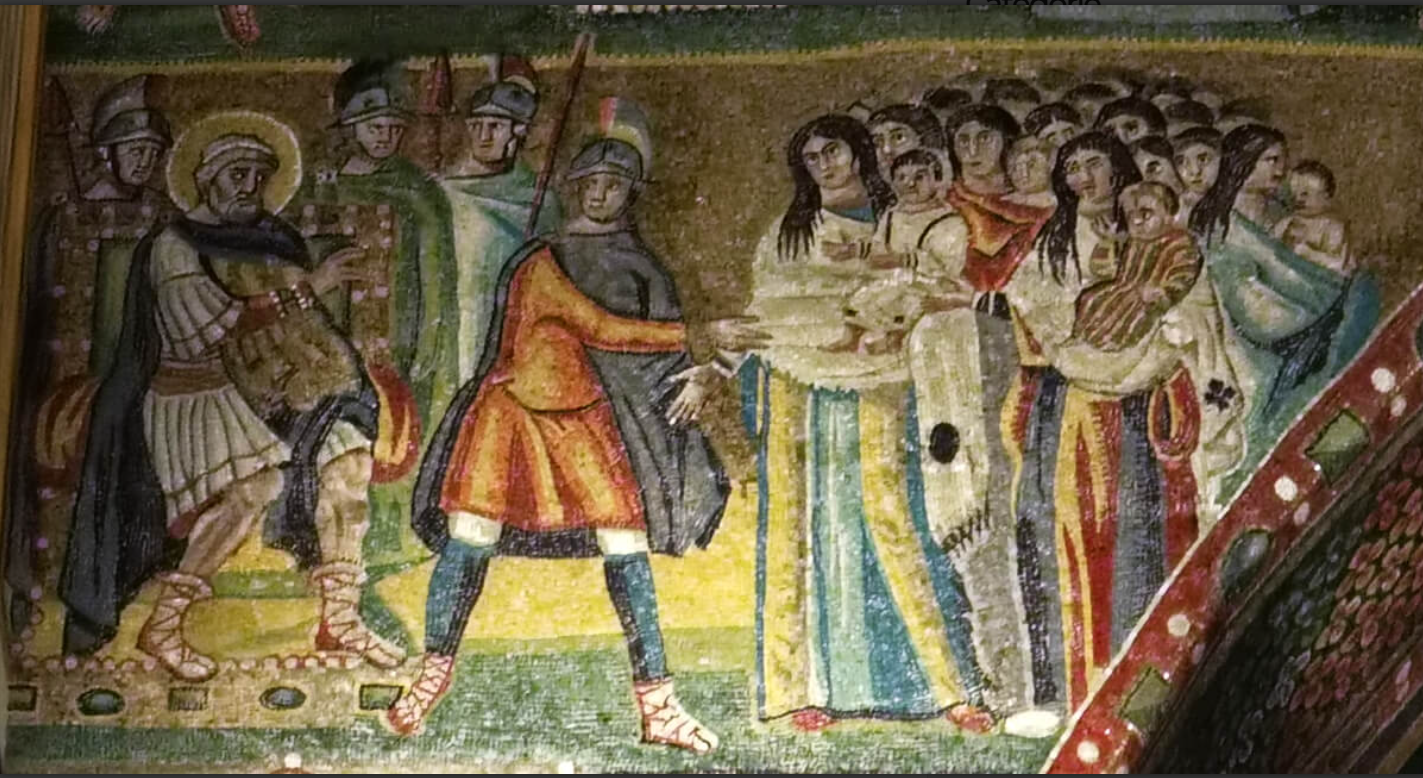
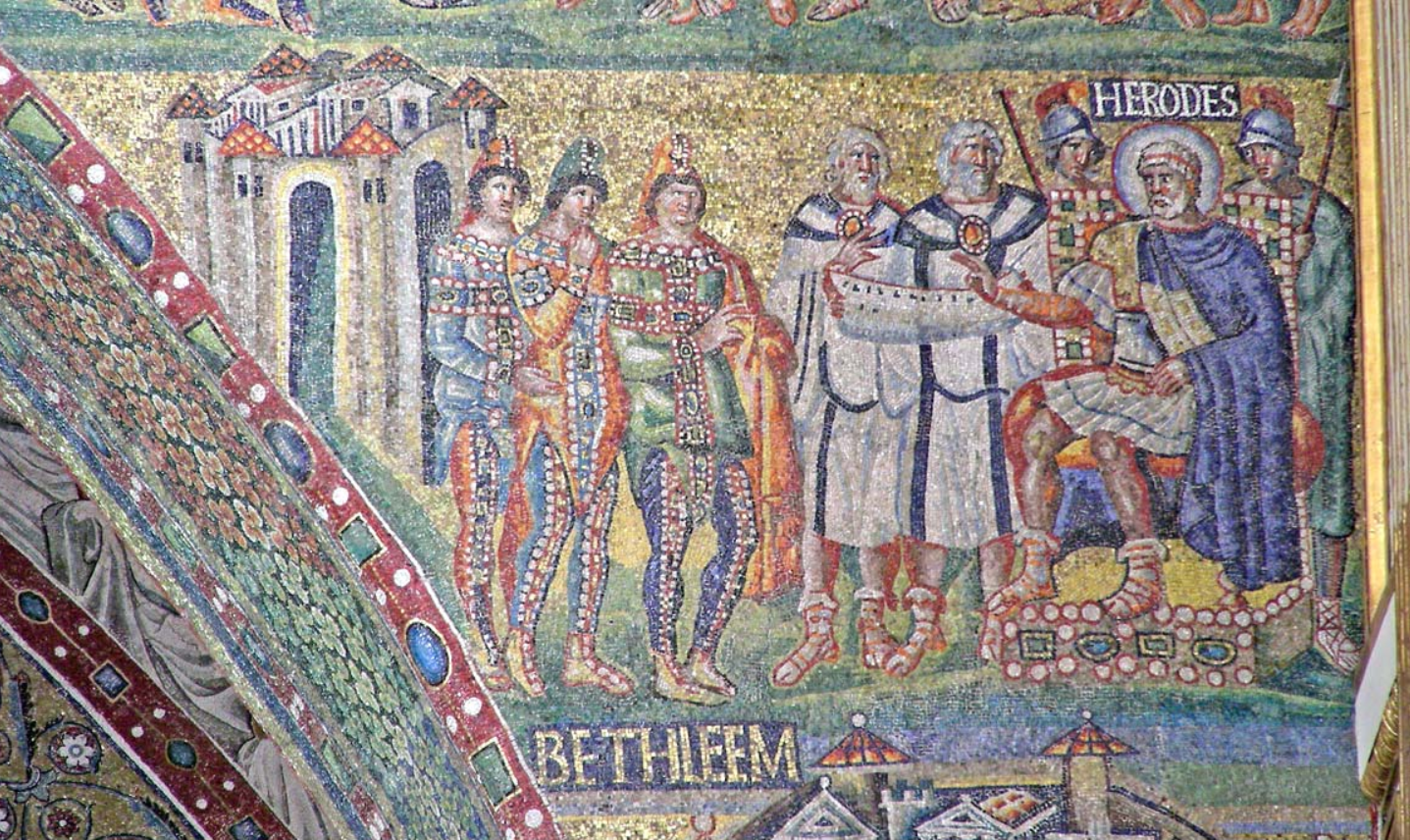
Five men approach. The three at the left are the Magi, in Phrygian caps and patterned trousers — the late-antique visual code for Easterners, and not for kings; the crowns enter the tradition centuries later. The two in white are the chief priests and scribes of Matthew 2:4, whom Herod assembled to ask where the Christ should be born. They wear the white dalmatic with two dark clavi, which on this arch marks senatorial rank — so Jerusalem’s religious establishment is rendered as Roman senators advising a client king. The scroll open between them is their answer, the Micah citation of Matthew 2:6, and BETHLEEM is lettered in the register directly beneath it.
Herod sits at the right on a gem-studded throne, feet on a footstool, in a blue-purple mantle, four helmeted guards behind him, labelled HERODES in Latin capitals. He alone carries a nimbus. The Magi have none, the scribes have none, the guards have none — so in this frame the nimbus marks neither sanctity nor kingship in general, but the enthroned sovereign in his own territory. In fifth-century art it descends from imperial iconography; Servius, writing at about the same date, describes it as the luminous surround of gods and emperors. The gem-studded throne follows Basil’s sermon rather than any source for the reign.Basilica di Santa Maria Maggiore, Rome, c. 432–440. Commons: RomaSantaMariaMaggioreArcoTrionfaleDxRegistro3.jpg; the full arch at 6,000 px is Santa Maria Maggiore Roma, Arco trionfale -FG.jpg. Confirm the licence of the source image before publication.
9. Three men, one name
A second and simpler distortion sits underneath the first, and it needs no scholarship to check. The “Herod” of most New Testament villainy is not this man.
- The Herod who imprisons and executes John the Baptist, and before whom Jesus is sent, is Antipas — Herod’s son, tetrarch of Galilee, who was in Gaul by AD 39.
- The Herod struck down in Acts 12, who kills James and imprisons Peter, is Agrippa I — Herod’s grandson, who died at Caesarea in AD 44.
- The Herod of the massacre, if the massacre happened, is Herod the Great, dead in 4 BC.
Three rulers, across two generations and half a century, collapsed by two thousand years of retelling into one villain wearing one name. Whatever else is true, a portrait assembled from that conflation is describing a composite who never existed.
10. Hostile from both flanks
The surviving tradition is not merely partial in one direction. Herod was disliked from opposite sides, for reasons that had nothing to do with his conduct.
From within Judaea: he was an Idumaean, of a house converted under the Hasmoneans a generation or two before, and he had displaced the Hasmonean dynasty itself. His rival Antigonus went to the Romans and argued that Herod had no right to the throne because he was a hemioudaios, a half-Jew. That charge is preserved in the record and has been doing work ever since; repeating it uncritically is adopting the argument of a defeated claimant. He also broke the priestly settlement, making the high priesthood appointive and importing an Alexandrian family to hold it.
From the Greek and Roman side: the surviving account is a Flavian client’s rework of a court apologia, as section 7 sets out. And in the later rabbinic tradition the whole Herodian settlement, priesthood included, is remembered with hostility for its closeness to Roman power.
There is no surviving neutral witness to this man’s character. That is the situation, and it is unusual even by the standards of ancient biography.
11. The inscriptions
There is a third body of evidence, distinct from both the texts and the buildings, and it is the one this memo has until now left out. Inscriptions are contemporary with their subjects; they were carved by the people who erected them, in public, for that generation to read; they are dated by letter-forms and find-context; and they are wholly independent of the manuscript tradition. Where Josephus is a single filtered channel and the buildings are mute, the stones speak in the words the ancient world itself chose. The corpus is set out in the master register at 52, 53 and 54; the survey followed here is Haensch (55), the German Archaeological Institute’s study of the whole Herodian epigraphic record.
The size of the record. The Herods appear in not much more than some fifty inscriptions in total, several of them doubtful. For Herod himself there are three certain honorific statue bases — two from Athens (IG II² 3440 = OGIS 414; IG II² 3441 = OGIS 427) and one from Kos (IG XII 4, 2, 882) — with three more fragmentary candidates, two further from Athens and one from Paphos: at most six monuments in the world. His sons are worse served: Antipas has two, from Delos and Kos; Philip one; and Archelaus, ethnarch of Judaea for ten years, has none at all. Agrippa I has almost nothing certain. Agrippa II, by contrast, is comparatively well attested across the northern territories.
What the Athenian stones say, and what they do not. The two Athens bases honour Herod as a public benefactor of the city, in the standard vocabulary of Greek civic gratitude: his excellence, his benefaction, his goodwill. He is styled Philoromaios — friend of the Romans — on one, and Eusebes Philokaisar — the pious friend of Caesar — on the other, that second stone being IG II² 3441 = OGIS 427; the difference between the two epithets is what the editors use to date the monuments relative to each other (register 56). The first of the two is catalogued in full: Athens, Acropolis inventory 13249, thirty-five centimetres high and about seventy wide, first published by Pittakis in 1858 from a find made on 10 November of that year, and standing today in the open air on the north side of the Panathenaic Way, a little before the turn towards the Erechtheion. Both epithets are his, on separate stones, and the second is worth pausing on in a memo about the name of Caesar: a Judaean king carried “Caesar-lover” as a formal public title, cut in Greek, in the city that invented the honorific decree. It is the name working as an honour rather than as a surname — the same name, in a third mode, alongside the grant and the adoption.
The honest counterweight must be stated in the same breath, because the record states it plainly. Haensch’s conclusion on these monuments is deflationary and this memo carries it as found: the inscriptions are formulated exactly as hundreds of others are; nobody calls Herod soter or ktistes, saviour or founder, the high honorifics available to Greek cities and used for others; and the bases are small — the Athenian ones no more than about 40 cm high, 80 wide, 50 deep — carrying standing figures, not horsemen or chariots. Herod was, on the stones, one benefactor among many, and honoured no more often than other client kings of the early principate. Whatever the epigraphic record supports, it does not support extraordinary reverence, and this memo does not claim it does.
An open question on these two stones, stated rather than resolved. The text in the figure above is the one that circulates. It is not, as given, an edition: a published epigraphic text marks with square brackets every letter not physically present on the stone, and the versions in general circulation carry no brackets at all. The Athens block is cracked across and weathered. Until the editions of IG II² 3440 and 3441 are set beside the photographs, it is not established here how much of each inscription is cut in the marble and how much is an editor’s restoration of the formula he expected to find — and the epithets are precisely the words a restorer would supply. That both epithets are genuine is independently supported by the catalogue (56); which stone carries which, and how much of either survives, remains on the verification register. The principle is the one this memo applies throughout: name the filter rather than pretend there is none, and an editorial hand is a filter even when it is light and honest.
What the stones do independently confirm. Four things, each of which matters to the argument of this memo and none of which depends on Josephus. First, the citizenship: the Kos base names Herod in a form that has been read as demonstrating his possession of Roman citizenship (59) — the grant of section 2, attested in stone rather than narrative. Second, the family’s Julian name in formal use: an inscription from Qalaat Fakra invokes the safety of Marcus Julius Agrippa, lord king, and of the lady queen Berenice — the enfranchised name, in the family’s own official titulature. Third, and most directly to the point of the whole memo: the Berytus architrave (AE 1928, 82), a monumental building inscription recording that Agrippa II and Berenice restored a structure which King Herod their great-grandfather had built — and in Haensch’s reconstruction the king’s titles at the head of it read rex magnus Agrippa Philocaesar, or Philoromaeus et Philocaesar. The last king of the house carried the name of Caesar as a Latin title on a public monument, four generations after a dictator gave his great-great-grandfather citizenship. Fourth, the household, and it repays a closer look than a list allows.
The wine jar. Storage jars from the Herodian layers at Masada and Herodium carry painted Latin shipping labels — tituli picti — and a number of them name the consignee outright. The best-known carries the consular year of 19 BC, a wine called Philonianum, the estate it came from, and then the line:
REGI HERODI IUDAICO
“for Herod, the Jewish king”
Source, not reviewed for this memo: Cotton and Geiger, Masada II: the Latin and Greek Documents (Israel Exploration Society, 1989), ISBN 965-221-011-0 — the individual label texts and their number. Berytus architrave: AE 1928, 82.
It is a dative of consignment, the construction a shipper writes on a crate, and it matters for three reasons. First, who wrote it. This is one of very few places Herod is named and titled by someone with no stake in him whatever — not a court historian, not a client city voting honours, not a hostile tradition, but a merchant completing a delivery. Second, what it says. The title is ethnic, not territorial: Herod the Jewish king, not king of Judaea. That is exactly how Plutarch names him a century later, listing him among Antony’s subject kings; and it stands against the finding that Herod never styled himself king of Judaea or of the Jews on his own coins or in his own dated documents (60.4). The territorial and ethnic titles appear when outsiders write about him and vanish when he writes about himself (section 13). Third, where it was found. The Greek bases that give him a royal title are all from abroad; this is among the few attestations of it recovered from within his own kingdom, in an excavated context. He is named on official weights and on a wine jar delivered to his own back door, and on not one surviving building inscription from the greatest building programme in the Roman east.
What was in the jars, and beside them, is the other half of the point: Italian wine, apples from Cumae on the Bay of Naples, fish sauce from Spain — the components of a Roman dinner, shipped the length of the Mediterranean and hauled up a desert cliff by pack animal, to a fortress built against the possibility of one day needing to hide in it.
And the date on the label. Roman shipping marks carry the consular year. The consul named on the Masada wine is Gaius Sentius Saturninus, consul in 19 BC. Twelve years later the same man was governor of Syria, and he sat — with his three sons — on the panel of some hundred and fifty assessors that Augustus authorised to try Alexander and Aristobulus at Berytus. Josephus records that Saturninus voted against the death penalty (section 14). The Roman whose consulship dates the king’s wine is the Roman who, a decade on, argued for the lives of the king’s sons. Nothing is built on the coincidence.
A last small note from the same channel: a taster of Augustus who died in AD 21 or 22 bore the added name Coetus Herodianus, most probably a slave who passed from Herod’s household to the emperor’s under the king’s will.
12. The coinage
Coins are the fourth body of evidence, and in some ways the best. They were struck by the king’s own mint, in his own lifetime, on his own instruction; they survive in thousands; and a die study of them can reconstruct how the mint actually worked. Nothing in them passes through Josephus. The near-complete study is Ariel and Fontanille’s, built on 2,504 examined specimens (register 61).
What Herod struck. Bronze only — no silver, no gold. That is not a choice but a statement of rank: Rome reserved precious-metal coinage to itself, and a client king struck base metal. Seventeen types in all, of which four belong to a dated denominational series marked year 3 — LΓ — whose absolute date is disputed between 37 BC, the mid-30s, and a proposal placing it in 27 BC on an era beginning with Octavian’s reconfirmation of his rule after Actium; the memo states the dispute and does not settle it. The rest are undated. The devices, set out in full because this memo aims to hold everything that is known: anchor — the badge of the defunct Seleucid kingdom, carried over from Hasmonean coinage; crossed cornucopiae with a herald’s staff between them; tripod and tripod table; an incense burner between palm branches; the cross within a circle; poppy or pomegranate, the identification uncertain; vine and grape cluster; wreath and diadem; palm branch; aphlaston; a domed object usually called a helmet; shield; winged caduceus; and, once, an eagle. Several are borrowed from Roman coinage — helmet, shield, caduceus — and were probably not read as Roman by his own subjects at all. The legend is Greek and it is always the same: ΒΑΣΙΛΕΩΣ ΗΡΩΔΟΥ, of King Herod.
The pattern that runs across four channels. Here the coinage joins the other three, and the convergence is the most substantial finding in this memo. Herod’s coins carry no portrait of him. He continued the Hasmonean practice and refrained from depicting living or mythical figures almost entirely — a qualification the Year 3 series requires, and which is set out below. That is not what client kings did: the Nabataeans, the Cappadocians, the kings of Commagene all put their own faces on their coinage as a matter of course. Set that beside the three findings already in this memo — no statue honouring him anywhere in his own kingdom except at Seeia, outside the Jewish heartland (section 10); not one surviving dedicatory building inscription naming him, from the greatest building programme in the Roman East (section 10); and Goodblatt’s reading of the documents, that he used regnal dating like a Hellenistic king but never styled himself king of Judaea or of the Jews (60.4). The coins confirm that last point independently: the legend says King Herod and nothing else — no territory, no people, no epithet, though he held three epithets on stone abroad.
Four independent evidence classes — statuary, building inscriptions, documents, coinage — and in every one of them the same absence. Inside his own kingdom the man did not put his face, his name or his titles forward. This memo does not offer a motive for that; the candidates run from religious scruple to political calculation to something else, and the argument over whether Judaean aniconism was prohibition or avoidance is live (58). But the pattern is a fact of the material record, it is independent of any text, and it sits very badly against the portrait of a ruler consumed by self-glorification. Stating that is not the same as establishing the opposite portrait, and the memo does not take the further step.
| Type | Size / weight | One face | Other face | Legend | Date | Reference |
|---|---|---|---|---|---|---|
| Largest denomination “8 prutot” | ~23 mm, 6–10 g | Domed device — helmet or incense burner — star above, palm branches flanking | Tripod with ceremonial bowl (lebes); LΓ and monogram ΤΡ in field | ΒΑΣΙΛΕΩΣ ΗΡΩΔΟΥ | Year 3 (LΓ) | Hendin 1169 · Meshorer 44 · RPC 4901 |
| Year 3 series 4 prutot | — | Ornamented cap or dome, star above | Poppy or pomegranate on a stem | ΒΑΣΙΛΕΩΣ ΗΡΩΔΟΥ | Year 3 (LΓ) | Hendin 1170 |
| Year 3 series 2 prutot | — | Crested helmet | Shield, decorated | ΒΑΣΙΛΕΩΣ ΗΡΩΔΟΥ | Year 3 (LΓ) | Hendin 1171 |
| Year 3 series 1 prutah | — | Winged caduceus | Poppy or pomegranate | ΒΑΣΙΛΕΩΣ ΗΡΩΔΟΥ | Year 3 (LΓ) | Hendin 1172 |
| Undated | — | Anchor | Two crossed cornucopiae with herald’s staff between | ΒΑΣΙΛΕΩΣ ΗΡΩΔΟΥ | undated | Hendin 1174 |
| Undated | — | Tripod table, palm branches flanking | Cross within a circle (diadem) | ΒΑΣΙΛΕΩΣ ΗΡΩΔΟΥ | undated | Hendin 1178 |
| Undated | — | Aphlaston — a warship’s ornamented stern | Palm branch | ΒΑΣΙΛΕΩΣ ΗΡΩΔΟΥ | undated | Hendin 1180 |
| Undated the figural exception | — | Cornucopia | Eagle standing, wings closed | ΒΑΣΙΛΕΩΣ ΗΡΩΔΟΥ | undated | Hendin 1181 |
The Year 3 series, in detail. Four of the seventeen types belong to one dated issue, and it deserves its own treatment: these are the largest, heaviest and most elaborate coins Herod ever struck, they are the only ones he ever dated, and a three-part study has been devoted to their iconography alone (62). The largest denomination, conventionally called eight prutot, runs about 23 mm across at weights from under six grams to over ten — the weight is irregular, as token coinage’s is. One face carries a domed helmet seen frontally, with cheek-pieces and straps hanging below and a wreath around it, a star above, flanked by two palm branches. The other carries a tripod with a ceremonial bowl, the lebes, above it; the legend ΒΑΣΙΛΕΩΣ ΗΡΩΔΟΥ around; and in the field on either side the date LΓ — year 3 — and a monogram, ΤΡ.
Almost everything about it is disputed. That is the honest state of the question and the memo records it as such. The domed object is read as Herod’s own ceremonial helmet by most, and as a thymiaterion, an incense burner, by others — a military emblem or a cultic one, and the difference is not small. The disagreement is worth stating in its own terms rather than as a footnote, because the standard label sits awkwardly on the object as struck. The catalogue description is a helmet seen frontally with cheek-pieces and straps; but on well-preserved examples the two elements at the sides curve outward and upward into volutes from a horizontal bar, where cheek-pieces hang downward beside a face, and the whole device stands on a fringe of vertical legs, where a helmet stands on nothing. Those features fit a covered incense burner — domed lid, looped handles, tripod stand — at least as well. Herod’s coinage elsewhere favours the implements of religious ceremony, the tripod table and the incense burner among them, which makes the cultic reading the less surprising of the two. The memo does not choose; it records that the single most prominent image on the reign’s most important coin has no agreed identification. The mint is given as Jerusalem by some and Samaria or Sebaste by others. The monogram ΤΡ has been read as a mint-master’s mark, as an abbreviation of a place, and as the title tetrarch, with the study finding no direct evidence for the last. It is also claimed in popular treatments as a religious sign, and the memo states the position plainly for readers who meet that claim. The device is a tau-rho, tau and rho in ligature. In much later Christian manuscript practice a tau-rho serves as a staurogram, standing for stauros, the cross; the separate chi-rho — different letters — abbreviates Christos. The two are routinely conflated. A tau-rho does not spell Christos and cannot, and no reading of this monogram as a claim to anointed kingship has standing in the numismatic literature. That a tau-rho ligature existed in pre-Christian use, on this coin among other places, is a real observation and has been made by New Testament scholars asking where the later Christian sign came from; it is an observation about the origin of a Christian symbol, not about Herod’s theology.
A claim standing next to that one is sound and is recorded as such: Herod was the first ruler of Judaea to inscribe his coins in Greek alone. The Hasmoneans before him struck in Hebrew, or in Hebrew and Greek together; every Herodian legend is Greek. Whatever the monogram means, the language of the coinage is a real break with what came before, and it is of a piece with the rest of this memo — a king addressing the wider world in its own tongue, on metal that circulated at home. Lorber’s reading of the whole programme as Dionysiac is recorded and rejected there as unsupported by most of the motifs. And the date itself — year 3 of what — is unsettled to the point that the standard references contradict one another outright: reputable catalogues and museum records date this same coin to 40 BC, to 38/37 BC, to 37 BC and to 30/29 BC. A reader who buys one is told four different things about when it was made.
Why the date matters, and the reading that connects it to section 14. The candidate eras are the Senate’s declaration of 40 BC, the capture of Jerusalem in 37, and Octavian’s reconfirmation of Herod’s crown after Actium in 30. The choice changes what the coins are. On the first two they are the money of a claimant fighting for a throne. On the third they are the money of a king who has just kept one. Marshak’s analysis, reported in the third part of the study, argues for the last: that the Year 3 coins postdate Actium, and that the aplustre — the ornamented stern-piece of a warship, which appears on the coinage — is a symbol of naval victory tying Herod to Octavian’s triumph, so that the issue attaches to the reconfirmation of 30 BC. A competing reading of the same device should be set beside it, because it points somewhere quite different: that the aplustre refers not to Actium but to Sebastos, the artificial deep-water harbour at Caesarea, the most technically remarkable thing Herod ever built (section 2). On the first reading the device honours another man’s victory; on the second it advertises the king’s own works, and it carries no implication for the date at all. If that holds, then the largest and most elaborate coinage of the reign was struck to mark the meeting at Rhodes described in section 14 — the moment Herod removed his diadem before the victor and was given it back. The date is unsettled.
One further finding from the die study belongs here: the Year 3 type shows evidence of rapid production, which is read as bearing on the coinage’s relationship to a specific event rather than to routine minting. A dated, urgent, high-value issue struck fast, once, and never repeated.
What this costs the previous paragraph, stated plainly. The absence of a portrait holds, and it is the load-bearing point. But “almost entirely without living or mythical depictions” needs qualifying in the light of this issue: a tripod with a lebes is the furniture of Greek sanctuary and oracle, an aplustre is a Greek and Roman victory emblem, and a star above a helmet belongs to a Hellenistic royal vocabulary. These are not figures of gods or men, and they would not offend an image prohibition in the way a portrait or a deity would. But they are not neutral either. On his largest coins Herod spoke in the symbolic language of the Greek and Roman world, to whoever could read it, while keeping his own face and every human and divine figure off the metal.
The cross within a circle. One further type belongs in any full account of the coinage, and it is the one device on which a religious reading has actually been proposed by people who work with the coins. A common Herodian issue carries a tripod table and palm branches on one face, and on the other the royal legend surrounding a cross set within a circle. The circle is generally taken for the royal diadem. The cross inside it is unexplained, and one suggestion in circulation is that it refers to the forms of anointing: that kings were anointed on the head with oil in a circular motion and priests with a cross, so that the two together would state a claim over both the royal and the priestly spheres — which would suit a king who controlled the high priesthood by appointment while being barred from holding it himself (section 2). That proposal is speculation and is recorded here as speculation: it has no standing in the die-study literature, and a cross within a circle is also simply a very common ancient device, found as a wheel, a monogram, a control mark and an ornament. It is set down because a complete account of what Herod struck should include it, and because it is the type on which any argument about anointing would have to rest — not the tau-rho monogram discussed above, which cannot bear that weight.
The eagle, and a correction to a common reading. One Herodian type is figural: a coin struck at Jerusalem showing an eagle with closed wings. It is routinely connected to the golden eagle Josephus says Herod set over the Temple gate, and read as the Roman imperial eagle — a client king planting Rome’s bird on the sanctuary. The numismatic analysis does not support that reading. The eagle on the coin is the closed-wing eagle of the Tyrian shekel, the currency actually used in the Temple, whose device descends from the Ptolemaic eagle of Zeus. Fontanille’s conclusion is stated flatly: there is no evidence whatever that Herod, through this eagle, meant to signal what the tradition has read into it (61.1). The episode itself remains in the record; the numismatic gloss on it does not.
What the coins do not flatter. Two findings run the other way and are carried as found. The coinage is, in the specialists’ own words, unimpressive — mostly poorly designed and poorly manufactured, issued sporadically, nothing like the quality of the buildings. And Ariel and Fontanille suggest a purpose for some of it that belongs with section 5: that certain issues functioned as handouts, in the manner of the Roman congiarium and donativum — largess distributed to the people. If that holds, some of the money in the benefactions chapter was physically this coinage, handed out by the fistful.
13. The absence
Set the channels beside one another and the same thing is missing from all of them. This is the strongest finding in the memo and it is stated as a list, because the accumulation is the argument.
- No building inscription. From the Temple platform, Caesarea, Sebaste, Masada, Herodium, Jericho, Hebron and thirty more works — not one surviving dedicatory inscription names him as builder. The single dedicatory inscription recovered from a Herodian building records a private donor.
- No statue at home. One monument in the whole kingdom carried a statue honouring him, at Seeia in the Hauran, on the Arab fringe.
- No portrait on the coinage. Seventeen types, not one face. The Nabataean, Cappadocian and Commagenian kings all put theirs on as routine.
- No territorial title. The coins read of King Herod and stop. The dated documents use regnal years in the Hellenistic manner and never style him king of Judaea or of the Jews.
- No name on his own tomb. At Herodium — the one site he named for himself, where he chose to be buried — the mausoleum carries no inscription of any kind. Which is why we cannot prove whose grave it is.
Measure that against what other rulers left. Augustus wrote out his own life and had it cut on bronze columns at his Mausoleum and copied on stone across the empire. Trajan put his name on a forum, a market, a column and a bridge. Herod’s own patrons and rivals stamped themselves on everything they touched, and the standard practice of the age was to build and then say who built it. Herod built more than any of them in the Roman east, and on the surviving evidence he signed none of it.
What survives with his name on it, in the whole world, is this: six honorific monuments, five of them abroad and put up by other people; two official weights; labels on wine jars, written by an Italian shipping clerk; one architrave raised by his great-grandchildren after he was dead; and his coins, which give the name and nothing else.
He is better attested as a customer than as a king.
No cause is offered here. The candidates are on the table in section 10 — a slow local epigraphic habit, the image question, the destruction of the wars, gilded metal letters prised off for their value, deliberate erasure — and the last of these is the one that can actually be tested, because erasure leaves physical rasura on stone and epigraphers publish it when they find it. None is reported on any Herodian inscription. That is what the evidence says today; it is not a verdict on what happened.
What can be said is this. The pattern is a fact of the material record, independent of every text. It runs through five channels that have nothing to do with one another. And it sits flatly against the one thing everybody thinks they know about the man — that he was consumed by his own glory. A ruler consumed by his own glory does not build the largest sacred enclosure in the Roman world and leave it unsigned, and does not end up in an unmarked grave inside a mountain named after him.
Two limits belong with it, and the memo states both. He is named on official weights from Jerusalem and Ashdod, and on the wine jars of section 11 — so the gap is specifically in monumental and honorific contexts, not in every context. And the titulature runs the same way: the royal title attaches to him in what others write — a merchant’s consignment label, Plutarch’s list of Antony’s kings — and not in what he issues himself. An absence of self-promotion is not a demonstration of virtue. It contradicts one specific charge, and it establishes nothing else.
14. What does not dissolve
A memo that only removed things would be worthless. Two bodies of material survive the whole of the above.
The executions. The dated sequence — Aristobulus III drowned at seventeen in about 35 BC; Hyrcanus II, past eighty, in 30; Mariamme I in 29; her mother Alexandra in 28; the sons of Babas and Costobarus about 25; Alexander and Aristobulus IV in 7; Antipater II five days before the king’s own death in 4 — is harder to dissolve than the portrait, because it has anchoring outside the channel. The trial of the two sons was authorised by a letter from Augustus, convened at Berytus, a Roman colony, before roughly a hundred and fifty assessors including the governor of Syria — whose recorded vote was against death — the same Gaius Sentius Saturninus whose consulship of 19 BC dates the Italian wine shipped to Masada (companion memo, 6.10). Antipater’s case was heard before Varus, governor of Syria, with intercepted letters in evidence, and the emperor’s permission was sought before the execution. Roman procedure, Roman venues, imperial sanction twice, and a dissenting vote on the record.
That the deaths happened is close to solid. What the channel controls is the framing — escalating paranoia, or a client court genuinely riddled with Hasmonean-restoration plots and adjudicated under Roman oversight. The same dated facts admit both, and this memo installs neither. Every one of these executions carries formal legal apparatus in the record itself; and legal apparatus has never been evidence of justice.
The record of the reign as a client king. The other thing that survives is the standing, and it survives partly outside Josephus. Plutarch names Herod the Jew among the subject kings on Antony’s side. Josephus — the hostile channel — states that Herod stood next after Agrippa in Caesar’s affection and next after Caesar in Agrippa’s. Augustus gave him authority over the administration of his own private estates, a position so far as is known unprecedented for a client king (60.3). Philo, independently of Josephus, records Marcus Agrippa keeping the feast in Jerusalem as Herod’s guest. None of that is character evidence. All of it is standing evidence, and it is better attested than the portrait.
15. A note on the title
“The Great” is not a contemporary honorific and no argument should rest on it. No inscription, coin or contemporary source uses it; his own coins read simply of King Herod; Josephus does not call him so. The epithet appears in later usage, and the common scholarly account is that it began as a way of distinguishing him from the later Herods — the elder Herod, in the sense of Pliny the Elder — and may also carry the sense of the great builder. What is attested in his lifetime, in stone, is three titles: Philoromaios, Philokaisar and Eusebes. Those are the ones to use.
16. King of the Jews — the title, and what he was actually called
Rome made him king. The New Testament calls the office King of the Jews. Herod put neither phrase on anything he issued. This section sets the three out against each other.
Section 15 sets out the epithets others gave him. This section sets out the title he was given and the one he used.
16.1 What Rome conferred, and what survives of it
Josephus gives the Senate vote of 40 BC twice, at Antiquities 14.381–389 and War 1.282–285: Antony and Octavian propose, Messalla and Atratinus speak for him, the Senate votes, and the decree is carried in procession to the Capitol between the two consuls to be deposited in the temple. He dates it by the consuls of the year, Domitius Calvinus and Asinius Pollio.
Appian, Civil Wars 5.75, confirms the act independently and without the ceremony: Antony appointed kings as he saw fit, and Herod was one of them.
The decree itself does not survive. Josephus says it was deposited on the Capitol; that temple burned in 83 BC, in AD 69 and again in AD 80. So the instrument that made him king is lost, and the fullest account of it reaches us through a historian writing a century later who worked from Nicolaus of Damascus — Herod’s own court writer, whose partiality Josephus states in writing (section 7).
16.2 What his own coinage says
Seventeen types across a reign of thirty-three years, all bronze, and every legend the same three words:
ΒΑΣΙΛΕΩΣ ΗΡΩΔΟΥ
basileōs Hērōdou — ‘of King Herod’
The largest denomination, dated to his year 3 (38/37 BC), carries an ornate helmet flanked by palms on one face and a tripod with the date mark LΓ on the other. No people, no territory, no priesthood, no epithet, and no Hebrew.
16.3 The comparison that makes the silence legible
Set beside the man he replaced and the son who followed him, the omission stops being an absence and becomes a choice.
| Ruler | Reference | Date | What the legend reads | Languages | Claims |
|---|---|---|---|---|---|
| Antigonus last Hasmonean | Hendin 481 | 40–37 BC | Greek: ΒΑΣΙΛΕΩΣ ΑΝΤΙΓΟΝΟΥ. Paleo-Hebrew: ‘Mattatayah the High Priest and the Council of the Jews’. Double cornucopiae; ivy wreath. | Greek and Hebrew | King, high priest, council |
| Herod | Hendin 1169 Meshorer 44 | yr 3 = 38/37 BC | ΒΑΣΙΛΕΩΣ ΗΡΩΔΟΥ. Ornate helmet with palms; tripod, date LΓ, monogram. | Greek only | King |
| Archelaus his son | Hendin 505 | 4 BC – AD 6 | ΗΡΩΔΟΥ alone, above a bunch of grapes. | Greek only | A name |
Antigonus addressed two audiences and claimed three things. He was king, he was high priest, and he named the council. Herod addressed one audience and claimed one thing. He could claim neither of the other two: he was not of priestly descent, and the council was not his. Archelaus, denied the title of king by Augustus, claimed nothing but the family name.
16.4 The two Latin constructions, and which one he gets
The distinction is grammatical and it is not trivial.
- REX IUDAEORUM — genitive plural. King of the Jews. A claim over a people.
- REX IUDAICUS — adjective. The Jewish king. A description of the man.
The wine-jar labels from Masada and Herodium carry the dative of consignment, REGI HERODI IUDAICO — ‘for Herod, the Jewish king’. That is the adjective. It is the only place the title reaches him from an outsider with no stake in him, and it is the weaker of the two constructions.
A note on the name itself, since the forms differ across the objects. Latin declines it as a Greek third-declension noun: HERODES nominative, HERODIS genitive, HERODI dative, HERODEM accusative. The wine labels read HERODI because the goods are for him. The nominative HERODES appears once in the entire surviving corpus — on the Berytus architrave, posthumously, cut by his great-grandchildren.
16.5 Where the other construction does appear
REX IUDAEORUM belongs to two passages of the New Testament, and to no object.
- Matthew 2:2 — the magi ask for the one born King of the Jews, and Herod is troubled. In the Vulgate, rex Iudaeorum.
- John 19:19 — the titulus on the cross: Iesus Nazarenus Rex Iudaeorum, and John 19:20 says it was written in three languages.
The Greek is the same construction in both: ΒΑΣΙΛΕΥΣ ΤΩΝ ΙΟΥΔΑΙΩΝ, a genitive plural.
16.6 What the evidence supports
No object from the period carries the phrase ‘King of the Jews’ in either language. Not a coin, not an inscription, not a weight, not a label. The titulus does not survive; the relic shown at Santa Croce in Rome is a later claim and is not evidence for the first century. The title exists in texts and nowhere else.
So the position is this. Rome conferred a kingship and the instrument is lost. Josephus records the conferral and reaches us through the king’s own writer. Herod struck the bare royal style for thirty-three years and never once claimed the people. The one outsider who names him uses an adjective. And the phrase that troubles him in Matthew and is nailed above a cross in John has never been found on anything.
The memo does not resolve what Herod thought he was. It records that on the one medium he controlled directly, and over three decades, he claimed less than the man he replaced and less than Rome had given him.
16.7 How many survive, and why the answer cuts both ways
This memo rests on scarcity. Six honorific monuments in the world, five of them abroad; two official weights; a crate of wine; no dedicatory inscription on any building. That is the finding of sections 11 to 13, and it holds. But it is not true of everything he issued.
Types are few and the count is unsettled. The catalogues give something in the range of seventeen to thirty for Herod himself, depending on which is used and how varieties are counted; Meshorer and Hendin do not agree, and this memo has checked neither at first hand. The figure is in the verification register and is not asserted here.
Specimens are many, and nobody has counted them. There is no census of surviving Herodian coinage and no corpus. What exists is excavation data, and it gives the order of magnitude:
- Magdala, excavated 2010–2017: about 2,500 coins recovered, of which 1,197 were identified as Jewish issues, Hasmonean and Herodian.
- Samaria: Reisner’s excavation reported 18 Herodian coins, 7 of them dated; Crowfoot’s later season reported 60, of which 11 were dated.
- Jerusalem: the ratio of undated to dated Herodian coins in excavation runs at about fifty to one.
Add the trade, where Herodian prutot sell for tens of dollars because they are common, and the realistic total is many thousands in museums, excavation stores, collections and private hands, uncounted.
So the man is at once among the worst-attested and among the most abundantly attested figures of the period, and which is true depends entirely on the medium.
The reason is not survival. It is manufacture. A coin type is struck in tens of thousands and dropped in the ground everywhere; a monument is one object that somebody chose to raise. The scarcity documented in this memo is therefore not an accident of what has come down to us. It is a record of how little was made — which is the whole of the argument, and this section is the control that shows it is not simply an artefact of loss.
17. What the record supports, and what it does not
What it supports. That the surviving portrait of Herod’s character rests on one channel whose partiality its own transmitter states in writing. That the massacre is single-attested, in a text composed some eighty-five years after the fact, with a visible literary frame and no corroboration in any other source, Christian, Jewish or Roman. That the popular Herod is a composite of three different rulers. That there is no surviving neutral witness. That the building programme was, in measurable terms, without parallel among client kings and beyond most of what the empire built for itself. That he was trusted by Augustus with an administrative role no other client king is known to have held. And that across five independent classes of material evidence — building inscriptions, statuary, coinage, documents and his own tomb — his name does not appear inside his own kingdom, though he built more there than any ruler of the Roman east.
One control belongs at the front of this. The scarcity set out above is not an artefact of survival. His coins come out of the ground by the thousand (16.7), from the same soil and the same centuries as the monuments that do not. What is thin is not what survived. It is what was made.
What it does not support. That he was a monster. That he was not. The evidence establishes that the received portrait is unverifiable and demonstrably confused in specific, checkable ways. It does not establish a replacement portrait, and it cannot — because the material that would be needed to establish one is the material that section 2 shows to be lost or filtered. Anyone constructing a rehabilitation from this evidence is doing what Nicolaus is charged with doing, in the other direction, and the charge would be equally fair.
That is not a failure to reach a conclusion. It is the conclusion, and it is a stronger one than either portrait, because it can be checked. The record has been rewritten — that much is demonstrable, and this memo demonstrates it. What the original said is not recoverable from what survives. Both halves of that sentence are findings, and the second is the one most easily forgotten by anyone pleased with the first.
18. The relics
The material record, which is the half of the evidence this memo rests on. Everything certain about Herod is a thing he built or a state instrument he issued; everything disputed about him is prose.
| Object | Where | Date | What it carries | Record | Find it |
|---|---|---|---|---|---|
| The complete inventory | — | — | Everything on earth bearing his name is listed in Herod the Builder, section 12: six honorific monuments, two official weights, the wine-jar labels, one posthumous architrave, and the coinage. It is not repeated here. | — | — |
| The Herodium mausoleum | Herodium — found 2007 | — | A monumental stairway six and a half metres wide, and three smashed sarcophagi, one of ornamented reddish limestone. No inscription of any kind. The identification as Herod’s tomb is disputed for that reason. | — | Netzer Herodium mausoleum 2007 sarcophagus |
| The Temple platform | Jerusalem — in situ | — | About 144,000 square metres, still standing, still in use. The largest sacred enclosure in the Roman world, carrying no dedicatory inscription. | — | Temple Mount Herodian masonry ashlar margin boss |
| Caesarea harbour | Sebastos — submerged, excavated | — | Hydraulic concrete moles built in open sea. The engineering is verified by underwater excavation and core sampling. | — | Sebastos harbour Caesarea hydraulic concrete Roman |
| The Hebron enclosure | Cave of the Patriarchs — in situ | — | Herodian masonry standing intact and unaltered to full height — and carrying no inscription, though it could. | — | Cave of the Patriarchs Herodian enclosure Hebron masonry |
| Masada | Judaean desert — excavated | — | The Northern Palace terraces, the cisterns, the casemate wall measuring about 1,400 m against Josephus’s seven stadia, the synagogue, and the Roman siege works still on the ground. | — | Yadin Masada Northern Palace cisterns casemate |
| The seventeen coin types | Judaea | 40–4 BC | No portrait on any of them. The Nabataean, Cappadocian and Commagenian kings all put theirs on as routine. | — | Hendin Herod the Great coins no portrait |
| Absent: the conduct record | — | — | Nothing written by anyone who served Herod survives, and Nicolaus reaches us only through Josephus, who states in writing that Nicolaus wrote to flatter. | — | — |
19. Sources
Every source used here is audited in the master source register, with its condition stated. The principal entries are: Josephus (42), with the confessed partiality at 42.1.16.183–186; Nicolaus of Damascus (5), with the transmission trail; the gospels of Matthew, Mark and Luke (48–50), the second and third cited for what they lack; Macrobius (51); the Greek and Latin epigraphic corpora (52–53); the Masada amphora inscriptions (54); Haensch on the epigraphic record (55); Krumeich and Lichtenberger on the statue monuments (56); Eck on erasure (57); Lichtenberger on the image question (58); Jacobson on the Kos inscription (59); the IJS conference volume (60), for Toher on Nicolaus, Sievers on the divergence between Josephus’s two accounts, Barrett on the procuratorship and Goodblatt on the documents; and Ariel and Fontanille on the coinage (61–62).
- Verification register. This memo is a synthesis of material set out in the two companion memos, and every claim of fact in it carries the verification status recorded there. Nothing here has been independently verified beyond what is stated in The Julii of Judaea and Herod the Builder: The Programme, Work by Work; the outstanding items on those memos — principally the bracketed editions of the Athens inscriptions and the catalogue numbers of the coinage — apply here unchanged. The wine-jar material in section 10 — the consignment formula, the labels, the consular date of 19 BC and the identification of that consul with the Saturninus of the Berytus panel — follows Cotton and Geiger, Masada II, and Josephus Antiquities 16.11.3; the claim that this is among the few attestations of the royal title from within the kingdom should be checked against the epigraphic corpus rather than a secondary summary. The section 3 material — the eagle at War 1.648–655 and Antiquities 17.149–163 with Bourgel’s 2021 reassessment, the three thousand at Passover, the four hundred talents, the three claimants and Varus’s two thousand crucifixions — follows War 2 and Antiquities 17 and is to be checked before publication.
Master register numbers refer to the master source register, where each source’s date, distance and survival condition is stated.
- The depictions — both figures are from the triumphal arch of Santa Maria Maggiore, Rome, c. 432–440, under Sixtus III: the massacre on the left of the third register, the Magi before Herod on the right, with the city registers below labelled HIERVSALEM and BETHLEEM. The figure is labelled HERODES in Latin capitals. Neither image is evidence for the events. Both descend from Matthew 2, the sole attestation, and postdate it by four centuries. The gem-studded throne follows Basil’s sermon; the massacre panel shows the order given rather than executed, and the violence of later treatments enters through Prudentius, Basil and Marino. The nominative HERODES is fifth-century Latin usage and is not evidence for Herod’s own titulature (section 16). The mosaics were restored repeatedly from the sixteenth century onward and the restoration history of these panels has not been checked here, so no detail of them is treated as securely fifth-century.
- Numbers of surviving coins — excavation reports: Magdala (Anahuac University, 2010–2017), approximately 2,500 coins with 1,197 identified as Jewish; Samaria, Reisner 1924 and Crowfoot; the Jerusalem undated-to-dated ratio. No census or corpus of Herodian coinage exists, and the figures above are indicative, not a count. The number of types is unsettled between Meshorer and Hendin and is in the verification register.
- The Senate vote of 40 BC — Josephus, Antiquities 14.381–389 and War 1.282–285: the proposal by Antony and Octavian, the speeches of Messalla and Atratinus, the decree and its deposit on the Capitol, dated by the consuls Domitius Calvinus and Asinius Pollio. Appian, Civil Wars 5.75, confirms the appointment independently. The decree itself does not survive; the Capitoline temple burned in 83 BC, AD 69 and AD 80.
- The coinage compared — Antigonus: Hendin 481, AJC I Group U, bilingual Greek and Paleo-Hebrew. Herod’s largest denomination: Hendin 1169, Meshorer 44, HGC 10 651, dated year 3. Archelaus: Hendin 505, AJC II 241,6. Catalogue numbers to be checked against Hendin, Guide to Biblical Coins, before citation.
- The two Latin constructions — rex Iudaeorum at Matthew 2:2 and John 19:19 in the Vulgate, against the adjective Iudaico on the Masada and Herodium labels. The Greek in both gospel passages is ΒΑΣΙΛΕΥΣ ΤΩΝ ΙΟΥΔΑΙΩΝ.
- That no object carries the phrase — a negative finding, and stated as one. No coin, inscription, weight or label from the period bears ‘King of the Jews’ in Greek, Latin or Hebrew. The titulus does not survive; the relic at Santa Croce in Rome is a later claim and is not evidence for the first century.
- Josephus, Antiquities of the Jews and The Jewish War — the spine of the whole memo: the grant (42.1.14; 42.2.1.194), the Senate scene and the Capitol walk (42.2.1.284–285), the succession hearings, the exiles, Agrippa’s arc and the events of AD 41 (42.1.18–19; 42.2.2.204–213), the war, the Vesuvius death (42.1.20.144). Master register 42.
- The Acts of the Apostles — the death of Agrippa I (45.1.12); Agrippa II and Berenice at Caesarea (45.1.25–26). Master register 45.
- Tacitus, Annals — the grant of Armenia Minor to Aristobulus in Nero’s first year (41.1.13.7). Master register 41.
- Suetonius, Divus Titus — Berenice’s dismissal (9.5.7). Master register 9.
- Cassius Dio, Roman History — Berenice on the Palatine (11.1.65–66); the deposition of Archelaus (11.1.55). Master register 11.
- The imperial fasti and inscriptions — the consulship of Gaius Julius Alexander Berenicianus, c. AD 116–117 (34.2). Master register 34.
- The lost house sources are master register items 43–44, with 5 for Nicolaus.
- Verification register. Drafted without live access to the source texts. To be checked against the linked editions before revision: the Josephus passage numbers throughout; the “Marcus Julius Agrippa” nomenclature on the coins and inscriptions of Agrippa I and II; the Capitol scene wording (42.2.1.285); the Tigranes genealogies; the Vesuvius identification (42.1.20.144); the Berenicianus consulship date and Herodian descent (standard prosopography, epigraphic); and the Agrippa II death-date dispute (c. 92 vs c. 100 via Photius on Justus). The Tacitus, Suetonius Titus, Acts and Dio citations follow the standard references. The family-tree relationships in the two figures follow the same sources and the standard prosopography, simplified; the Tigranes–Berenicianus descent line and the maternal chains in the adopted-clan tree are to be checked with the rest. The v2.0 genealogy additions — the ten-wives register and issue (42.1.17), the Glaphyra and Herodias marriages, the Aretas war of AD 36, Salome’s bequest of Jamnia to Livia, the Berenice marriages including Marcus Julius Alexander, and the Alexandrian house of the alabarch and Tiberius Julius Alexander — follow Josephus and the standard prosopography and are to be checked with the rest. Acts 24 (Drusilla and Felix) added at 45.1.24. The transmission-trail claims at register 5 — the Athenaeus citations, the Constantinian Excerpta attribution, and the absence of the Herodian books from the excerpts — and Josephus’s criticism of Nicolaus at 42.1.16.183–186 are standard transmission scholarship, to be checked with the rest. The v2.1 additions — the execution-sequence passages across 42.1.15–17 and 42.2.1 (including the Berytus assessors and the dissenting vote), the two-lost-sources finding behind the War–Antiquities divergences, the daughters’ marriage register, the Papyrus 70 dating, the Justin and Protevangelium echoes, and the Macrobius conflation — are to be checked with the rest. The v2.2 ages: two are attested in the text (Aristobulus III at seventeen; Agrippa I in his fifty-fourth year, with Hyrcanus “past eighty”); all others are computed from standard birth-year reconstructions (Herod c. 73–72 BC; Alexander c. 35 BC; Aristobulus IV c. 31 BC; Antipater II c. 46 BC; Agrippa II and Berenice AD 27/28) and are marked “about” in the text; the passage numbers for the two attested ages are to be checked with the rest. The v2.5 additions — the Rhodes meeting of 30 BC, the famine relief of 25 BC through Petronius, Agrippa’s visit and sacrifice at Jerusalem in 15 BC, the Sinope journey of 14 BC and the Ionian plea, the Aquileia reconciliation of 12 BC, the Olympic endowment, and the educations at Rome — rest on Josephus and are to be checked with the rest; the building figures are those of the companion memo and its surveys. The v2.6 epigraphic section follows Haensch 2014 (55) throughout: the corpus numbers (IG II² 3440 and 3441, IG XII 4, 2, 882, AE 1928, 82, CIL VI 9005), the six-monument count, the base dimensions, the Kos citizenship reading (Jacobson 1993–94), the Berytus reconstruction and its Philocaesar titles, the Masada tituli, and the Agrippa II dating argument are all to be checked against that study and its cited editions before publication. Outstanding on section 13: the bracketed editions of IG II² 3440 and 3441 have not been consulted here, so the extent of editorial restoration in each — including in the epithets — is unverified; and which of the two stones appears in the catalogue photograph at no. 42 should be settled against the recorded dimensions. The v2.8 benefactions: the Olympic passage (Josephus, War 1 and Antiquities 16), the five-hundred-talent valuation of the Caesarean games with Livia’s contribution, the tax remissions, the tomb-of-David episode and its position immediately before the criticism of Nicolaus, and the weights at AE 1972, 672 and Ashdod are all to be checked with the rest. The v2.9 Agrippa passages rest on Josephus, War 1.400 and 1.416 and Antiquities 16.12–62, with Philo (Legatio 291–297) on the Jerusalem visit; the date of Agrippa’s letter to the Ephesians is given variously in the secondary literature and is unresolved here. The v3.0 numismatic claims — the seventeen types, the bronze-only restriction, the Year 3 dating dispute, the absence of portraiture and the comparison with other client kings, the Tyrian-shekel derivation of the eagle, and the congiarium proposal — follow Ariel and Fontanille and Fontanille’s AJN paper (61) and are to be checked with the rest. Section 2 rests on Josephus, Antiquities 14.127–139 and 14.185–195 and War 1.187–201: the campaign narrative, the Strabo citation with Asinius Pollio and Hypsicrates, the citizenship grant, the quoted decrees naming Hyrcanus, and the walls divergence are all to be checked, together with Pucci Ben Zeev, Jewish Rights in the Roman World (1998), the standard study of the documents Josephus quotes — which should be consulted for whether any decree touches Antipater’s status directly. The v3.2 additions — the Sanhedrin trial and Sextus Caesar’s letter, the Quirinius assessment and Judas the Galilean, the Caligula statue crisis with Petronius’s delay and Agrippa’s intervention (Philo, Legatio, as well as Josephus), the fall of Masada, and above all the dating overlap between the consulship and the war of Kitos — are to be checked with the rest; the last of these should be checked before any weight is placed on it. The Year 3 material in section 16 follows Fontanille and Ariel (62) and the catalogue concordance at 62.4; the competing dates, the helmet-or-thymiaterion reading, the monogram, the aplustre argument and the rapid-production finding are all to be checked in the three parts of that study before publication. The v3.4 additions — Plutarch, Antony 61 for the subject kings with Antony; Josephus on Simon son of Boethus, his tenure and deposition and the later standing of the house of Boethus; and the tau-rho and chi-rho distinction — are to be checked with the rest. The v3.5 additions — the full device inventory, the volute-and-legs observation on the Year 3 device, the Caesarea reading of the aplustre, and the cross-within-a-circle type with its anointing proposal — are to be checked against Hendin’s Guide to Biblical Coins and the die study (61, 62); the anointing proposal is recorded as speculation and should not be reported as a finding.
Murrell, B.B. (2026). The Herod Question. Moral’s Mark. Version v1.3 (30 August 2026).