Sacred Time — Seven, Fifty, and the Rising of Sirius
How ancient calendars built festivals and monuments around the Sun, the Moon, the harvest, and the star Sirius — with a hypothesis on a cosmic pulse.
Framing.Sections 1–9 below are the documented record — scripture, festival practice, astronomy, and architecture, each traceable to a source. Section 10 is the author's hypothesis. It is set apart deliberately: the reader should be able to see exactly where the evidence ends and the proposal begins. The hypothesis is offered for inquiry, not asserted as established science.
1. Two numbers: seven and fifty
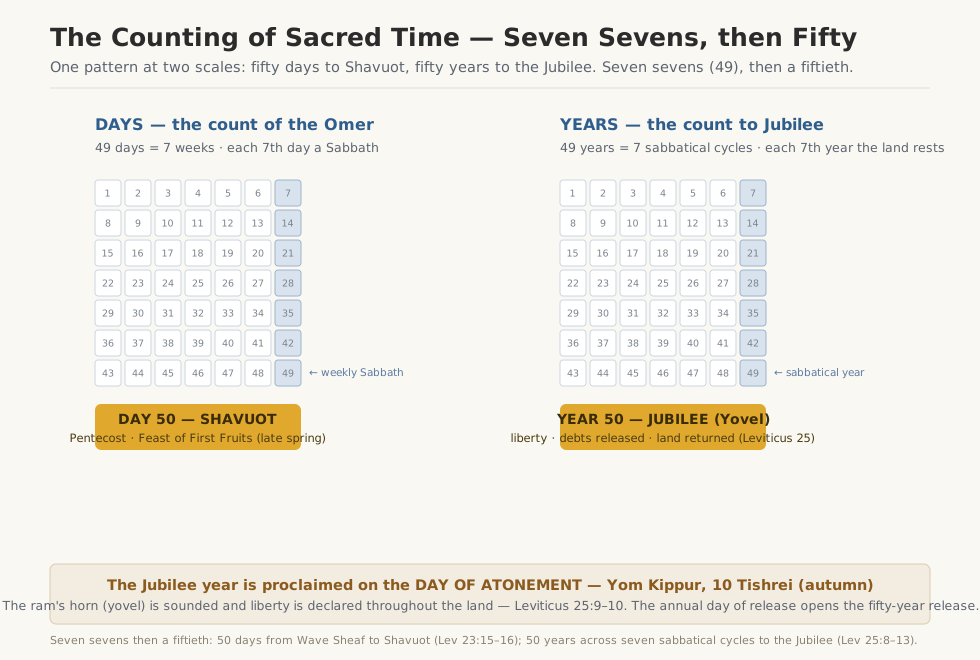
Ancient sacred calendars are built on counting, and two numbers recur: seven and fifty. Seven gives the week and the Sabbath. Fifty appears twice over, at two scales — fifty days and fifty years — and though the two are separate festivals in separate seasons, they are deliberately the same shape: seven sevens, then a fiftieth. Understanding that nested rhythm, and the calendar frame it runs on, is the spine of everything below.
2. The frame: a lunisolar calendar
The Hebrew calendar keeps two clocks at once. The months follow the Moon — each begins at the new moon, so a month runs about 29–30 days and a year of twelve months is roughly 354 days. But the festivals must stay in their seasons, which follow the Sun — Passover in spring, the ingathering in autumn. Twelve lunar months fall about eleven days short of the solar year, so left alone the festivals would drift backward through the seasons. To prevent that, a whole leap month is added seven times in every nineteen years (the Metonic cycle), which pins the festivals to their seasons. The calendar is therefore Moon-for-months, Sun-for-seasons, corrected by intercalation.
One feature matters for what follows: the calendar has two new years. Nisan, in spring, is the first month — the head of the festival calendar and the count from which the spring feasts run. Tishrei, in autumn, holds Rosh Hashanah, the new year for counting years — the civil and agricultural reckoning on which the sabbatical and Jubilee cycles turn. So the fifty-day count hangs off the spring new year, and the fifty-year count off the autumn one. Two anchors, two seasons, one calendar.
3. The fifty-day count: spring
From the day after the sabbath in Passover week, the Torah commands a count: seven full weeks, forty-nine days, and the fiftieth day is a holy convocation (Leviticus 23:15–16). That fiftieth day is Shavuot — the Feast of Weeks, the Feast of Harvest, the Day of First Fruits — falling on 6 Sivan, in late spring. The count spans the grain harvest: barley at Passover, wheat gathered seven weeks later.
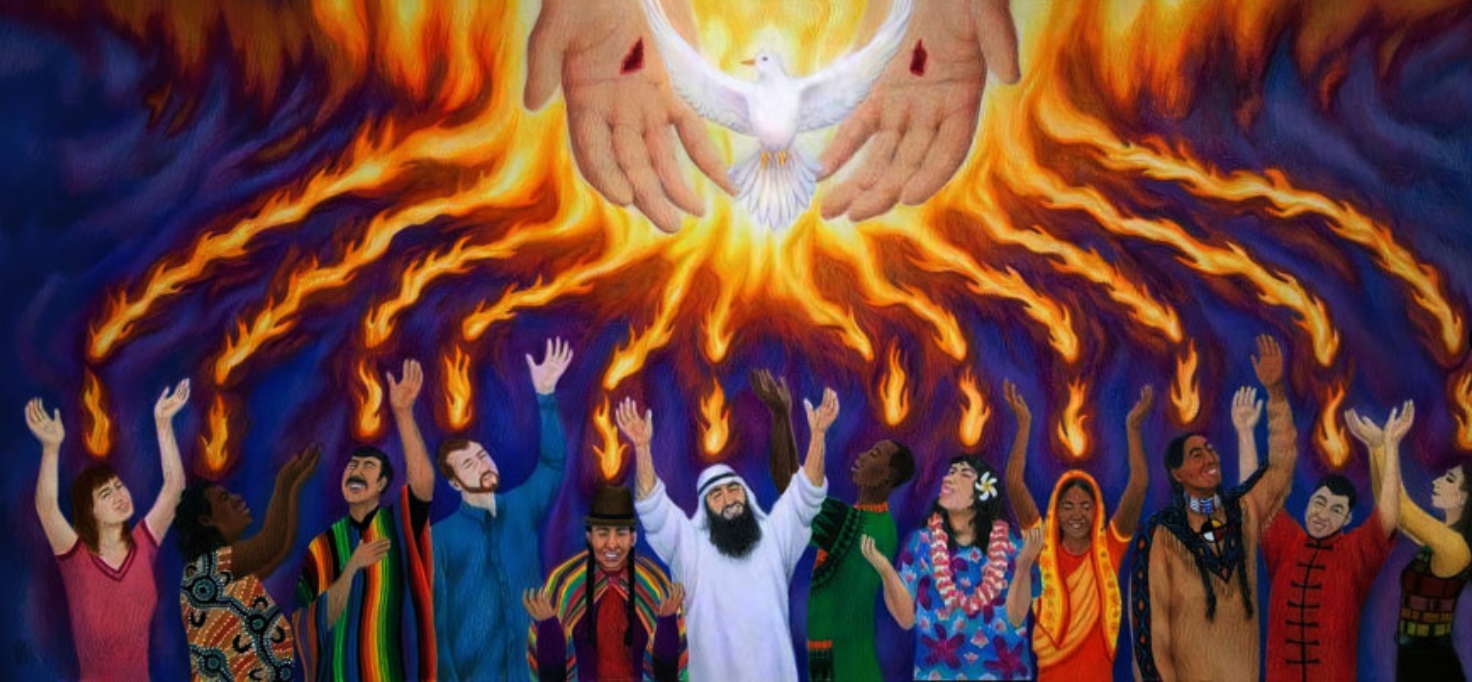
The Greek-speaking world called the fiftieth-day festival Pentecost — pentēkostē, "fiftieth." In Acts 2, Jesus' followers are gathered for it when a sound like a rushing wind fills the house, tongues as of fire rest on each, and they speak in other languages. The church kept the name but later counted its fifty days from Easter, so Christian Pentecost falls between about 10 May and 13 June; in England it became Whitsunday, for the white garments of the newly baptised. Shavuot, Pentecost, and Whitsunday are, in origin, one festival under three names.
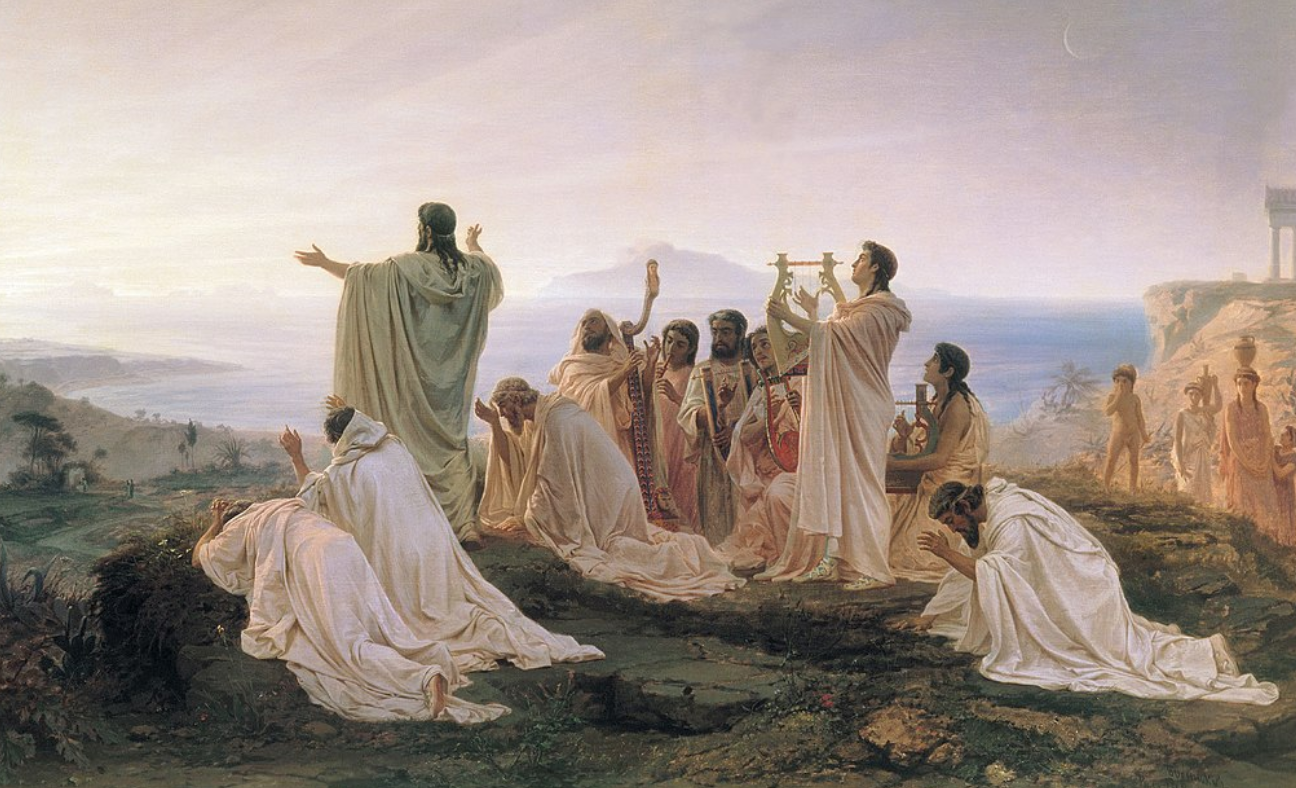
The count could also repeat. In the Qumran (Essene) calendar of the Temple Scroll, three fifty-day festivals ran in sequence — New Wheat (Shavuot), then New Wine, then New Oil, each fifty days after the last — an extended jubilee of fifties through the season.
4. The Day of Atonement and the fifty-year Jubilee
The other fifty belongs to autumn. Its pivot is the Day of Atonement (Yom Kippur), the 10th of Tishrei — the holiest day of the Hebrew year (Leviticus 16; 23:26–32). A day of fasting and self-affliction, a Sabbath of Sabbaths, it was the one day a year the high priest entered the Holy of Holies to make atonement for the whole nation, with the two goats: one offered, and one — the scapegoat — sent into the wilderness bearing the people's sins. Its meaning is cleansing and release.
On that day, in the fiftieth year, the Jubilee was proclaimed. Seven sabbatical cycles are counted — seven times seven years, forty-nine — and the fiftieth year is hallowed (Leviticus 25:8–13). It is announced by sounding the yovel, the ram's horn, on the Day of Atonement, when "liberty is proclaimed throughout the land" (Leviticus 25:9–10): debts released, indentured people freed, land returned to its families, and the ground left to rest. The Septuagint uses the same word, pentēkostē, for this fiftieth year as for the fiftieth day — the two fifties are, linguistically, one number.
The autumn month is dense: Tishrei also holds Rosh Hashanah (the new year) and, five days after the Day of Atonement, Sukkot — the Feast of Tabernacles, the ingathering that closes the fruit harvest. Where Passover-to-Shavuot brackets the spring grain harvest, the Tishrei feasts bracket the autumn ingathering.
5. One rhythm, nested: the week written large
Seen together, the counts are a single pattern repeated at rising scales. The 7th day is the Sabbath. The 50th day is Shavuot. The 7th year is the Sabbatical (Shmita), when the land itself rests and debts are released. The 50th year is the Jubilee. Seven, then seven-times-seven-plus-one — the same figure at the scale of days and again at the scale of years. The Jubilee is, in effect, a Sabbath of years: the nation keeps a week-of-years rhythm just as a person keeps a week-of-days rhythm.
The honest direction of this is worth stating, because it is the stronger claim. The sabbatical and Jubilee counts are built from the seven-day week, not the origin of it — Leviticus reasons from the week outward ("as the land keeps a sabbath"). The week is the seed; the Sabbatical year and the Jubilee are that seed grown to the scale of years and half-centuries. The seven-day cycle itself is older and separate, its roots usually traced to the seven "wandering" bodies visible to the naked eye — the Sun, the Moon, and the five bright planets — which is why the days still bear their names. The calendar takes that inherited unit and propagates it, deliberately, across every scale of time.
6. Fifty beyond Israel
The number fifty, and its root of seven times seven, carried weight in several civilisations — but, importantly, for different reasons, arrived at independently. That distinction matters, and it is drawn at the end of this section.
Mesopotamia. In Sumerian and Babylonian numerical theology, the great gods were assigned sacred numbers on a descending scale — Anu 60, Enlil 50, Ea/Enki 40, Sin 30. Fifty was Enlil's number, the number of the chief god. When Babylon's priests raised their own god Marduk to the head of the pantheon, the creation epic Enuma Elish crowns him with fifty names, and the god-list An = Anum explicitly assigns Enlil's number 50 to Marduk — a deliberate signal that the kingship of the gods had passed to him. Here fifty marks supreme rank, in a base-60 system, not a harvest count.
China. The Yijing (I Ching) calls fifty "the number of the Great Expansion" (dayan zhi shu). In the ancient yarrow-stalk divination, the diviner takes fifty stalks, sets one aside as the still centre, and works with the remaining forty-nine to build a hexagram. The formal echo of the Hebrew structure is striking — fifty as the whole, forty-nine in play — but the two traditions developed it independently from their own cosmologies, with no evidence of contact, which makes the parallel a convergence on a natural number-structure, not a shared source.
Greece and Rome. Pentēkostē ("fiftieth") is itself Greek. Fifty recurs as a round, complete number in Greek myth — the fifty Danaids, the fifty Nereids, the fifty rowers of a penteconter — more a conventional "large whole" than a sacred count. Rome later inherited the Hebrew Jubilee directly: the Christian Holy Year was first proclaimed by Boniface VIII in 1300 and set by Clement VI at fifty-year intervals, before being shortened to twenty-five.
Elsewhere. In Islamic tradition, the Night Journey (Mi'raj) tells of fifty daily prayers reduced to five, and the Day of Judgment is described as lasting fifty thousand years (Qur'an 70:4). In Tantric Hindu tradition, the roughly fifty letters of the Sanskrit alphabet are mapped to the fifty petals of the six lower chakras.
What this does and does not show. Fifty is a genuinely notable cross-cultural number — but its weight arises independently in each place: a sabbatical count in Israel, a rank-number in Mesopotamia, a divination cosmology in China, a round whole in Greece, and direct inheritance in Christian Rome. That several roads lead to fifty says more about fifty being a natural, memorable number — and about seven-times-seven being an obvious structure to build — than about any single hidden signal behind them all. The Hebrew-to-Christian Jubilee is a real line of transmission; the rest is convergence, and honesty requires keeping those two apart.
7. Sirius and the Egyptian year
Egypt kept a different marker, and hung its year on a star. The heliacal rising of Sirius — Sopdet to the Egyptians, Sothis to the Greeks — is the star's first reappearance at dawn after a season lost in the Sun's glare. That rising opened the Egyptian year: it was, in the ideal calendar, day one, the first of the month of Thoth, kept as the festival prt Spdt, "the Going Forth of Sopdet." And it fell close to the annual flooding of the Nile, the event on which Egyptian life depended. Sirius at dawn announced the flood, the renewal of the fields, the restarting of the year. Sopdet was identified with Isis.
Two features are well documented. The date shifts with latitude — the rising is seen on different days along the Nile — and it drifts against the fixed civil calendar over centuries, because the Egyptian 365-day year had no leap day. That drift is the ~1,461-year Sothic cycle: the rising slowly parted from its ideal date of 1 Thoth as the centuries passed. Sirius was, for Egypt, the most reliable herald of the season — a precise sky-to-earth clock for the flood and the year.
7.1 The seventy days in the Duat
The rising carried Egypt's central theme of death and rebirth, and this is where the Duat — the underworld — enters. Each year Sirius vanished from the sky for about seventy days, lost in the Sun's glare, and the Egyptians read this absence as the star's passage through the Duat. The Carlsberg I papyrus describes Orion and Sopdet as gods who spend seventy days in the Duat and rise again — the heliacal rising as a resurrection, the star returning from the underworld to renew the land.
That seventy-day descent was mirrored on earth. Embalming and mummification traditionally took about seventy days, explicitly modelled on the star's journey, so that the dead followed Sopdet's path through the Duat; the same texts say a star's burial is performed "in the same way as men's." Sopdet (Sirius) was Isis, Sah (Orion) was Osiris, and their son Horus — the triad whose myth of death and resurrection the rising re-enacted, Osiris restored by Isis. The rising was not only a calendar marker but a yearly enactment of return.
8. Stone and light: the Sun made permanent
Egypt's supreme deity was the Sun itself, deified. Ra was not a god merely associated with the Sun — he was the daytime Sun, the creator and king of the gods, who rose each dawn from the primeval waters. His journey is the Sun's: by day he sails the sky in his barque; by night he passes through the Duat, battling the serpent Apophis, and is reborn at dawn — sunrise as a daily resurrection, the same death-and-return the star kept yearly. His cult centre was Heliopolis, the "City of the Sun"; over time he merged into Amun-Ra and Ra-Horakhty, and pharaohs styled themselves "Son of Ra."
The obelisk is the monument of this cult, and the Egyptians told us what it was: a ray of the Sun turned to stone. Its shaft rises to a small pyramid, the benben or pyramidion, often sheathed in gold or electrum to blaze in the first and last light. Raised at Heliopolis and dedicated to Ra, the obelisk is the first sunrise made vertical and permanent; some also served as gnomons, casting a shadow that tracked the Sun across the day and year. The ray the ancients honoured in stone was, by their own account, the Sun's.
9. Eyes to the sky, and Sirius across cultures
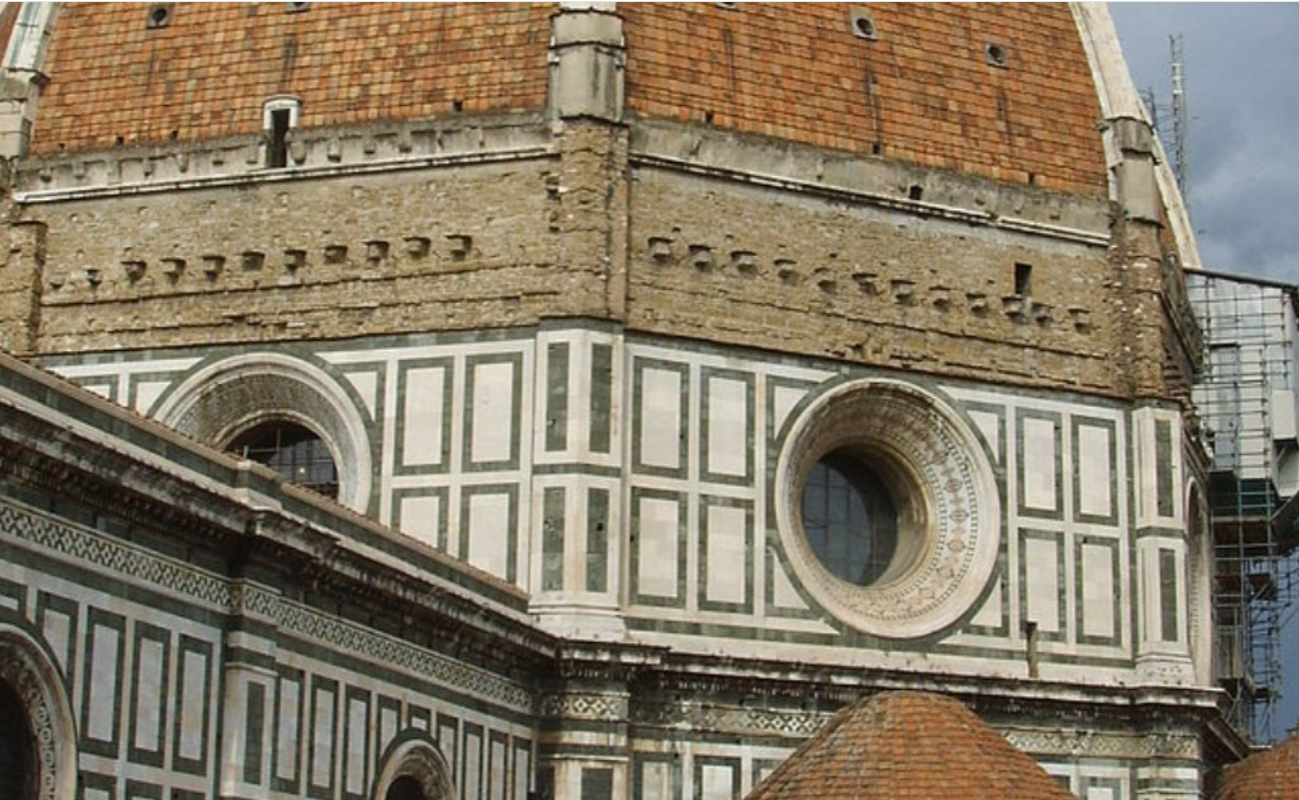
Sacred buildings were pierced with openings to the heavens and oriented to the sky. The Pantheon carries an open oculus whose disc of sunlight tracks the interior and falls on the doorway around the April equinox. Newgrange admits sunrise into its inner chamber only at the winter solstice; Abu Simbel lights its sanctuary on two days a year; a gnomon in Brunelleschi's dome over Florence Cathedral drops a spot of noon sunlight onto a meridian line near the summer solstice — a solar observatory built into a church. In every case that can be tested, these apertures admit the Sun, on solar dates.
Sirius itself recurs beyond Egypt. Sirius A and Sirius B form a binary with a ~50-year orbital period (Sirius B is a white dwarf, invisible to the naked eye, discovered only in 1862). Among the Dogon of Mali, the ethnographers Griaule and Dieterlen recorded traditions of a companion to Sirius and a roughly fifty-year period, alongside the Sigui ceremony held about twice a century — how that material should be interpreted remains a genuine, open puzzle in the anthropology of astronomy.
10. The Great Year
Above the annual cycle sits a slow one. Earth's axis wobbles, completing a full circuit — the precession of the equinoxes — in about 25,772 years. Divided into twelve, this gives the ~2,160-year "ages" (Pisces, Aquarius, and so on). This "Great Year" is real astronomy, and the longest cycle the ancients could, in principle, have tracked through the slow shift of the stars against the seasons.
11. The author's hypothesis — a Sirian pulse
The following is the author's hypothesis. It is not part of the documented record above, and it is presented as a proposal for inquiry, not as established fact.
The author holds that the observances in Sections 1–9 are more than solar, lunar, and agricultural clocks — that they track a recurring pulse of energy reaching Earth from the Sirius system, and that the ancients built their festivals and monuments to anticipate and receive it. In this view:
- The Holy Spirit of Pentecost — arriving as wind and fire, conferring the gift of tongues and a lifting of the spirit — is the human experience of such a pulse at a known, counted moment.
- The pulse is proposed to arrive at nested intervals — weekly, yearly, every fifty years (the great pulse, the Jubilee), and across the ~2,000-year ages — set by the orbits and alignments of the Sirius system, including a proposed, as-yet-unconfirmed third star.
- The precise counting of the calendar — seven sevens to the fiftieth — is read, in this hypothesis, as the method by which the day of the pulse was tracked and kept.
- The author proposes that the strength of the pulse has varied over long time, and reads the ancients' art, language, and religion as designed to preserve the memory of it.
These claims are the author's, offered to open a line of inquiry. The physical mechanism — how energy from an 8.6-light-year-distant star would reach Earth on a weekly, annual, or fifty-year schedule — is not established by current physics, and the third star is not confirmed by current astronomy. The hypothesis is recorded here as a hypothesis. The documented record in Sections 1–9 stands independently of it, and does not depend on it being true.
References
- Lunisolar Hebrew calendar; lunar months, solar seasons, and the nineteen-year (Metonic) intercalation; Nisan and Tishrei as two new years — standard calendrical reference.
- Fifty-day count to Shavuot — Leviticus 23:15–16; Deuteronomy 16:9–10; names in Exodus 23:16 and Numbers 28:26; date 6 Sivan.
- Pentecost = "fiftieth" (Greek pentēkostē); Acts 2:1–4 (wind, fire, tongues); Whitsunday and the white baptismal garments.
- Qumran / Essene stacked fifty-day festivals (New Wheat, New Wine, New Oil) — Temple Scroll; Dead Sea Scrolls scholarship.
- Day of Atonement — Leviticus 16; 23:26–32 (fasting, the high priest, the two goats).
- Jubilee (Yovel), the fiftieth year, proclaimed on the Day of Atonement by the ram's horn — Leviticus 25:8–13; sabbatical year (Shmita) — Leviticus 25:1–7, Deuteronomy 15; pentēkostē for the fiftieth year in the Septuagint (Leviticus 25:10).
- Origin of the seven-day week in the seven naked-eye "wandering" bodies; the planetary day-names — history-of-astronomy sources.
- Egyptian new year on the heliacal rising of Sirius (Sopdet/Sothis); 1 Thoth and prt Spdt; the Nile flood; identification with Isis; the ~1,461-year Sothic cycle; latitude dependence and calendar drift — Egyptological and archaeoastronomical sources.
- The seventy-day "Duat" absence of Sirius and its identification with the ~70-day mummification period; the Carlsberg I papyrus; the Sopdet–Isis / Sah(Orion)–Osiris / Horus triad.
- Ra as the deified Sun; Heliopolis; the solar barque and nightly passage through the Duat; the obelisk as a "petrified sunbeam," the benben/pyramidion, and its use as a gnomon — Egyptological sources.
- Celestial architecture — Pantheon oculus; Newgrange (winter solstice); Abu Simbel; Toscanelli's gnomon in Brunelleschi's dome, Florence — archaeoastronomy sources.
- Sirius A/B binary, ~50-year orbit; Sirius B a white dwarf discovered 1862 — standard stellar astronomy.
- Dogon Sirius traditions — Griaule & Dieterlen; the Sigui ceremony; and the scholarly debate over interpretation.
- Precession of the equinoxes, ~25,772-year Great Year, and the ~2,160-year ages — standard astronomy.
About this memo.This memo is authored under the direct editorial direction of Brett Murrell, drafting and citation handling AI-assisted. The reasoning and the conclusions are the author's. The documented record (Sections 1–9) is distinguished throughout from the author's hypothesis (Section 10), which is presented as a hypothesis for inquiry rather than established fact. This methodology is disclosed openly so readers can weigh the work on its merits.
Cite this memo.Murrell, B. (2026). *Sacred Time — Seven, Fifty, and the Rising of Sirius* (working draft). v0.2 (4 July 2026).