The Julian Web: Six Houses and the Name of Caesar
The series in charts: every house that carried the name Julius in the first century, the marriages that joined them, the high priests the Herodian kings appointed, and the single male line that ran from Caesar’s grant to a Roman consulship.
Reading note. This is the summary memo of the series. Each claim here is argued, with its passages, in the memo named beside it: The Julii for the gens, The Julii of Rome for Octavian’s blood and Antonia’s household, The Julii of Judaea for Herod’s house, and The Julii of Alexandria for the alabarch’s.
1. The numbers
- Caesar’s citizenship grant to Antipater, the founding act of Herod’s Julii: 47 BC.
- Marriages in the record between Herod’s line and another Julius house: four, into Alexandria, Emesa twice, and Commagene.
- Years the house of Annas held the high priesthood: about thirty-four; the house of Boethus, about thirty, counting Joazar’s second term.
- Consulship of Gaius Julius Alexander Berenicianus, Herod’s descendant: AD 116 or 117, under Trajan.
- Children of both a Herodian and an Alexandrian parent in the record: one, Agrippinus.
- Span of the wall chart: eight dated generations, c. 100 BC to the third century.
2. The six houses
Julius was the family name of every person enfranchised by Caesar, Augustus or Tiberius, and of every slave they freed. In the first century it was carried by at least six houses of rank. The table gives each, with how and when the record first shows the name.
| House | Region | How it held the name | First attested |
|---|---|---|---|
| Julii Caesares | Rome | Birth; later emperors by adoption | ancient |
| Herod’s house | Judaea | Caesar’s grant to Antipater | 47 BC |
| Juba II and Selene | Mauretania | Citizenship grant | by 25 BC |
| The alabarch’s house | Alexandria | Grant; date and grantor unrecorded | by c. AD 15 |
| Royal house of Emesa | Syria | Grant; date and grantor unrecorded | by AD 14–42 |
| Royal house of Commagene | Anatolia | Citizenship grant | by AD 38 |
The last male Julius Caesar recorded in high office is Lucius Julius Caesar, consul in 64 BC, who died about 40 BC. Every later Roman “Julius” of the imperial house held the name by adoption. The Eastern houses held it by law. None held it by descent from Caesar.
3. The chart
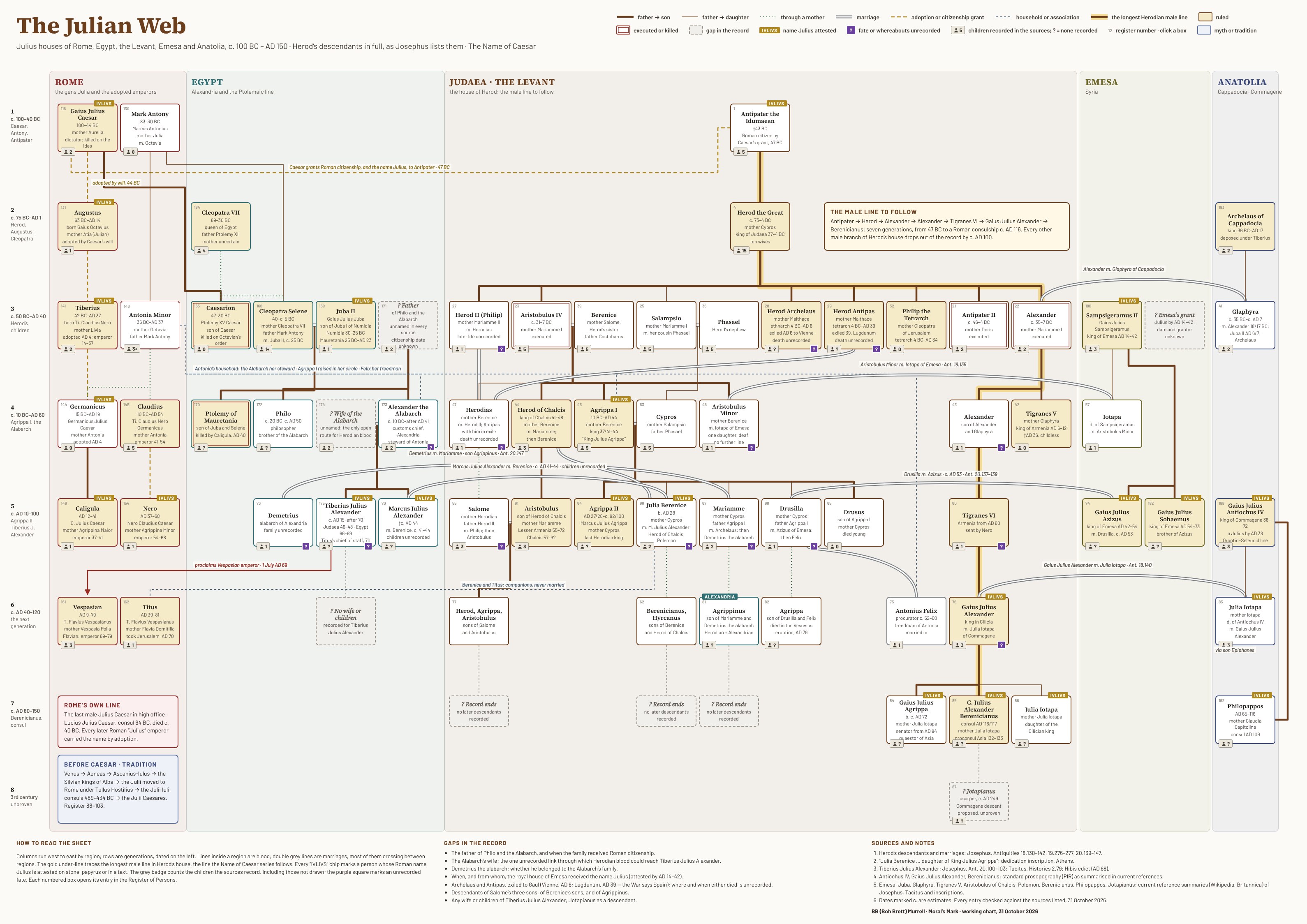
The wall chart sets the houses west to east, Rome to Anatolia, across eight dated generations. Lines inside a region are blood; double grey lines are marriages, most crossing between regions. A gold underline traces the longest Herodian male line. Dashed boxes mark the gaps; a purple square marks a person whose fate or whereabouts the record does not give.
4. The male line
Herod’s house kept a line passing father to son for seven generations. It runs through Alexander, the son Herod executed, and his Cappadocian wife Glaphyra, to the kings of Armenia and Cilicia and a consul of Rome. Every other male branch of the house leaves the record by about AD 100.
5. The marriage web
The houses met by marriage and in one household. Every link in the record is below, with its date and passage. The Antonia link is a household, not a marriage, and is set out in The Julii of Rome, section 10.
| Link | Type | Date | Source |
|---|---|---|---|
| Caesar → Antipater | Citizenship grant | 47 BC | 42.2.1.194 |
| Alexander m. Glaphyra | Herod–Cappadocia | c. 18/17 BC | 42.1.16.11 |
| Antonia’s household | Alabarch, Agrippa I, Felix | c. AD 20s–40s | 42.1.19.276 |
| Marcus Julius Alexander m. Berenice | Alexandria–Herod; children unrecorded | AD 41–c. 44 | 42.1.19.277 |
| Demetrius m. Mariamme | Alexandria–Herod; son Agrippinus | unrecorded | 42.1.20.147 |
| Aristobulus Minor m. Iotapa | Herod–Emesa | unrecorded | 42.1.18.135 |
| Drusilla m. Azizus | Herod–Emesa | c. AD 53 | 42.1.20.139 |
| Berenice m. Polemo | Herod–Cilicia; she left him | after AD 48 | 42.1.20.145 |
| Gaius Julius Alexander m. Iotapa | Herod–Commagene | c. AD 58 | 42.1.18.140 |
Alexandria and Commagene are attested as Julii before their first recorded marriage into Herod’s line. For Emesa the order cannot be fixed: its kings bear the name by AD 14–42, and Iotapa’s marriage to Aristobulus Minor is undated; Drusilla’s marriage to Azizus, c. AD 53, comes after. What the marriages show is that the Julius houses of the East married one another.
6. The high priests, 63 BC – AD 70
Herod ended the hereditary Hasmonean high priesthood and chose priests “of no eminent families” (42.1.20.247). From then until the Temple fell the office went to whoever the ruling power favoured. The chart shows every tenure by house; hovering a bar names the priest and who appointed him.
Herod and Archelaus drew on the house of Boethus, Alexandrian by origin and Herod’s in-laws through Mariamme II. Rome’s governors drew mostly on the house of Annas. Agrippa I, Herod’s grandson, returned the office to Boethus. The count from Herod to 70 matches Josephus’s twenty-eight only when the one-day substitute is included (42.1.20.250). The full list from Zadok under Solomon is on the High Priests register.
| # | High priest | Term | House | Appointed by |
|---|---|---|---|---|
| — | Hyrcanus II | 63 BC–40 BC | Hasmonean | Pompey |
| — | Antigonus II | 40 BC–37 BC | Hasmonean | the Parthians |
| 1 | Ananelus | 37 BC–36 BC | Other | Herod |
| 2 | Aristobulus III | 36 BC–35 BC | Hasmonean | Herod |
| — | Ananelus, again | 35 BC–30 BC | Other | Herod |
| 3 | Joshua ben Fabus | 30 BC–23 BC | Phiabi | Herod |
| 4 | Simon ben Boethus | 23 BC–5 BC | Boethus | Herod |
| 5 | Matthias ben Theophilus | 5 BC–4 BC | Other | Herod |
| 6 | Joseph ben Ellemus (one day) | 5 BC | Other | substitute |
| 7 | Joazar ben Boethus | 4 BC | Boethus | Herod |
| 8 | Eleazar ben Boethus | 4 BC–3 BC | Boethus | Archelaus |
| 9 | Joshua ben Sie | 3 BC–1 BC | Other | Archelaus |
| — | Joazar ben Boethus, again | 1 BC–AD 6 | Boethus | unclear |
| 10 | Ananus ben Seth (Annas) | AD 6–AD 15 | Annas | Quirinius |
| 11 | Ishmael ben Fabus | AD 15–AD 16 | Phiabi | Gratus |
| 12 | Eleazar ben Ananus | AD 16–AD 17 | Annas | Gratus |
| 13 | Simon ben Camithus | AD 17–AD 18 | Kamith | Gratus |
| 14 | Joseph Caiaphas | AD 18–AD 36 | Annas | Gratus |
| 15 | Jonathan ben Ananus | AD 36–AD 37 | Annas | Vitellius |
| 16 | Theophilus ben Ananus | AD 37–AD 41 | Annas | Vitellius |
| 17 | Simon Cantheras | AD 41–AD 43 | Boethus | Agrippa I |
| 18 | Matthias ben Ananus | AD 43–AD 43 | Annas | Agrippa I |
| 19 | Elioneus ben Cantheras | AD 43–AD 44 | Boethus | Agrippa I |
| 20 | Joseph ben Camydus | AD 44–AD 46 | Other | Herod of Chalcis |
| 21 | Ananias ben Nedebaeus | AD 46–AD 58 | Other | Herod of Chalcis |
| 22 | Ishmael ben Fabus II | AD 58–AD 61 | Phiabi | Agrippa II |
| 23 | Joseph Cabi | AD 61–AD 62 | Other | Agrippa II |
| 24 | Ananus ben Ananus | AD 62–AD 62 | Annas | Agrippa II |
| 25 | Jesus ben Damneus | AD 62–AD 63 | Other | Agrippa II |
| 26 | Jesus ben Gamaliel | AD 63–AD 64 | Other | Agrippa II |
| 27 | Matthias ben Theophilus II | AD 65–AD 66 | Other | Agrippa II |
| 28 | Phannias ben Samuel | AD 67–AD 70 | Other | the Zealots, by lot |
7. What the web shows
The series opened on a question: did the name Julius pass between these houses by blood? Set on one sheet, the record answers in parts.
- Carried. Herod’s line held the name from 47 BC to a consulship under Trajan, by Caesar’s grant.
- Carried. Herod’s line married into three other Julius houses, and produced kings and a consul.
- Not carried. Alexandria and Commagene held the name before any recorded Herodian marriage; for Emesa the order is undated.
- Not carried. No Herodian ancestor is recorded for the Alexandrian, Emesene or Commagenian Julii.
- Open. The alabarch’s wife; Demetrius’s family; the date of Iotapa’s marriage into Herod’s line.
The open items are the ones a single new document could close. An inscription naming the alabarch’s wife, or a papyrus dating the Emesene grant, would move a line on this chart from dashed to solid, or remove it.
8. The gaps
- Archelaus and Antipas, the two sons of Herod exiled to Gaul — Archelaus to Vienne in AD 6, Antipas to Lugdunum in AD 39 (the War says Spain). Where and when either died is unrecorded (42.1.17.344; 42.1.18.252; 42.2.2.183).
- The father of Philo and the alabarch, and when that family became Roman citizens.
- The alabarch’s wife, the one unrecorded parent through whom Herodian blood could reach Alexandria early.
- When, and from whom, the house of Emesa received the name Julius.
- The descendants of Salome’s sons, of Berenice’s sons by Herod of Chalcis, and of Agrippinus.
- Any wife or children of Tiberius Julius Alexander.
- Jotapianus, usurper about AD 249, claimed as a descendant of the Commagenian line: proposed, unproven.
9. Sources
Reference codes read source.work.passage and resolve on the Master Source Register, which carries every source used across this series.
- Josephus 42.1 Antiquities of the Jews and 42.2 The Jewish War — the grant (42.2.1.194); Herod’s descendants and their marriages (42.1.18.130–142; 42.1.20.139–147); the alabarch’s house (42.1.19.276–277); the high priests (42.1.15–20, with the summary at 42.1.20.224–251; 42.2.4.155). Sections 2–6. Master register 42.
- Tacitus 41.1 Annals — Tigranes VI placed in Armenia, AD 60 (41.1.14.26). Section 4. Master register 41.
- The imperial fasti and inscriptions 34.2 — the consulship of Berenicianus. Section 4. Master register 34.
- The Greek epigraphic corpora 52.1 — the Athens dedication to “Julia Berenice”; the Commagenian and Emesene royal names. Section 2. Master register 52.
- The modern prosopography 96.3 — the Eastern royal houses (Emesa, Commagene, Mauretania) as given in the standard prosopography and current reference summaries; modern reconstruction, not ancient testimony. Section 2. Master register 96.
- Lost sources — the Memoirs of King Herod (43); Justus of Tiberias (44), whose chronicle ran to the death of Agrippa II; the commentaries of Vespasian and Titus (97).
- Verification register. The chart and tables summarise the four companion memos and carry their verification registers. Particular to this memo: the first-attestation dates for Emesa (by AD 14–42), Commagene (by AD 38) and Mauretania (by 25 BC) follow current reference summaries and are to be checked against the inscriptions and coins; the marriage dates c. AD 53 and c. AD 58 are estimates; the high-priest terms are modern estimates from Josephus’s order of appointment and differ between lists by about a year, notably for AD 62–64; the Boethus family’s Alexandrian origin rests on 42.1.15.320; the Glaphyra marriage passage (42.1.16.11) and date are to be checked; and Jotapianus’s descent is a modern proposal.
Murrell, B.B. (2026). The Julian Web: Six Houses and the Name of Caesar. Moral’s Mark — MMM Memo Series, The Caesar–Cleopatra Period Claimants Thread, v1.0 (31 October 2026). https://moralsmark.com/memo-julian-web