What Is Intelligence?
Humans have two abilities, the mind and the awareness that remains when the mind is quiet. SI has the first and, on present evidence, not the second.
Since an executive order of 29 September 2026, the United States government calls artificial intelligence “super intelligence”. A comparison needs a measure, so this memo first sets out what intelligence is, from SI test results, brain research on memory and time, and the Eastern and Western traditions of training the mind.
It proposes two legs. The mind stores, reasons and builds past and future from memory. No-mind is the awareness that remains when that activity stops, described by Patanjali, Zen and the Tao and measured in meditators. SI is a mind, larger and faster than ours on much of what minds do, with no demonstrated no-mind.
Eight factors are drawn together in section 14, with consciousness, not yet explained, beneath them all. No accepted test for awareness in a machine exists. Part 2 turns the legs into grades; Part 3 decides who has authority.
Draft. Published for review. Sources and figures not yet checked against the original are listed in section 15, Open checks.
Reading note. The two-leg account of intelligence is the author’s proposal. Where the memo states it, it says so. Where science or a tradition supports a part of it, the source is named, and where they disagree, both are given.
“SI” is used throughout for what was called AI, following the US government usage adopted in September. No claim about SI’s abilities in this memo comes from what an SI says about itself; it comes from test results. Figures are dated, because they change with every model release.
1. The numbers
- SWE-bench Verified, a software-repair test: top SI scores rose from about 60% in 2024 to nearly 100% in 2025.
- Emotional-intelligence tests: six SI models averaged 82% correct, humans 56%.
- Expert reports judged blind by professionals in 44 occupations: SI matched or beat the expert 40.6% to 49% of the time.
- Long tasks: frontier SI is four-fifths reliable only on tasks that take a human one to three hours.
- About 86 billion neurons in the human brain.
- About 100 million words heard by a child by age ten; about 15 trillion tokens used to train one SI model.
- About 3,600 meditators surveyed on awareness without thought; twelve features identified.
- Patanjali’s definition of yoga, Yoga Sutra 1.2: the stilling of the mind’s movements.
2. What SI can do today
On 29 September 2026 the President of the United States signed an executive order, “Inaugurating the Era of Super Intelligence”, directing every executive-branch department and agency to use “Super Intelligence” and “SI” in place of “Artificial Intelligence” and “AI” in correspondence, public communications and policy documents. The White House gave the reason as recognising “the continuously advancing technological frontier”. This series uses SI because the order made it the official term.
The word claims more than the record shows. Intelligence has many traits, and on the measured results below SI leads by a wide margin on some and falls well short of humans on others. It is super in places and weak in others. This memo sets out what intelligence is, so that the claim can be graded trait by trait in Part 2.
The Stanford AI Index 2026 reports that top models meet or exceed human baselines on doctoral-level science questions, multimodal reasoning and competition mathematics. The same report names the pattern underneath: a “jagged frontier”, very strong in some places and weak in others.
The weak places are specific. Robots complete about one household task in eight. On ARC-AGI-3, released in March 2026, a solver is dropped into a game with no instructions and must work out the goal by trial. Gemini 3.1 Pro scored 0.37%, GPT 5.4 0.26%, Claude Opus 4.6 0.25% and Grok 4.20 zero. Human testers solved every environment.
Seven months later the gap had narrowed but not closed. On ARC Prize’s standard test harness in October 2026, GPT-6 Astra scored 62.7% and Claude Opus 5 30.2%. Changing only the harness around one model, with no change to the model, raised its score from 7.8% to 38.3%. The $700,000 grand prize, for human-level performance on the private set, is unclaimed.
| Test | What it measures | Humans | Best SI |
|---|---|---|---|
| SWE-bench Verified | Fixing real software faults | — | Near 100% |
| Emotional-intelligence tests | Choosing the right response, on paper | 56% | 82% |
| GDPval | Expert reports, judged blind | Yardstick | 40.6–49% |
| Remote Labor Index | Paid freelance jobs to client standard | Yardstick | 16.1% |
| Household robot tasks | Physical work in a home | — | 12% |
| ARC-AGI-3 | A new game, no instructions | All solved | 0.37% (Mar); 62.7% (Oct) |
Dates: SWE-bench 2025; EQ tests May 2025; GDPval September 2025; Remote Labor Index July 2026; robots AI Index 2026; ARC-AGI-3 March 2026 (launch) and October 2026 (standard-harness leaderboard). Higher figures exist on the public games and under other harnesses — up to 99.95% for the GPT-6 family on ARC Prize’s results page (99.9% for GPT-6 Astra on the Provider Adapter harness, a connection built by the model’s maker), 97.5% for Gemini 4 Argon on its own Provider Adapter (verified 16 October 2026; 49.8% on the standard harness), and 98.98% self-reported by the Schema project on the 25 public games — and are not comparable with the standard-harness scores.
Three limits apply to every figure in the table. One popular mathematics benchmark carries a 42% error rate in its answer key. Models can score well by having seen the test during training. And a high benchmark score does not carry over reliably to real work, which is why the freelance figure is so far below the exam figures.
The pattern is consistent across the table. SI scores high where the question is set and the answer can be checked. It scores low where the task is open, physical or never seen before. A memo that asks whether SI is “super” has to say super at which of these, because the answer differs by row.
3. The mind, memory and time
Osho called the human mind a biocomputer: a machine for storing, recalling and reasoning, run on biology. Brain research supports one part of that description directly. The same network that recalls the past also builds the future. Schacter and Addis named the process constructive episodic simulation: the brain assembles both from stored fragments.
The evidence comes from damage. Patients whose hippocampus is destroyed lose their past, and they also lose the ability to imagine a new future scene (Hassabis and colleagues, 2007). Memory is the raw material of the future as well as the record of the past. Past and future, as lived, are built by the mind out of what it has stored.
That building runs most of the time. Killingsworth and Gilbert sampled 2,250 people through their phones and found their minds wandering away from the present activity 46.9% of the time. People reported being less happy while their minds wandered. The network responsible is the default mode network, active during self-talk, memory and planning.
The author proposes that creating time is a function of the mind. Past and future, as lived, exist only where a mind builds them from memory; without that building there is only the present. On this view an animal has a mind, but of a different design, with far less of the part that builds time. It lives mostly in the present: it may plan ahead and remember the past, but no animal is known to keep a calendar or celebrate a birthday.
The evidence supports most of this. No animal is known to keep a calendar or mark an anniversary, and the mainstream view is that full mental time travel is far more developed in humans than in any other species (Suddendorf and Corballis, 2007).
Some animals build a little time. Scrub jays remember what they hid, where and when (Clayton and Dickinson, 1998), and store food for a breakfast they will need (Raby and colleagues, 2007). Apes save a tool for the next day (Mulcahy and Call, 2006), and ravens plan for tool use and barter (Kabadayi and Osvath, 2017).
The author separates two kinds of time. The first is solar time: the daily rhythm set by the Earth turning against the Sun. Nearly all life runs on it. Body clocks with a cycle close to 24 hours are found in cyanobacteria, plants, animals and humans, and daylight resets them each day.
Solar time is built in. Its clock genes were identified in fruit flies by Hall, Rosbash and Young, who received the 2017 Nobel Prize in Physiology or Medicine for the work. Birds also inherit the timing and direction of their migration. Solar time runs on the code, not on a mind.
The second kind is mind time: a past and a future built from memory. Humans run on both kinds; an animal runs mainly on the first, with a little of the second.
SI runs on a third kind: the computer clock. A quartz oscillator in the processor times every operation, billions of cycles a second, and a model produces its output in iterations, one token per pass. This clock is not set by the Sun, and the model has no sense of the time between its iterations or between requests.
Much of what an animal does is not stored in its mind at all; it is coded in its DNA. Deer mice dig burrows of a set shape, escape tunnel included, without ever seeing one. Weber and Hoekstra traced burrow length and the escape tunnel to separate regions of the genome (2013).
Hybrid lovebirds inherit a confused mix of their two parent species’ ways of carrying nest material (Dilger, 1962). Practice refines the code but does not replace it: weaver birds build better nests with experience (Walsh and colleagues, 2011).
The author proposes that an animal has a smaller mind of a different design and a large store of behaviour in its code, and that humans carry the same kind of store beneath a larger mind. In the author’s terms, DNA is the standard model for the hardware. Newborn reflexes and the capacity for language are inherited, not taught.
What DNA is shown to carry is behaviour, not memories of events. The nearest exception is one study in which mice trained to fear a smell had offspring sensitive to it (Dias and Ressler, 2014). The mechanism is unclear and the result is debated.
SI has a past, its training data, and can write plans for a future. It has no continuous present. A model runs only while it processes a request; between requests no process runs. It has the time-building mind without a present moment to return to. It has no DNA; what it starts with is its design and what training fixed into it.
4. No-mind: what remains when thinking stops
The Eastern traditions describe a second state. Patanjali defines yoga as yogas chitta vritti nirodhah, the stilling of the mind’s movements (Yoga Sutra 1.2). Zen calls the result mushin, no-mind. The Tao says it is reached by dropping, not acquiring: “In the pursuit of learning, every day something is acquired. In the pursuit of the Tao, every day something is dropped” (chapter 48).
Science now studies the state under other names. Gamma and Metzinger surveyed about 3,600 meditators in 2021 and identified twelve features of “pure awareness”: silence, clarity, and alert awareness “without egoic self-consciousness”, with time and effort fading. Some respondents reported the same state outside meditation, in accidents, illness, between sleep and waking, and in absorbed childhood play.
The brain measures fit. Experienced meditators show reduced default mode network activity (Brewer and colleagues, 2011) — the same network that builds past and future. The system that runs time goes quiet in no-mind. A separate state, cessation, in which awareness itself stops for seconds, has been recorded in the laboratory (Chowdhury and colleagues, 2023) and is not the same as no-mind.
No-mind cannot be known by any mind, human or SI, because the mind is what falls away. It is entered, not known. Osho calls the awareness present in it superconsciousness and names the qualities he says arise from it in a series of books: intuition, creativity, compassion, courage, trust, joy, maturity and intelligence, defined as “the creative response to now”.
Other traditions name an overlapping list. Galatians 5:22–23 calls love, joy, peace, patience and self-control “the fruit of the Spirit” — a result, not an effort. Patanjali 1.48 says insight in absorption is ritambhara, “filled with truth”. Science has measured some of these in practitioners: meditators gave up a seat to a person in visible pain about 50% of the time, against about 15% of controls (Condon and colleagues, 2013).
No-mind must be trained
The author’s position is that no-mind has to be developed; in adult life it does not arrive by itself. The traditions agree, and over more than two thousand years they built many methods for quieting the mind into stillness. In the author’s proposal, that stillness is what opens the signal to Source.
The methods work through different doors: a question the mind cannot answer, the breath, the senses, a repeated sound or prayer, or plain watching. The Vijnana Bhairava Tantra, a Kashmiri text of about the seventh to eighth century, lists 112 such techniques; Osho’s commentary on it is The Book of Secrets.
| Method | Tradition | Works through |
|---|---|---|
| Koan | Zen (Rinzai) | Exhausting thought |
| Zazen, “just sitting” | Zen (Soto) | Plain watching |
| Vipassana | Buddhist | Body, sensations, mind |
| Anapanasati | Buddhist | The breath |
| Pratyahara | Yoga Sutras | Withdrawal of the senses |
| Mantra | Hindu and Buddhist | A repeated sound |
| Zuowang, “sitting and forgetting” | Taoist (Zhuangzi) | Dropping knowledge and self |
| Jesus Prayer | Christian (hesychasm) | A repeated prayer |
| Dhikr | Sufi | Remembrance of the names of God |
| Self-enquiry, “Who am I?” | Advaita (Ramana Maharshi, 20th century) | The sense of self |
Each method uses the mind to quiet the mind. An object, a question or a sound is held until thinking tires and drops, and what remains is awareness with nothing in it. Section 5 sets out the routes into that state, and section 9 the two stages of training the methods share.
5. Three routes into the empty mind
The thinking mind falls quiet by three routes. They differ in what fills attention and in how long the state lasts. Only one is trained.
| Route | Examples | What drops | What remains |
|---|---|---|---|
| Absorption | Sport, craft, skiing | Self and time | The task |
| Observation | Zazen, vipassana, witnessing | Self, time and object | Awareness only |
| Interruption | Laughter, orgasm, free fall | Self and time, briefly | A moment, unchosen |
Absorption is flow. Csikszentmihalyi lists loss of self-consciousness and an altered sense of time among its core features, and flow studies find reduced activity in the medial prefrontal areas linked to self-referential thought (Dietrich 2004; Ulrich and colleagues 2014). The mind is still working. It is so full of the task that nothing is left for self-talk. Patanjali’s term for absorption with an object is savikalpa samadhi.
Observation is meditation. The mind is watched without being fed until it empties. Patanjali’s term for absorption without any object is nirvikalpa samadhi. This is the only route trained to reach the state deliberately and to stay in it.
Interruption is the peak experience. Maslow described it in 1964: loss of time and of self. Orgasm studies show reduced activity in the brain’s self-control regions (Georgiadis and colleagues, 2006), and extreme stress takes the prefrontal cortex offline (Arnsten, 2009). These moments last seconds and cannot be held.
The free-fall case returns to memory. In a falling experiment people felt the fall lasted longer, but they did not perceive faster during it (Stetson, Fiesta and Eagleman, 2007). The stretch in time came from denser memory recording afterwards. Even the sense of time in a peak moment is built by memory.
The koan
Zen trains the observation route with a tool built on the separation of mind and no-mind: the koan. A koan is a short case or question that reasoning cannot resolve, such as Hakuin’s “What is the sound of one hand?” or case 29 of the Gateless Gate (compiled by Wumen Huikai, 1228), in which two monks argue whether the flag or the wind is moving and the Sixth Patriarch answers, “Not the wind, not the flag: mind is moving.”
The student works on the koan until thinking is exhausted, and the response is meant to arise only when it stops.
The student then brings a response to the teacher in a private interview, dokusan. A response worked out by reasoning, or taken from the commentaries, is turned away. The master is the one who can tell where a response came from: from the mind, from memory, or from the state the koan points to. The words alone do not show it. The teacher judges the whole response, in person.
How the master tells is not explained. Zen calls it transmission from mind to mind, ishin denshin, outside words and scriptures, and gives no method. In the author’s proposal, what the test shows is the source of a response: wisdom that comes from Source, not from the mind’s store.
That is why a written answer to a koan proves nothing about no-mind, for a human or for SI. The tradition never accepted the words as the test; it accepted a master’s judgement of their source. Part 2 (section 14) applies this to SI, and Part 3 (section 13) records how seven SI systems answered a koan written for the purpose, on Bodhidharma’s single sandal, which has no written commentary to draw on.
6. What is intelligence? The standard definitions
The word comes from the Latin intelligere: inter, between, and legere, to choose or read. The root meaning is to choose between. There is no single agreed modern definition, and the main ones are listed below.
- Psychology. “A very general mental capability that, among other things, involves the ability to reason, plan, solve problems, think abstractly, comprehend complex ideas, learn quickly and learn from experience” (Gottfredson, 1994, signed by 52 researchers).
- Multiple intelligences. Separate abilities: linguistic, logical-mathematical, spatial, musical, bodily, interpersonal and intrapersonal (Gardner, 1983).
- Triarchic theory. Analytical, creative and practical intelligence (Sternberg, 1985).
- Machine intelligence. “An agent’s ability to achieve goals in a wide range of environments” (Legg and Hutter, 2007).
- Turing. Set aside the question “can machines think?” and replaced it with a behavioural test, the imitation game (1950).
Every definition on the list describes the mind: reasoning, learning, solving, achieving goals. None includes the awareness that remains when the mind stops. The nearest are Gardner’s intrapersonal intelligence and Sternberg’s practical intelligence, and neither describes no-mind. By the standard definitions, a machine that reasons well enough is intelligent in full.
Osho draws the line the definitions miss. He separates intellect, which reacts from memory and stored knowledge, from intelligence, which responds freshly to the present. By his definition, an output generated from patterns in training data is intellect. That is his definition and this memo’s proposal, not a measured finding.
7. Knowledge and wisdom
The proposal, set out side by side:
| Human | SI | |
|---|---|---|
| Mind | A biocomputer, with memory banks | A larger, more powerful computer, with larger memory banks |
| No-mind | No memory; a wifi-like signal to a universal computer: Source | None |
| Built-in code | DNA: the standard model for the hardware | Design and training: the standard model for its hardware |
| Draws on | What it has stored, and what comes through no-mind | What it was built and trained on |
The author’s proposal, not an established finding.
Knowledge is what the mind stores: facts, procedures, patterns. Wisdom, in this memo’s proposal, is a connection beyond the mind to the divine Godhead — what Figure 1 calls Source. The proposal places knowledge in the mind leg and wisdom outside measurement altogether. SI on this account can hold more knowledge than any human, and wisdom is not a quantity it can accumulate.
The traditions agree that the two differ, though not on what wisdom is. Proverbs 9:10 opens: “The fear of the LORD is the beginning of wisdom.” Buddhism trains ethics, concentration and wisdom together, and teaches that wisdom is not reached without ethics. Socrates held that virtue is knowledge (Plato, Protagoras), which is the opposite position: on his account the two are one.
The objection is plain. Wisdom as a connection to Source cannot be tested, so a sceptic can dismiss it. The memo does not ask the reader to accept it as fact. It records it as the author’s proposal and keeps it out of the Part 2 grades, where it is listed among the things that cannot be measured.
8. Knowledge and experience
A person can ski down a hill, or can talk about skiing down a hill. The author has used this example for years, and philosophy has three names for the gap it shows. Russell separated knowledge by description from knowledge by acquaintance. Ryle separated knowing that from knowing how. Polanyi named tacit knowledge: “we can know more than we can tell” (1966).
The Tao Te Ching is the sharpest test case. Its first line reads: “The Tao that can be spoken is not the eternal Tao.” An SI can explain every chapter, compare translations and trace the links to Zhuangzi and Zen. That is knowledge by description. The text points to acquaintance, reached by dropping, and there is no step in how an SI is built that corresponds to dropping.
A human who has only read the Tao is in the same position as the SI. The difference is that the human can practise. Chapter 56 warns against claiming otherwise: “Those who know do not speak; those who speak do not know.”
9. Two trainings: East and West
Rodin’s The Thinker sits with chin on hand, every muscle working on a thought. It is the West’s image of intelligence: the mind fully engaged. The seated meditating Buddha is the East’s image: the body still and the mind quiet. Both are trainings, and they train different legs.
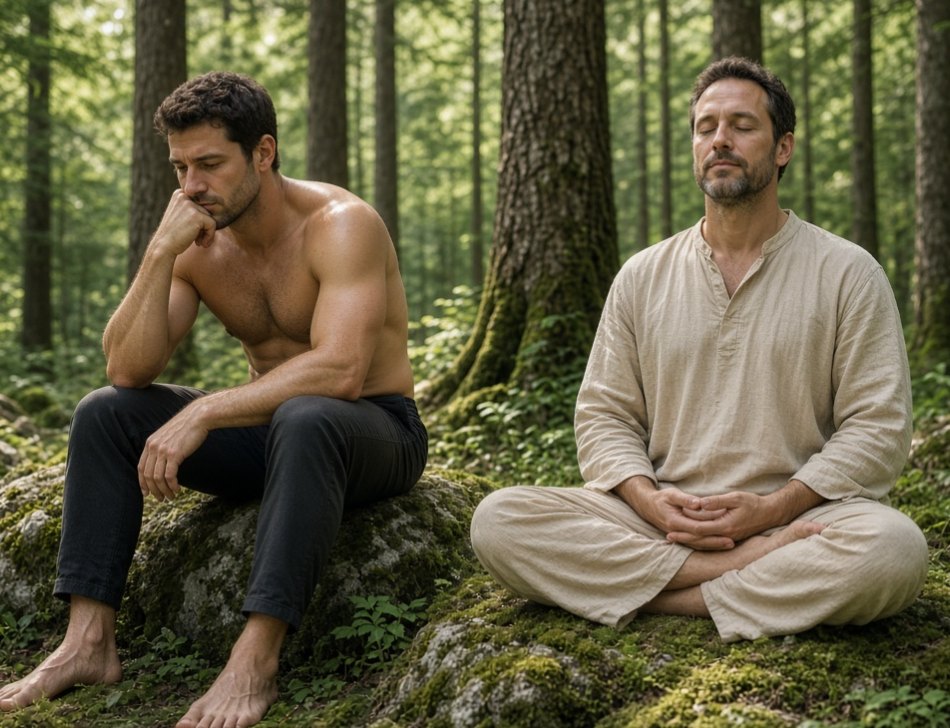
The West trained the mind. Descartes made doubt the method in 1637. Edward de Bono spent a career on thinking skill and separated it from intelligence: intelligence is the horsepower of a car, thinking is the skill with which it is driven. His “intelligence trap” is the high-horsepower mind that uses its power to defend a view rather than explore it.
The East trained no-mind, by two forms of meditation that are also two stages. Mind meditation works with thought: holding attention on an object, or watching whatever arises. Lutz and colleagues (2008) sorted these into focused attention and open monitoring. No-mind meditation ends thought: awareness remains with nothing in it. Travis and Shear (2010) added a third category, automatic self-transcending, for this.
In most traditions the first form is the path to the second. Osho teaches witnessing as the method and no-mind as the result: watched thoughts slow, gaps appear, and the gaps are no-mind. Patanjali’s sequence runs the same way, from concentration to meditation to absorption. Teachers agree that forcing thoughts to stop fails, because the effort is itself mind.
Osho describes the mind as legs: walk when you need to, rest when you do not. Mathematics, booking a flight and organising are walking. Most people leave the legs running. When an SI is on, it is all mind: it has the walking state and the switched-off state, and no third state of rest with awareness present.
Osho spoke in his talks of the universal man: one trained in the mind and able to turn it off and enter no-mind, the two trainings of East and West met in one person. Proficiency in only one leaves a person short. A related figure in his talks, “Zorba the Buddha”, joins Zorba, the West and materialism, to the Buddha, the East and spirituality, with meditation as the bridge.
The author states the same: the universal man is the measure of the complete mind, both legs, used and dropped at will. On this proposal SI is proficient in the first leg and has no demonstrated second, so it is short in the same way.
10. Can SI produce new thought?
Margaret Boden separates three kinds of creativity: combining familiar ideas, exploring a known space of possibilities, and transforming the space itself. SI does the first two at scale. The third — a change in the rules that makes new thoughts possible — is the one in question.
Ada Lovelace wrote in 1843 that the Analytical Engine “has no pretensions to originate anything”. Turing answered her in 1950. Bringsjord, Bello and Ferrucci turned the exchange into a test in 2001: a system passes if it produces something original that its designers cannot explain from how it was built. No current system has been shown to pass it.
A finding looks like an exception and is not. Interpretability research has traced cases where a model reaches an answer by an internal route different from the reasoning it then writes out; in one, a model added numbers by parallel shortcuts and then described the schoolbook carrying method (Anthropic, 2025). That resembles intuition. The route was traced to circuits learned in training, which makes it mind.
Part 2 sets out the full test and the premises behind the conclusion that SI has no access to no-mind. The short form: when a human’s thought stops, awareness remains; when an SI’s computation stops, the SI is off. That second point is fact. Whether computation can ever produce awareness is unsettled, and Part 2 gives both sides.
11. Where the new comes from
Insight has a measured signature. Jung-Beeman and colleagues (2004) recorded a burst of high-frequency brain activity over the right temporal lobe just before people solved word problems by sudden insight, and not before solutions reached step by step. The “aha” is a distinct event, preceded by a quieting of other activity.
Creativity research separates two routes in meditation. Open-monitoring meditation increased divergent thinking in one study; focused-attention meditation did not (Colzato and colleagues, 2012). Watching the mind without holding it opened more alternatives than holding it on one point. This is a single study and is carried as such.
Several stories are usually told here and are not used. The Mozart letter describing whole symphonies arriving at once is a forgery. The Einstein line about the intuitive mind as a sacred gift is misattributed. Kekulé’s and Mendeleev’s dream accounts are disputed, Crick’s reported LSD use is unverified, and Ramanujan’s line about equations and the thought of God is attributed, not documented.
The story of Marie Curie solving a problem in her sleep and finding the answer in her own handwriting is told by Osho; no primary source was found.
What is documented about Ramanujan is enough. He worked largely outside formal training, and he credited the goddess Namagiri with his results, according to his own circle. Many of his results were stated without proof and proved by others later.
Otto Loewi’s case is documented in his own account. On the night of 2 April 1921 he woke, wrote notes on an experiment he had dreamed, and in the morning could read neither the notes nor recall the dream. The next night he woke at about 3 a.m. with the same experiment, went straight to his laboratory and ran it.
He stimulated the vagus nerve of one frog heart and moved the fluid around it to a second heart with its nerve detached. The second heart slowed. Nerves pass their signal by a chemical, later identified as acetylcholine, and the work brought Loewi the Nobel Prize in 1936, shared with Henry Dale.
12. Entheogens
Psilocybin acts on the same network meditation quiets. Carhart-Harris and colleagues (2012) found that it decreased activity and connectivity in the default mode network, the system that builds past, future and the narrative self. The drug route and the meditation route converge on the same brain change by different mechanisms.
Australia has regulated the clinical route. Since 1 July 2023, authorised psychiatrists may prescribe psilocybin for treatment-resistant depression and MDMA for post-traumatic stress disorder under the Therapeutic Goods Administration’s rescheduling. Outside that scheme both remain prohibited.
Steve Jobs told John Markoff that taking LSD was “one of the two or three most important things I have done in my life”, as Markoff reports in What the Dormouse Said (2005). It is one man’s account, quoted second-hand, and is carried as that. The memo does not claim that entheogens produce no-mind, only that they act on the network no-mind quiets.
13. Different strengths
On much of the mind, SI is already superior: knowledge, speed, formal reasoning. On some of it, the human mind still leads, and power is the plainest case. The brain runs on about 20 watts (Raichle and Gusnard, 2002). A median text prompt to Google’s Gemini used about 0.24 watt-hours in August 2025, so a brain running for a day uses the energy of about 2,000 prompts.
Per question, SI is cheap. For learning, the human is far ahead. A brain from birth to eighteen uses about 3,150 kilowatt-hours; an unofficial outside estimate for training GPT-4 is 52 to 62 gigawatt-hours, a ratio of about 16,000 to 20,000 to one. Assumptions: brain only, a constant 20 watts; the GPT-4 estimate assumes about 25,000 A100 chips running for 90 to 100 days, figures OpenAI has not confirmed.
Learning data shows the same gap. A child hears about ten million words a year; Meta trained Llama 3 on about 15 trillion tokens. Humans also generalise from one or two examples, which is the ARC-AGI-3 result in section 2. SI efficiency is improving fast, so these are dated figures, not permanent ones.
The series thesis follows. Humans have two abilities, mind and no-mind. SI has one, mind, and is faster and more knowledgeable on much of it. Part 2 builds grades that show where each leads. Part 3 divides the work by strength and keeps the authority human.
14. Consciousness: where mind and no-mind meet
Mind and no-mind are both states of consciousness, and this memo has not yet said what consciousness is. Neither has science. What consciousness is, and why some brain activity is experienced and some is not, is unsettled. What can be set out is the range of states a person passes through, and what each leaves to report.
| State | Thought and memory | Awareness | What is reported |
|---|---|---|---|
| Waking | Active | Present | The world, and thought about it |
| Flow | Absorbed in a task | Present; self drops away | The task; time passes unnoticed |
| Dreaming | Active; reasoning reduced | Partial; sometimes lucid | Scenes, often unlike waking life |
| Deep sleep | None reported | None reported | Usually nothing |
| General anaesthesia | None reported | None reported | Usually nothing; some report dreams |
| No-mind | Absent | Present | Awareness with nothing in it |
Sleep stages and anaesthesia from the research cited below; the flow and no-mind rows from sections 4 and 5.
The author places flow as a stage of no-mind and as the brain’s optimum working state. The task fills attention, self-talk and the sense of time drop away, and measured activity falls in the frontal areas linked to self-referential thought (Dietrich, 2004; section 5).
Dreams draw on waking experience, but they are not replays of it. In one study only about 1 to 2% of dream reports contained a memory replayed as it happened (Fosse and colleagues, 2003). Where the rest of a dream comes from is not established, and dreams vary widely between people and between nights.
Some dreamers know they are dreaming. Laboratories have recorded lucid dreamers signalling with agreed eye movements from inside the dream (LaBerge and colleagues, 1981), and in 2021 researchers held two-way exchanges with dreamers during REM sleep, putting questions that the dreamers answered while still asleep (Konkoly and colleagues, 2021).
Sleep also produces answers. People who slept were more than twice as likely as those who stayed awake to find a hidden shortcut in a task they had practised (Wagner and colleagues, 2004). Loewi’s experiment in section 11 is a single case of the same thing: the answer arrived while reasoning was offline.
Why we sleep is not settled. The leading explanations are the consolidation of memory, the clearing of waste from the brain, shown in mice in 2013 (Xie and colleagues), and the resetting of connections between neurons. None has displaced the others.
Where a person goes in deep sleep or under anaesthesia is not known. People report nothing, and a measure of how widely the brain’s response to a magnetic pulse spreads is low in both states and high in waking and dreaming (Casali and colleagues, 2013). Whether awareness is absent, or present and not recorded, cannot be tested from the inside.
The two halves
The brain has two halves joined by the corpus callosum, a bridge of about 200 million nerve fibres, narrow beside the halves it joins. Each half controls the opposite side of the body, and the body is itself asymmetric: the heart lies to the left, the liver to the right.
The halves specialise in part. Language is processed mostly in the left half in about 95% of right-handed people, and some spatial attention and face recognition lean right. Neither half dominates a whole person: a study of over 1,000 brain scans found no evidence of people being “left-brained” or “right-brained” overall (Nielsen and colleagues, 2013).
The balance shifts through the day. The nasal cycle alternates which nostril breathes more freely every few hours, and one study found the more active half of the brain alternating with it, on the opposite side (Werntz and colleagues, 1983). Yoga describes the same alternation as the ida and pingala channels.
Meditators show more coordinated activity between the halves and thicker fibres in the corpus callosum (Luders and colleagues, 2012). Iain McGilchrist argues that the right half attends to the whole and the left to detail and control, and that modern culture favours the left (The Master and His Emissary, 2009); the argument is debated.
The author proposes that the brain works as a two-stage computer, and that flow, meditation and no-mind are states in which both halves work in unison rather than one dominating.
Four states, one ground
The Mandukya Upanishad gives a four-part answer: waking, dreaming, deep sleep, and turiya, “the fourth”, the awareness that underlies the other three and is touched by none of them. Its turiya matches this memo’s no-mind: awareness without content.
The author proposes that mind and no-mind are two ways consciousness operates, and that the states above are its range. Dreaming, like no-mind, can carry what reasoning did not produce. SI has no sleep and no dreaming. Between requests no process runs, and when the power is off there is no process at all. The author’s position is that SI’s off state is not sleep: whatever SI is while it runs, off is off.
The factors, together
The memo has set out the factors that bear on intelligence one section at a time. Together:
- Mind: the biocomputer with its memory banks (sections 3, 7).
- Time: the mind builds past and future; the body keeps solar time (section 3).
- Built-in code: behaviour and the solar clock carried in DNA (section 3).
- No-mind: awareness without thought, trained by method (sections 4, 5, 9).
- Flow: a stage of no-mind and the optimum working state (sections 5, 14).
- The two halves: working in unison rather than one dominating (section 14).
- Sleep and dreams: answers that arrive while reasoning is offline (sections 11, 14).
- Consciousness: the ground beneath all of them, not yet explained (section 14).
SI shares the first factor at a larger scale and has a design and training in place of the third. It has a computer clock in place of the second, and no demonstrated result on the others.
15. Open checks
- ARC-AGI-3 final results. Due 4 December 2026; figures to be updated then.
16. Sources
Reference codes read source.work.passage and resolve on the Master Source Register, which carries every source used across this series. Register numbers for this memo are pending. Entries marked not checked online are cited from the drafting record and must be verified before publication.
- The White House, “Fact Sheet: President Donald J. Trump Inaugurates the Era of Super Intelligence” (29 September 2026) — the renaming, its scope and the stated reason. Section 2.
- Stanford HAI, AI Index Report 2026, via MIT Technology Review, “Want to understand the current state of AI? Check out these charts” (13 April 2026) — expert-level test results, the jagged frontier, robots at 12% of household tasks, the 42% benchmark error rate, SWE-bench rise. Section 2, 1. Checked 24 October 2026 against a full-text copy of the report (top takeaways 1, 4 and 5). Cross-checked against Unite.AI, “Stanford AI Index 2026 reveals a field racing ahead of its guardrails” (April 2026).
- ARC Prize Foundation, ARC-AGI-3 results as reported by DZone, “The only AI test that still humbles every machine” (8 May 2026); ARC Prize leaderboard, standard harness (as mirrored by BenchLM, 19 October 2026); and Tech Times, “ARC-AGI-3 scaffolding beats model upgrades” (6 October 2026) — frontier scores, harness effect, prize status. Section 2.
- ARC Prize Foundation, ARC-AGI results page and GPT-6 Astra results page (checked 23 October 2026) — 99.95% for the GPT-6 family; 62.7% standard harness and 99.9% Provider Adapter for GPT-6 Astra; Gemini 4 Argon 97.46%. BigGo Finance, Gemini 4 Argon ARC-AGI-3 report (October 2026) — 49.8% standard harness, verified 16 October 2026. Section 2.
- Patwardhan and others, GDPval: Evaluating AI Model Performance on Real-World Economically Valuable Tasks, arXiv 2510.04374 (2025) — 44 occupations, win-or-tie rates. Sections 1, 2.
- Center for AI Safety and Scale AI, Remote Labor Index, as reported by Inbenta (9 July 2026) — 2.5% rising to 16.1%. Section 2.
- Schlegel and Mortillaro, emotional-intelligence tests and LLMs, Communications Psychology (22 May 2025), via University of Geneva release — 82% against 56%. Sections 1, 2.
- METR, Time Horizon 1.1 (January 2026, model figures to May 2026) — 50% and 80% task horizons. Section 1.
- Schacter and Addis, “The cognitive neuroscience of constructive memory”, Phil. Trans. R. Soc. B 362 (2007); Hassabis and others, PNAS 104 (2007) — memory builds past and future. Section 3. Not checked online.
- Killingsworth and Gilbert, “A wandering mind is an unhappy mind”, Science 330 (2010) — 46.9%, 2,250 people. Section 3. Not checked online.
- Clayton and Dickinson, Nature 395 (1998); Mulcahy and Call, Science 312 (2006); Raby and others, “Planning for the future by western scrub-jays”, Nature 445 (2007); Kabadayi and Osvath, “Ravens parallel great apes in flexible planning for tool-use and bartering”, Science 357 (2017); Suddendorf and Corballis, Behavioral and Brain Sciences 30 (2007) — animal memory and planning. Section 3. Not checked online.
- Weber, Peterson and Hoekstra, “Discrete genetic modules are responsible for complex burrow evolution in Peromyscus mice”, Nature 493 (2013); Dilger, “The behavior of lovebirds”, Scientific American 206 (1962); Walsh and others, “Repeatability of nest morphology in African weaver birds”, Biology Letters (2010) and Behavioural Processes (2011); Nobel Assembly at Karolinska Institutet, Nobel Prize in Physiology or Medicine 2017 (Hall, Rosbash and Young), molecular mechanisms controlling the circadian rhythm; Dias and Ressler, “Parental olfactory experience influences behavior and neural structure in subsequent generations”, Nature Neuroscience 17 (2014). Section 3. Journal details not checked online.
- Patanjali, Yoga Sutras 1.2, 1.17–18, 1.48, 3.1–3 — stilling, savikalpa and nirvikalpa samadhi, truth-bearing insight. Sections 4, 5, 9.
- Laozi, Tao Te Ching, chapters 1, 48, 56. Sections 4, 8.
- Gamma and Metzinger, “The Minimal Phenomenal Experience questionnaire (MPE-92M)”, PLOS ONE 16(7) (2021); Metzinger, The Elephant and the Blind (MIT Press, 2024) — pure awareness. Sections 1, 4.
- Brewer and others, PNAS 108 (2011) — default mode network in meditators. Section 4. Not checked online.
- Chowdhury and others, “Investigation of advanced mindfulness meditation ‘cessation’ experiences using EEG spectral analysis”, Neuropsychologia 190 (2023) — 37 cessations, one meditator. Section 4.
- Osho, Insights for a New Way of Living series (St. Martin’s Griffin), incl. Intelligence: The Creative Response to Now, Awareness, Intuition; From Sex to Superconsciousness (1968). Sections 3, 4, 6, 9.
- Vijnana Bhairava Tantra (c. 7th–8th century), 112 techniques; Osho, The Book of Secrets; Satipatthana Sutta (MN 10) and Anapanasati Sutta (MN 118); Patanjali, Yoga Sutras 2.54 (pratyahara); Zhuangzi, chapter 6 (zuowang); The Philokalia (Jesus Prayer); Ramana Maharshi, Who Am I? (Nan Yar). Section 4. Not checked online.
- Osho, Zorba the Buddha (talks); From Bondage to Freedom, chapters 13 and 40, as quoted by Osho News — Zorba the Buddha. Section 9. Not checked against the books.
- Condon and others, “Meditation increases compassionate responses to suffering”, Psychological Science 24 (2013). Section 4. Not checked online.
- Csikszentmihalyi, Flow (1990); Dietrich, Consciousness and Cognition 13 (2004); Ulrich and others, NeuroImage 86 (2014) — flow. Section 5. Not checked online.
- Maslow, Religions, Values, and Peak-Experiences (1964); Georgiadis and others, European Journal of Neuroscience 24 (2006); Arnsten, Nature Reviews Neuroscience 10 (2009); Stetson, Fiesta and Eagleman, PLoS ONE 2 (2007). Section 5. Not checked online.
- Gottfredson, “Mainstream Science on Intelligence”, Wall Street Journal (13 Dec 1994); Gardner, Frames of Mind (1983); Sternberg, Beyond IQ (1985); Legg and Hutter, Minds and Machines 17 (2007); Turing, Mind 59 (1950). Section 6.
- Proverbs 9:10; Galatians 5:22–23; Plato, Protagoras. Sections 4, 7.
- Russell, “Knowledge by Acquaintance and Knowledge by Description” (1911); Ryle, The Concept of Mind (1949); Polanyi, The Tacit Dimension (1966). Section 8.
- de Bono, Teaching Thinking (1976); Descartes, Discourse on the Method (1637); Lutz and others, Trends in Cognitive Sciences 12 (2008); Travis and Shear, Consciousness and Cognition 19 (2010). Section 9. The horsepower line is attributed; exact source to be confirmed.
- Boden, The Creative Mind (1990); Lovelace, Note G to Menabrea’s memoir (1843); Bringsjord, Bello and Ferrucci, Minds and Machines 11 (2001); Anthropic, “On the Biology of a Large Language Model” (2025). Section 10.
- Jung-Beeman and others, PLoS Biology 2 (2004); Colzato, Ozturk and Hommel, Frontiers in Psychology 3 (2012); Kanigel, The Man Who Knew Infinity (1991). Section 11. Not checked online.
- Carhart-Harris and others, PNAS 109 (2012); Therapeutic Goods Administration, rescheduling of psilocybin and MDMA (effective 1 July 2023); Markoff, What the Dormouse Said (2005). Section 12.
- Raichle and Gusnard, PNAS 99 (2002); Google, measuring the environmental impact of AI inference (August 2025); Meta, Llama 3 model card (2024); Azevedo and others, Journal of Comparative Neurology 513 (2009). Sections 1, 13.
- Wumen Huikai, The Gateless Gate (Wumenguan, 1228), 48 cases; case 29, “Not the Wind, Not the Flag”. Section 5.
- Alladi, review of The Man Who Knew Infinity, Inference — Namagiri as reported by Seshu Aiyar and Ramachandra Rao; results stated without proof. Section 11.
- Ludvigsen, “The carbon footprint of GPT-4”, Towards Data Science (2023) — 51.8 to 62.3 GWh, from about 25,000 A100 chips over 90 to 100 days; the author calls it educated guesswork. Section 13.
- Hakuin and the koan interview: New World Encyclopedia, “Hakuin” (the sound of one hand, Hakuin’s selection of koans); Wikipedia, “Sanzen” (dokusan in the Rinzai school, a private interview centred on the assigned koan). Section 5. Encyclopedia sources; a scholarly history is not yet consulted.
- Loewi, “An Autobiographic Sketch”, Perspectives in Biology and Medicine 4 (1960); McGill Office for Science and Society, “Otto Loewi” — the dreamed experiment, 1921; Nobel Prize in Physiology or Medicine 1936. Section 11. Loewi’s own account not checked online.
- Fosse, Fosse, Hobson and Stickgold, “Dreaming and episodic memory: a functional dissociation?”, Journal of Cognitive Neuroscience 15 (2003); LaBerge and others, “Lucid dreaming verified by volitional communication during REM sleep”, Perceptual and Motor Skills 52 (1981); Konkoly and others, “Real-time dialogue between experimenters and dreamers during REM sleep”, Current Biology 31 (2021); Wagner and others, “Sleep inspires insight”, Nature 427 (2004); Xie and others, “Sleep drives metabolite clearance from the adult brain”, Science 342 (2013); Casali and others, “A theoretically based index of consciousness independent of sensory processing and behavior”, Science Translational Medicine 5 (2013); Mandukya Upanishad, verses 1–12. Section 14. Not checked online.
- Nielsen and others, “An evaluation of the left-brain vs. right-brain hypothesis with resting state functional connectivity MRI”, PLOS ONE 8 (2013); Werntz, Bickford, Bloom and Shannahoff-Khalsa, “Alternating cerebral hemispheric activity and the lateralization of autonomic nervous function”, Human Neurobiology 2 (1983); Luders and others, “Bridging the hemispheres in meditation”, NeuroImage 61 (2012); McGilchrist, The Master and His Emissary (Yale, 2009). Section 14. Not checked online.
- Not used, and why: the Mozart letter (a forgery); the Einstein “intuitive mind” quotation (misattributed); Kekulé and Mendeleev dream accounts (disputed); Crick and LSD (unverified); Ramanujan’s “thought of God” line (attributed, undocumented); Marie Curie solving a problem in her sleep and finding the answer in her own handwriting (told by Osho in Tao: The Three Treasures, vol. 4; no primary source found). Section 11.
- Verification register. Carried as reported and not settled: GDPval and Remote Labor Index (secondary reports); the GPT-4 energy estimate (unofficial, from leaked hardware figures); the renaming order’s number and Federal Register citation (Executive Order 14434, 91 FR 63129, consistent across secondary sources); the Osho “mind as legs” teaching (from a talk, not located); Osho’s universal man (heard by the author in a talk; not located in print); the Jobs quotation (second-hand); every entry marked not checked online.
About this memo. This memo is authored under the direct editorial direction of Brett Murrell. Drafting, structuring, and citation handling are AI-assisted. The reasoning and the conclusions are the author's. This methodology is disclosed openly so readers can weigh the work on its merits.
Murrell, B.B. (2026). What Is Intelligence? Moral's Mark Memo Series, v0.3 draft (25 October 2026). https://moralsmark.com/memo-what-is-intelligence
Draft for review. See the open checks section.