The ART of the PsyOP
Power has always rested on popular opinion, and power has always worked to manufacture it. From the Mandate of Heaven to the printing press to the nudge unit — how the trade evolved, its documented modern record, its methods, and a working checklist for spotting an operation before it alters your reality.
“The conscious and intelligent manipulation of the organized habits and opinions of the masses is an important element in democratic society. Those who manipulate this unseen mechanism of society constitute an invisible government which is the true ruling power of our country.”
— Edward Bernays, Propaganda (1928), opening lines
1. The numbers
- Three millennia ago the Zhou dynasty formalised the Mandate of Heaven — legitimacy held through acceptable rule and visibly revoked by popular revolt: the oldest written doctrine that power rests on opinion.
- 31 BC: Octavian took Rome’s sole rule after a years-long character campaign against Antony — climaxing in the reading of Antony’s will to the Senate — that won the war of opinion before the fleet action at Actium decided the rest.
- 1517 → 1520s: print carried Luther’s theses across the German lands in weeks and made him Europe’s most published author — the first time a private individual out-broadcast a continental institution.
- Paine’s Common Sense saturated the American colonies within a year of January 1776 — read aloud in taverns and army camps, it moved a constitutional dispute to a republican revolution.
- ~50 journalists had covert relationships with the CIA on the agency’s own admissions to the US Senate’s Church Committee (1976); Carl Bernstein’s investigation put the figure at over 400.
- 2022: covert pro-Western networks pushing US narratives were exposed by Stanford and Graphika and removed by Twitter and Meta, prompting a Pentagon review of its clandestine information warfare.
- Israel’s Ministry of Diaspora Affairs commissioned Tel Aviv firm Stoic to run a covert campaign of fake accounts targeting US lawmakers with pro-Israel content, including AI-generated comments (reported 2024; networks removed by Meta and OpenAI).
- For fifteen years, 1956–71, the FBI’s COINTELPRO ran approved covert actions against domestic American civil-rights and dissident groups.
- 1964 → 2005: the Gulf of Tonkin “second attack” that carried the US into Vietnam did not occur, per the NSA’s own declassified history.
- 1990: the “incubator babies” testimony that helped sell the Gulf War was delivered by the Kuwaiti ambassador’s daughter, coached by PR firm Hill & Knowlton.
- 75,000 volunteer speakers were fielded by the Committee on Public Information (1917–19), the first modern mass-persuasion agency — American and aimed at Americans.
- 2012: the Smith–Mundt Modernization Act lifted the ban on US government-produced propaganda being disseminated to domestic American audiences.
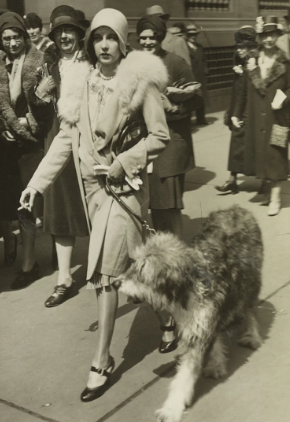
- Debutantes were paid to light “torches of freedom” in New York’s Easter parade — a cigarette account, staged as women’s liberation, with the press tipped off in advance.
- Behavioural-insights teams are standing structures of government across the OECD world — the open, domestic, institutionalised arm of the same trade, called nudging. Australia’s unit, BETA, sits inside the Department of the Prime Minister and Cabinet.
2. The power of opinion, and of reputation
The oldest political fact is that force cannot govern alone. David Hume wrote it down in 1741: since force is always on the side of the governed, the governors have nothing to support them but opinion — “it is therefore, on opinion only that government is founded; and this maxim extends to the most despotic and most military governments.”
Two centuries earlier, Étienne de La Boétie had drawn the operational consequence in the Discourse on Voluntary Servitude: a tyrant has only the power the governed lend him, and falls of his own weight the day they resolve to serve no more.
Machiavelli gave princes the same advice from the other side of the desk — the best fortress that exists is not being hated by the people.
Rulers acted on the maxim millennia before the philosophers wrote it. The Zhou kings of China (from c. 1046 BC) formalised legitimacy itself as the Mandate of Heaven — held through acceptable rule, forfeited through misrule, its revocation made visible in popular revolt: the world’s oldest standing doctrine that the crown sits on opinion. Ramesses II fought Kadesh (c. 1274 BC) to a stalemate at best and carved it across Egypt’s temple walls as a crushing personal triumph — state media in stone.
Darius I cut his version of his accession into the cliff at Behistun in three languages. Caesar wrote his own war coverage in the Commentaries; the empire kept the city fed and entertained on what Juvenal sneered at as bread and circuses; and by 798 the phrase vox populi, vox Dei was current enough that Alcuin warned Charlemagne against listening to it.
Before print, the distribution network walked. The travelling singer was the medium: Norse kings kept skalds on the payroll to carry their deeds from hall to hall, West African courts kept griots as the living record and voice of the dynasty, and the minstrels and ballad-sellers of medieval Europe moved the stories of kings and nation across lands where almost nobody could read — the epics themselves, from Homer to the Chanson de Roland, are the surviving playlist of that circuit.
And the channel cut both ways, like every channel since: the same ballad trade that praised a king could blacken one, and a story sung is a story remembered.
Reputation is opinion in storage — the ruler’s standing account of it — which makes reputation the asset and the target. The proof runs in both directions. Octavian took sole rule of Rome by spending years destroying Antony’s reputation before any decisive battle: the foreign queen, the bewitched general, the seized will read aloud to the Senate; Actium settled what the character campaign had already decided, and the victor then wrote his own record in the Res Gestae.
Eighteen centuries later the French monarchy’s standing was shredded the same way from below: decades of underground libelles buried Marie-Antoinette in pornographic pamphlets and fabricated quotes — “let them eat cake” among them, a line from Rousseau’s Confessions, written when she was a child in Austria, attached to her by the campaign and pinned on her firmly only by later retelling. A fake quote helped fell a queen; the technique needed no software. Character assassination is regime change conducted through reputation, and every operator since has known it.
Scale is the multiplier, and the printing press was the deepest change the trade ever absorbed. In 1517 print carried an obscure monk’s theses across the German lands in weeks; through the 1520s Luther became Europe’s most published author, out-broadcasting the continent’s central institution. The heavier blow was translation.
The Church had held scripture in Latin and its interpretation in the priesthood — England had banned unauthorised English translation outright since 1408 — so the authority’s claims could never be checked against the source by the people they governed. Luther’s German New Testament (1522) and Tyndale’s English one (1526, printed abroad and smuggled in; Tyndale was strangled and burned for it in 1536) handed the primary text to the reader.
That is the birth of the method this memo ends on: verification against the source, by anyone, in their own language — and the resulting fracture rearranged every throne in Europe, with licensing, censorship and stamp taxes following the press everywhere it went. Paine’s Common Sense (January 1776) sold on the order of 150,000 copies among two and a half million colonists and moved a dispute to a revolution inside a year.
The mass press, then radio, put a voice in every kitchen; the world wars industrialised the trade — Britain’s atrocity reports, America’s Committee on Public Information with its 75,000 volunteer speakers — and created the professional class section 4 follows into peacetime.
The current medium changes two things in kind: distribution (an operation needs accounts, not presses) and targeting (the recommendation algorithm delivers each message to the temperament most likely to act on it, and amplifies whatever angers you). The battlefield is the feed, and everyone carrying a phone is standing on it.
The hinge of everything that follows: whoever holds power must hold opinion and reputation, and knows it — so any tool that moves opinion at scale is, automatically, a weapon that can move it against the throne.
3. Staged events and false flags
Arguments move opinion slowly; events move it at once, because an event feels like evidence rather than persuasion. So the shortcut, run for as long as states have wanted wars their publics didn’t, is to manufacture the event — and the record here is not speculation but tribunal findings, archives and declassified files.
On 18 September 1931, officers of Japan’s Kwantung Army dynamited their own railway at Mukden, blamed Chinese saboteurs, and invaded Manchuria on the pretext — established afterwards by the Tokyo tribunal and the perpetrators’ own accounts.
On 31 August 1939, the SS staged “Polish” attacks on German positions, including the Gleiwitz radio station, complete with bodies dressed in Polish uniforms — Operation Himmler, sworn to at Nuremberg by the SS officer who led the Gleiwitz raid; Germany invaded Poland the next morning citing the attacks. On 26 November 1939, the Soviet Union shelled its own village of Mainila, blamed Finland, and launched the Winter War four days later — acknowledged from the Russian side in the post-Soviet era.
The democracies’ file is thinner but not empty. The USS Maine exploded in Havana harbour in 1898 from a cause never established — a later US Navy study led by Admiral Rickover concluded an internal explosion was most likely — but the Hearst and Pulitzer press sold Spanish sabotage as fact, and “Remember the Maine” carried the country into war: a fake certainty, if not a staged event.
In 1962 the US Joint Chiefs of Staff signed Operation Northwoods, a proposal for staged attacks — including against American citizens and property — to be blamed on Cuba as pretext for invasion; the civilian leadership rejected it, and the memo sat classified until 1997.
It was never run, and that is precisely its value as evidence: the willingness existed on paper at the top of a democracy’s military. The Gulf of Tonkin non-attack and the Nayirah testimony, documented in section 5, complete the set — the staged incident, the reported incident that never occurred, and the fabricated atrocity are one family of technique.
Two lessons travel forward. First, the false flag works by hijacking the strongest response in the toolkit — outrage at an attack — which forecloses the checking step exactly when it is most needed; the checklist’s first item exists for this.
Second, the accusation is now as weaponised as the technique: real atrocities and real massacres get waved away as “false flags” by whoever they inconvenience, so the label itself deserves the same standard as the event — verified from primary evidence or withheld. The technique is documented history; the reflex accusation is usually the cheaper operation.
4. The father of the trade: Edward Bernays
The epigraph is not a critic’s caricature; it is the founder’s mission statement. Edward Bernays — born Vienna 1891, died 1995 at 103 — was Sigmund Freud’s nephew twice over: his mother was Freud’s sister, and his father’s sister was Freud’s wife. The relation was the business.
Bernays took his uncle’s picture of the irrational unconscious, plus the crowd psychology of Le Bon and Trotter, and turned it into a profession — and the spin ran both ways, because Bernays also acted as Freud’s promoter in America, arranging the US publication of his lectures and building the fame of the theory he was simultaneously applying. One family supplied both the model of the irrational public and the trade that monetises it.
His conclusion, stated openly across Crystallizing Public Opinion (1923), Propaganda (1928) and “The Engineering of Consent” (1947): publics are moved by symbols, identity and desire rather than argument, so a functioning democracy requires an unseen class of professionals steering the herd.
He began on the Creel Committee selling the First World War, and drew the conclusion on record in his own late interviews: if propaganda could be used for war, it could be used for peace — but “propaganda” had been made a dirty word by the Germans, so he went looking for other words and found “counsel on public relations.”
The profession’s name is itself the first product: propaganda, rebranded. He opened the first such office in 1919, taught the first university PR course in 1923, and worked into the Reagan era. Life named him among the hundred most influential Americans of the century.
His campaigns are the methods chapter avant la lettre, and each one named a mechanic this memo still uses:
Identity capture — the famous set-up. American Tobacco’s George Washington Hill wanted the half of the market that taboo kept from smoking in public: women. Bernays consulted the psychoanalyst A. A. Brill, who supplied the frame — cigarettes as “torches of freedom” — and in the 1929 New York Easter parade a procession of hired debutantes lit up on cue, photographers positioned in advance, the press briefed to expect a suffragette-style protest.
The papers ran the staged event as spontaneous news, and the taboo broke on schedule. Every mechanic in one stunt: a manufactured event, a rented movement, a planted frame, laundered through news coverage. Attach the product to a cause, and objecting to the product becomes objecting to the cause.
Manufactured authority — the third-party technique. To sell bacon for Beech-Nut, he surveyed thousands of physicians on whether a hearty breakfast beat a light one, then released “doctors recommend a hearty breakfast” to the press with bacon and eggs as its face. The client vanishes behind a disinterested authority; today’s version fronts the message with think-tanks, “independent” fact-checkers and grassroots groups. It is section 6’s source laundering, patented.
The pseudo-event. Light’s Golden Jubilee (1929) staged a global commemoration of the light bulb’s fiftieth anniversary — Edison, Ford and a US president in attendance — as promotion for General Electric. Manufacture the occasion and the coverage manufactures itself; the modern engagement-bait cycle runs on the same principle.
The commercial–covert bridge. For United Fruit in the early 1950s, Bernays ran press junkets and placed stories building the picture of a communist menace in Guatemala — narrative preparation that ran ahead of the CIA’s 1954 coup against the elected Árbenz government. A fruit company’s PR budget and a state covert operation worked the same story from two ends, which is the cleanest documented case of the trades being one trade.
The boomerang closes the account. Bernays recorded in his 1965 autobiography that the journalist Karl von Wiegand told him Goebbels kept Crystallizing Public Opinion in his library and was drawing on such works for the campaign against Germany’s Jews.
Bernays, Jewish himself, wrote that it shocked him — and the lesson he left, whether he intended it or not, stands at the head of this memo: the toolkit has no politics and no loyalty. It serves whoever picks it up, which is why the only stable defence is on the receiving end.
5. The documented record
The doctrine is public and the target is stated. The US Army defines psychological operations as planned operations to convey selected information to audiences to influence their emotions, motives, objective reasoning, and ultimately behaviour — renamed Military Information Support Operations in 2010, and back to PSYOP since. Military deception aimed at enemy commanders is as old as war; the operations below are different in kind, because their audiences are publics — foreign, allied, and domestic.
The claim “psyops are real” needs no inference. Each entry below is established by official inquiry, declassified file, sworn testimony, or platform takedown reports — the operators’ own paper.
The United States. The Church Committee (1975–76) documented CIA use of journalists and media assets. The Pentagon Papers (1971) and the NSA’s own 2005 historical study of the Gulf of Tonkin incident documented a war escalated on a second attack that had not occurred. The Nayirah testimony (1990) — a Kuwaiti diplomat’s daughter, coached by PR firm Hill & Knowlton, telling Congress of incubator babies — helped sell the Gulf War.
COINTELPRO (1956–71) ran over two thousand approved disruption operations against domestic civil-rights and dissident groups, including deliberately fomenting violence between rival organisations. In 2022, Stanford Internet Observatory and Graphika exposed covert pro-US networks on Twitter and Meta platforms pushing anti-Russia and anti-Iran narratives at Middle Eastern audiences, and the Pentagon ordered an audit of its clandestine information operations. Since 2012, Smith–Mundt’s domestic dissemination ban is gone.
Israel. The Ministry of Diaspora Affairs commissioned Stoic’s covert network — about US$2 million, hundreds of fake personas, AI-written replies — aimed at US legislators and publics during the Gaza war; removed and attributed by Meta and OpenAI in 2024. Alongside it sits the open-budget version: state-funded advocacy campaigns run in the clear.
The United Kingdom. The Army’s 77th Brigade, formed in 2015 as a dedicated information-warfare unit, was tasked during Covid with monitoring and countering narratives circulating among the British public — confirmed in Parliament.
What this list excludes, and why. Western governments and platforms also attribute large operations to Russia, China and Iran, and their governments attribute operations back. Every one of those attributions is a claim made by a party to the same information war, delivered through channels this memo says to treat with scepticism.
Under the memo’s own rule they are claims to verify against primary evidence, not facts to inherit — so they are left out rather than laundered in. The entries above stand on a different footing: each is documented against the operator by its own state’s inquiries, courts, archives or contractors.
The record establishes the base fact: information operations against domestic and allied publics are standing practice, run through press, testimony, and social platforms, with the legal barrier against domestic targeting formally removed. That is the factual basis for the memo’s standing instruction: question everything — including the material that flatters your existing view, which is precisely the material an operation would feed you.
6. The methods
The toolkit is small and stable. Operations differ in language and flag; the mechanics repeat.
Repetition. The illusory-truth effect: statements feel truer each time they are encountered, regardless of accuracy. An operation’s first job is frequency, which is why bot networks exist — not to persuade, but to make a claim ambient.
Emotional hijack. Fear, disgust, and grievance move faster than analysis and suppress it while active. Content engineered to spike those states is engineered to bypass the checking step. The spike is the tell: the moment a post makes the blood rise is the moment to slow down, because that response is the product.
Manufactured consensus. Astroturf — fake grassroots. Hundreds of accounts agreeing create the impression that “everyone knows,” and humans defer to perceived majorities. The Stoic network wrote its own supportive replies to its own posts.
Wedge amplification. The cheapest operation doesn’t invent a division; it finds a real one and pumps energy into both sides. COINTELPRO’s documented playbook included inflaming rival organisations against each other until the conflict turned violent. When both poles of an argument are being fed rage about each other, ask who benefits from the widened gap.
Source laundering. Plant the story where scrutiny is low, then cite the citation. The Cold War version planted stories in friendly foreign papers and quoted them home as independent confirmation; the modern version runs anonymous account → screenshot → aggregator → “people are saying.” Each hop strips provenance and adds apparent independence.
Atrocity framing. From incubator babies to fabricated outrages, the atrocity story is the fastest route from neutral to combatant. Real atrocities exist — which is exactly what gives fabricated or misattributed ones their power, and why the specific claim, not the genre, is what has to be verified.
Identity flattery. “You’re one of the few who see it.” Recruiting the target as a co-conspirator inoculates the content against correction: any debunk becomes proof of the cover-up. Operations on every side use the awake/asleep frame, because a target who has staked identity on a claim will defend it for free.
Meme packaging. A meme is a payload with the sourcing removed: no author, no date, no citation, high velocity, and humour as armour — objecting to it reads as humourless. The four-panel comparison, the recursive joke, the screenshot-of-a-screenshot are formats, and formats are neutral; the point is that the format itself deletes the provenance a reader would need.
Algorithmic terrain. None of the above requires the platform’s cooperation; engagement optimisation supplies the amplification for free. Rage travels farther than correction on the platform’s own physics. An operation doesn’t need to beat the algorithm — it needs only to feed it.
AI at scale. Generation is now free: unique, fluent comments by the thousand (already documented in the Stoic takedown), synthetic faces for personas, cloned voices, fabricated images. The marginal cost of a persuasive fake has fallen to about zero, which moves the entire burden onto verification.
7. The nudge: the same trade, run openly, at home
The polite end of the influence business has a name, a Nobel prize and a desk in most governments. A nudge, as defined by Richard Thaler and Cass Sunstein in Nudge (2008), is any feature of how choices are presented that predictably alters behaviour without forbidding options or materially changing incentives — the default box pre-ticked, the item placed at eye level, the letter that mentions what your neighbours do.
Thaler took the 2017 Nobel in economics for the underlying work; Sunstein ran the White House regulatory office that applied it.
It is institutionalised. The UK built the first government Behavioural Insights Team — the “Nudge Unit” — inside the Cabinet Office in 2010. The US formalised its version by executive order in 2015, directing federal agencies to apply behavioural science to their programmes.
Australia followed: New South Wales stood up a Behavioural Insights Unit in 2012, and BETA, the Behavioural Economics Team of the Australian Government, has sat inside the Department of the Prime Minister and Cabinet since 2016. By 2017 the OECD counted over 200 public institutions doing this work worldwide.
The results are real, which is the point. UK pension auto-enrolment — a pure default switch, act to leave instead of act to join — took participation among eligible private-sector employees from about 42 per cent in 2012 to 86 per cent within a decade. Tax letters telling recipients that most people in their town pay on time measurably raised on-time payment in randomised trials.
The same mechanics run commercially as choice architecture in every supermarket and app, and in their abusive form have a regulatory name — dark patterns — for which the US FTC extracted a US$2.5 billion settlement from Amazon in 2025 over a cancellation flow designed to defeat the person using it.
The difference between a nudge and a psyop is not the mechanics — defaults, framing, social proof and salience are section 6’s toolkit with the covert channel removed. The difference claimed for it is disclosure and interest: done in the open, in the chooser’s own interest, with the options left standing. Sometimes that claim holds; a pension default that doubles saving is hard to fault. But the line is thinner than the branding, and the clearest demonstration was at home.
In March 2020 the UK government’s behavioural advisory group SPI-B put it in writing: “The perceived level of personal threat needs to be increased among those who are complacent, using hard-hitting emotional messaging.” That is a state deliberately raising fear in its own population to move behaviour — section 6’s emotional hijack, published in the minutes. Several of the group’s own members later said publicly that the fear campaign went too far.
So the memo’s rule does not stop at the border or at the flag on the account. Your own government influences you as standing, staffed, budgeted practice — mostly openly, sometimes not, usually with good intentions, occasionally by frightening you on purpose. The checklist in section 9 applies to the public-health campaign and the tax letter exactly as it applies to the anonymous meme: what is this designed to make me feel, and who decided I should feel it?
8. Case study: the FT panel
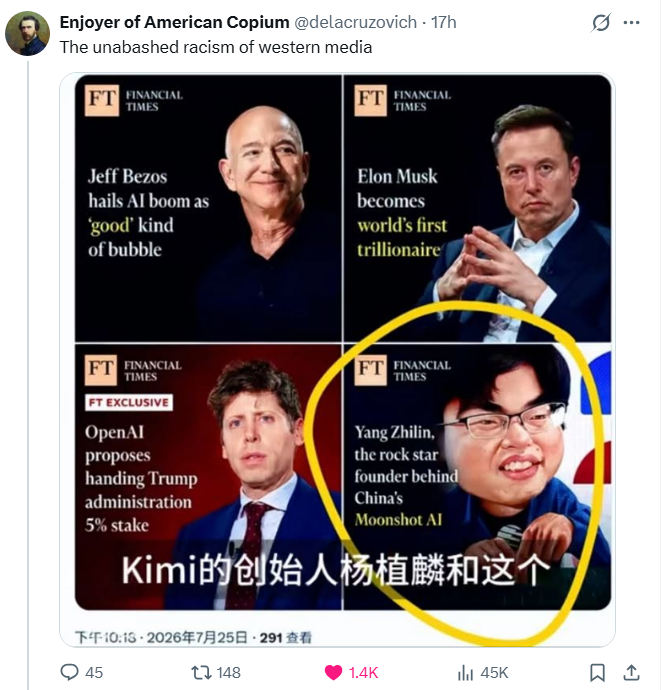
In July 2026 the Chinese lab Moonshot AI released Kimi K3 and briefly knocked the wind out of US tech stocks. Within days a four-panel image circulated: three Financial Times social cards showing Jeff Bezos, Elon Musk and Sam Altman in composed portraits, and a fourth showing Moonshot founder Yang Zhilin mid-expression, ringed in yellow, captioned as western media racism.
The version that crossed my feed came from an account trading in American decline, had 1.4 thousand likes at 45 thousand views, and carried a Chinese video caption across its bottom edge — the screenshot had already been through at least one Chinese-language commentary before arriving dressed as a fresh observation.
Run the checklist against it. The core grievance is checkable and partly real: the FT did run an unflattering illustration of Yang, and open replies to the FT’s own post objected — “this portrait is beneath you as a publication” — before any meme existed.
What the four-panel adds is construction: hand-picked composed portraits for the three Americans (each of whom has been mocked in western front pages for years — the selection simply excludes those), a frame that upgrades one editor’s picture choice into “unabashed racism,” and distribution through accounts whose entire output serves one flag.
A real editorial slight, wrapped in a manufactured comparison, amplified by aligned networks, harvesting genuine grievance — most effective operations are built exactly this way, around a true kernel, because the checkable part buys trust for the unchecked part.
And one layer up sits the recursion:
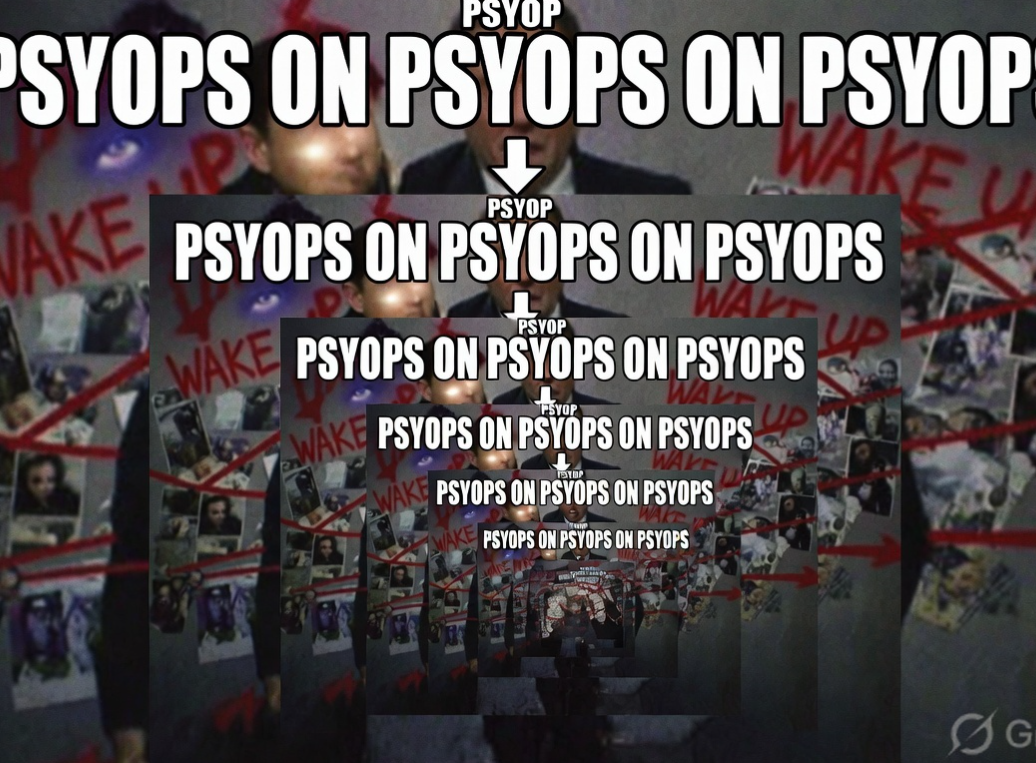
Calling something a psyop is itself a move in the game. The accusation is free, unfalsifiable at a glance, and flattering to whoever deploys it — which is why the label gets attached to authentic grassroots anger as readily as to real operations, usually by the side the anger inconveniences. There is no floor to the regress and no exit through cleverness.
The exit is boring: drop the meta-game entirely and verify the object-level claim. Did the FT run that image? Yes — checkable in one search. Is western media systematically racist toward Chinese founders? That is a statistical claim about thousands of editorial decisions, and a four-panel meme is not a sample.
9. How to spot one
Ten checks, in the order they cost you effort:
- Feel the spike. If a post produces instant rage, fear, disgust or vindication, treat the emotion as the payload and pause before sharing. Nothing true stops being true after ten minutes of checking.
- Ask who benefits. Not rhetorically — name the parties served by you believing this, and the parties served by the division it widens.
- Find the original. Reverse-search the image; find the primary document, the full video, the actual quote in context. Most operations die at this step because the artifact is cropped, misdated, mistranslated or assembled.
- Check the messenger’s history. An account posting one country’s grievances, one conflict’s atrocities, or one movement’s rage all day is a channel, whatever it is besides.
- Look for the missing denominator. Four examples prove nothing about thousands of cases. Any claim of a pattern needs the base rate; a montage is a selection, and the selection is the argument.
- Watch for both poles being fed. If your feed shows each side an outrage about the other, symmetrical and simultaneous, consider a common supplier.
- Note the provenance strip-mining. Screenshots of screenshots, “BREAKING” with no outlet, quotes with no date, memes with no source — each missing element had to be removed by someone.
- Clock the velocity. Coordinated timing — the same phrasing across many accounts inside an hour — is the signature of a network, not a public.
- Beware content that flatters you. The material engineered for you agrees with you. Apply the hardest checks to the posts you most want to share.
- Verify, then conclude — in that order. Believe nothing on arrival, including debunks; the counter-psyop is also a psyop. Hold the conclusion open until a primary source closes it.
10. The standing position
There is a war for attention and allegiance running through every feed, waged simultaneously by states, parties, firms and movements, documented in their own budgets and indictments. Its ammunition is your emotion and its objective is your behaviour — what you buy, whom you hate, how you vote, whether you show up. No flag abstains, so no feed is neutral ground, and the material most dangerous to you personally is the material built for your own biases.
The defence is not cynicism, which is just credulity inverted — believing nothing is as exploitable as believing everything, since a public that trusts nothing can be moved by anyone. The defence is method: question everything, verify before believing, weight primary sources over packaging, and hold conclusions loosely enough to update. Question everything is not a slogan on this site; it is the operating procedure this memo exists to equip.
End where the trade ends: with its own self-description, broadcast in prime time. In December 2024, CBS’s 60 Minutes sat two retired Mossad officers down to explain the Hezbollah pager operation — shell company stacked on shell company until the target bought its bombs from its enemy at market price. One compared the construction to The Truman Show: a fake world, everything controlled from behind the scenes, everything appearing completely normal to the man inside it.
The other described the agency as a global production company that writes the screenplay, directs, produces and plays the leading roles — “and the world is our stage.” The segment paused on the agency’s long-time motto, drawn from Proverbs 24:6 and rendered in English since Ostrovsky’s book as by way of deception, thou shalt do war.
The memo opened with Bernays declaring an invisible government the true ruling power, in 1928, in print, under his own name. It closes with practitioners of deception describing the world as their stage, in 2024, on camera, to an audience of millions. Neither end of the century hid anything. The war for opinion is admitted by its own operators, at the founding of the trade and at its current edge — and the only party still relying on trust is the audience.
The summary of five thousand years fits in one sentence: power practises the art of deception with whatever tools each age supplies, and against it stands the search for truth, which has only ever had one tool — verification against the primary source, the same act that broke the Latin monopoly five centuries ago and the same act at the top of the checklist above. Question everything.
11. Sources
- US Senate Select Committee to Study Governmental Operations (Church Committee), Final Report (1976), and Carl Bernstein, “The CIA and the Media,” Rolling Stone (1977) — the documented CIA–press relationships; the ~50 figure per agency admissions and Bernstein’s 400+; sections 1 and 5.
- Stanford Internet Observatory and Graphika, Unheard Voice (August 2022), with subsequent Washington Post reporting — the covert pro-Western network takedown by Twitter and Meta and the Pentagon’s review of clandestine information operations; sections 1 and 5.
- The New York Times, Haaretz and FakeReporter reporting (June 2024), with Meta and OpenAI takedown disclosures (May 2024) — the Israeli Ministry of Diaspora Affairs’ ~US$2 million commissioning of Stoic; hundreds of fake accounts targeting US lawmakers; AI-generated comments; sections 1, 5 and 6.
- US Senate (Church Committee) and FBI records on COINTELPRO (1956–71) — over 2,000 approved actions; domestic disruption operations, including fomenting conflict between rival groups; sections 1, 5 and 6.
- Robert J. Hanyok, Skunks, Bogies, Silent Hounds, and the Flying Fish, NSA cryptologic history (declassified 2005) — the 4 August 1964 Gulf of Tonkin “second attack” that did not occur; sections 1 and 5.
- US House and Senate records and subsequent reporting on the Nayirah testimony (October 1990) and Hill & Knowlton’s Citizens for a Free Kuwait campaign; sections 1 and 5.
- Smith–Mundt Modernization Act of 2012 (enacted in the FY2013 NDAA) — repeal of the domestic dissemination ban; sections 1 and 5.
- US Army doctrine — FM 3-05.30 / the PSYOP–MISO definitions: planned operations to convey selected information to influence emotions, motives, objective reasoning, and behaviour; section 5.
- Committee on Public Information records and George Creel, How We Advertised America (1920) — the 75,000 Four Minute Men speakers; sections 2 and 4.
- UK Parliament statements and reporting on the Army’s 77th Brigade and its Covid-era tasking; section 5.
- Hasher, Goldstein & Toppino (1977) and subsequent replications — the illusory-truth effect; section 6.
- Richard Thaler and Cass Sunstein, Nudge: Improving Decisions About Health, Wealth, and Happiness (2008) — the definition of a nudge and choice architecture; Thaler’s 2017 Nobel; section 7.
- UK Cabinet Office / Behavioural Insights Team publications (2010– ) — the first government nudge unit; the social-norm tax-letter randomised trials; section 7.
- US Executive Order 13707, Using Behavioral Science Insights to Better Serve the American People (September 2015); section 7.
- OECD, Behavioural Insights and Public Policy: Lessons from Around the World (2017) — the 200+ institutions count; with NSW Behavioural Insights Unit (2012) and BETA, Department of the Prime Minister and Cabinet (2016); sections 1 and 7.
- UK Department for Work and Pensions, workplace pension participation statistics — eligible private-sector participation from about 42 per cent (2012) to 86 per cent under automatic enrolment; section 7.
- SPI-B, Options for increasing adherence to social distancing measures (22 March 2020, published on gov.uk) — the “perceived level of personal threat needs to be increased” recommendation; subsequent public statements by SPI-B members; section 7.
- US Federal Trade Commission v. Amazon (settled September 2025) — the US$2.5 billion settlement over the Prime cancellation flow; dark patterns as regulated deceptive design; section 7.
- Edward Bernays, Crystallizing Public Opinion (1923), Propaganda (1928), “The Engineering of Consent” (1947), and Biography of an Idea (1965) — the invisible-government passage quoted at the head of this memo; the von Wiegand/Goebbels account; with Bernays’ filmed late-life interviews in Adam Curtis, The Century of the Self, part 1 “Happiness Machines” (BBC, 2002) — his own account of renaming propaganda “counsel on public relations”; section 4.
- Larry Tye, The Father of Spin: Edward L. Bernays and the Birth of Public Relations (1998) — Torches of Freedom (1929), the Beech-Nut hearty-breakfast campaign, Light’s Golden Jubilee (1929), the United Fruit/Guatemala press campaign ahead of the 1954 coup; Bernays’ role promoting Freud’s work and reputation in the United States; Life’s 1990 list; sections 1 and 4.
- David Hume, “Of the First Principles of Government” (1741) — government founded on opinion only; Étienne de La Boétie, Discourse on Voluntary Servitude (c. 1548); Niccolò Machiavelli, The Prince (1532), ch. XX on fortresses and the people’s hatred; section 2.
- Primary monuments and classical sources — the Zhou Mandate of Heaven doctrine; the Kadesh reliefs of Ramesses II; the Behistun inscription of Darius I; Caesar’s Commentaries; Augustus, Res Gestae Divi Augusti; Plutarch and Cassius Dio on Octavian’s campaign against Antony and the reading of the will; Juvenal, Satire X (bread and circuses); Alcuin’s letter to Charlemagne (c. 798) on vox populi; the skaldic court-poetry, griot and European minstrel/ballad traditions as the pre-print distribution circuit, with the Homeric epics and the Chanson de Roland as its surviving repertoire; sections 1 and 2.
- Andrew Pettegree, Brand Luther (2015) and standard Reformation print scholarship — the 1517–1520s pamphlet explosion; Luther as Europe’s most published author; the vernacular scripture record (the 1408 English ban on unauthorised translation; Luther’s 1522 German New Testament; Tyndale’s 1526 English New Testament and his execution in 1536); sections 1 and 2.
- Thomas Paine, Common Sense (1776) and standard circulation scholarship (~150,000 copies in year one); the French libelles literature on Marie-Antoinette, with Rousseau, Confessions (written 1760s) as the actual source of “qu’ils mangent de la brioche”; sections 1 and 2.
- International Military Tribunal for the Far East findings and standard scholarship on the Mukden incident (1931); the Nuremberg affidavit of SS-Sturmbannführer Alfred Naujocks on the Gleiwitz operation and Operation Himmler (1939); post-Soviet Russian acknowledgments on the shelling of Mainila (1939); section 3.
- H. G. Rickover, How the Battleship Maine Was Destroyed (US Naval History Division, 1976); Joint Chiefs of Staff, Operation Northwoods memorandum (13 March 1962, declassified 1997, National Security Archive); section 3.
- CBS News, 60 Minutes, “The Pager Plot” (Lesley Stahl, first aired 22 December 2024; published transcript) — the retired Mossad officers’ pretend-world, global-production-company and Truman Show descriptions of the Hezbollah pager operation; the segment’s reference to the agency’s Proverbs 24:6 motto; with Victor Ostrovsky, By Way of Deception (1990), for the standard English rendering; section 10.
- Financial Times social posts on Moonshot AI’s Yang Zhilin and the public replies objecting to the portrait (July 2026); the circulating four-panel comparison and its amplification; Kimi K3 launch coverage (July 2026); section 8.