Whirlpools All the Way Down, and Up
One shape, from an electron’s orbit to a cluster of galaxies.
The mechanism has three parts, and all three can be measured in the weather. A dent — the centre of Typhoon Tip sat 14,300 pascals below its surroundings. Something drawn in — air pushed into the hollow from every side. And a deflection — the Earth’s surface moves at 465 metres per second at the equator and not at all at the pole, so air travelling north runs ahead of the ground beneath it and appears to curve.
A dent alone is not a whirlpool. A dent plus a deflection is. The proof is a gap in the record: no hurricane has ever formed within five degrees of the equator, where there is no deflection at all. Applied outward, the same three parts give the orbit of a planet and its spin from one cause — and applied inward, they give the atom, whose field loops out at the poles and back round the outside exactly as a hurricane does.
What this memo does and does not do
It demonstrates the mechanism on Earth, where all three parts are measured, and then shows the same form at every scale from the atom to a galaxy cluster.
It does not quantify the torque at any scale beyond the weather. The rates, lever arms and angular-momentum accounting are in memos 5.9, 5.15 and 5.16.
Draft. A working draft, published for scrutiny rather than as a settled result.
The rule set out here is demonstrated on Earth before it is applied anywhere else. The weather is where it can be watched, and the watching has been going on for a century.
1. Everything Turns
An electron goes round a nucleus. A nucleus spins. The Earth turns once a day and circles the Sun. The Sun turns once a month and circles the galaxy. The galaxy turns once every two hundred and thirty million years, and the cluster it belongs to turns too.
| System | Across | One turn takes | At the centre |
|---|---|---|---|
| An electron’s orbit | 53 picometres | 150 attoseconds | a nucleus |
| The Earth | 6,371 km | 24 hours | an iron core |
| Jupiter and its moons | 2 million km | 2 to 17 days | Jupiter |
| The solar system | ~100 AU | 1 to 250 years | the Sun |
| The Milky Way | 100,000 light years | 230 million years | a black hole |
| A galaxy cluster | 30 million light years | billions of years | the largest galaxy |
Forty orders of magnitude between the smallest and the largest. Nothing about a nucleus resembles a galaxy. And the shape is the same every time — something concentrated in the middle, everything else going round it, and the whole thing flattened toward a disc.
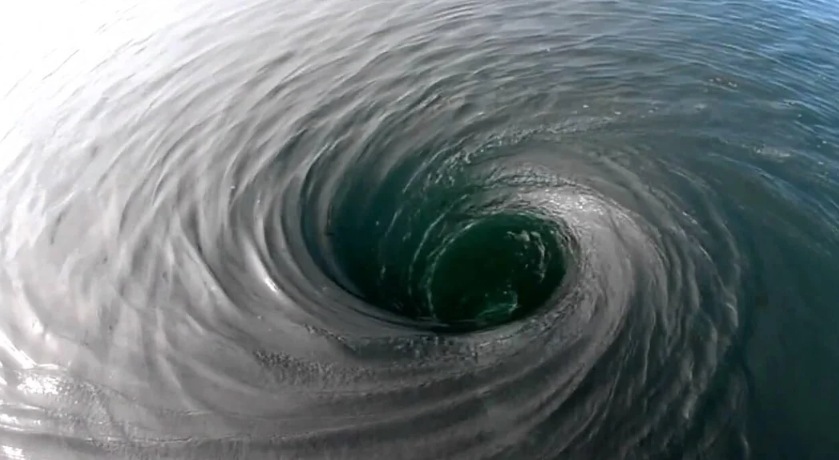
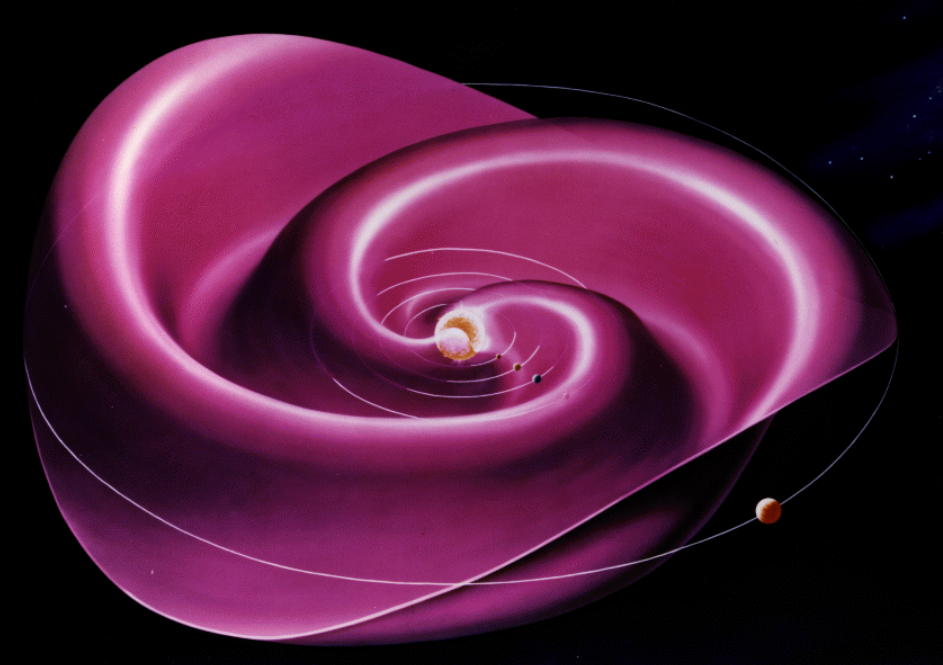
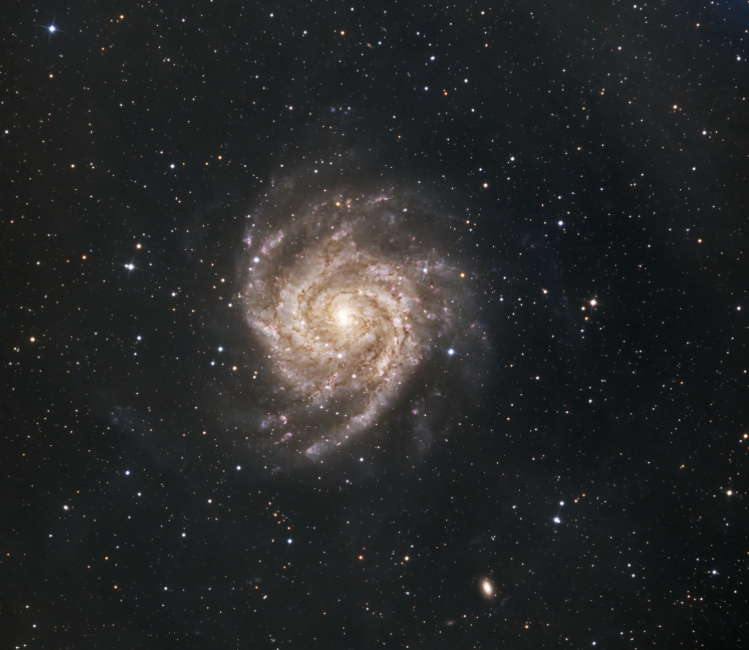
Three pictures, three different substances, and a size range of twenty-one orders of magnitude between the first and the last. Nobody would guess they were unrelated.
What this memo does with that
A pattern repeating across forty orders of magnitude is either a coincidence or a mechanism. This memo sets out the mechanism: a dent in a medium, something drifting into it, and a deflection that turns the drift into a circle.
All three can be measured on Earth, in the weather, which is where the argument starts.
2. What Sits At The Centre
Every one of those systems has mass piled up in the middle. Not always the same kind of thing — a nucleus, a star, a black hole, the largest galaxy in a crowd — but always a concentration.
And a concentration of mass compresses the Aether around it. That is what memo T.5.1 sets out: mass lowers the pressure of the medium, making a dent that is deepest at the mass and rises back toward the deep-space baseline with distance.
So the centre is two things at once
It is where the mass is. And it is the lowest point in the medium for a long way around — the bottom of a pressure hollow that reaches out much further than the mass itself does.
The concentration and the dent are not two facts. They are one fact seen from two sides. Wherever there is a lump of matter, there is a hollow in the Aether centred on it.
A black hole is simply what that looks like when it is extreme. The rule is the concentration, not any particular kind of object — which is why the same shape appears around a nucleus, where there is no black hole for a hundred million light years.
3. What Makes It Turn
A dent on its own does not make a whirlpool. Something has to be drawn in, and something has to turn the drawing-in into a circle. On Earth all three parts can be measured, so that is where to start.
A storm is a dent with air pushed into it
Ordinary air at sea level sits at about 1,013 millibars. The centre of Typhoon Tip, in 1979, sat at 870 — 14,300 pascals below its surroundings. That is the dent, and the surrounding air was pushed into it from every side.
The air does not fall straight in. It spirals.
The mechanismA spinning sphere does not move at one speed
The Earth turns once a day. But a point near the equator travels round a far bigger circle than a point near the pole, so it has to move faster to get round in the same time.
| Latitude | The ground moves at |
|---|---|
| 0° — the equator | 465 metres per second |
| 30° | 402 |
| 45° | 329 |
| 60° | 232 |
| 90° — the pole | nothing at all |
Take a parcel of air at the equator. It is already travelling east at 465 metres per second, because the ground beneath it is. Push it north toward a low-pressure centre and it carries that speed with it — nothing takes it away.
By the time it reaches 45 degrees the ground below is only doing 329. The air is running 136 metres per second ahead of the ground. It looks deflected to the east.
Nothing pushed it sideways. It kept going straight and the ground turned away underneath it. This is called the Coriolis effect, and the sphere is what produces it — the deflection follows the sine of the latitude, which is the shape of a ball.
The proofNo hurricane has ever formed on the equator
The deflection is zero at the equator and grows toward the poles. If the deflection is what starts a storm turning, then storms should not be able to start where there is none.
No hurricane has ever formed within five degrees of the equator. Not one, in the whole record. The low pressure forms, the air rushes in, and nothing spins up.
A dent alone is not a whirlpool. A dent plus a deflection is a whirlpool — and the gap along the equator is where that is proved.
The direction is inherited from the system, not chosen by the storm. Anticlockwise in the northern hemisphere, clockwise in the southern, every storm without exception.
One thing that is not true, and is worth clearing up
Water does not go down a bath drain one way in Sydney and the other in London. The bath-drain story is a myth. A drain is far too small for the Earth’s rotation to make any difference, and it turns whichever way the water happened to be moving already.
The same goes for a tornado, which is too small for the Earth to steer. Size decides whether the larger system sets the direction. A hurricane is hundreds of kilometres across and the Earth governs it. A plughole is not.
4. Drawn In And Moving Through
The solar system has the same three ingredients, at a different scale.
Something is drawn in. A star burns, and burning means taking in and giving out. On this account what it takes in is the Aether and what it gives out is light. The draw is slow — less than a nanometre per second at the Sun’s surface — but it never stops.
And the whole system is moving. The Sun travels through the galaxy at 230 kilometres per second, carrying every planet with it. The medium is not still around us. It streams past.
Inward plus sideways is a spiral
Water going down a drain in a still bath falls more or less straight. Tip the bath while it drains and the water arrives at an angle, and what was a fall becomes a spiral.
A star is a draining bath that is also being tipped, continuously, for as long as it burns. The medium comes in from every side and the whole arrangement is sliding sideways through the galaxy at the same time.
5. What A Spiral Does To A Body In It
Drop a leaf in a stream and two things happen. It travels downstream, and it turns as it goes.
The turning is not mysterious. The water on one side of the leaf moves a little faster than the water on the other, so it pushes a little harder on that side. A difference in pressure across a body is a turning force.
The linkThe same mechanism as gravity, applied sideways
Memo T.5.1 sets out the force of gravity as a pressure difference across a body, acting inward: higher pressure on the far side, lower on the near side, so the body is pushed toward the mass.
Here it is the same difference acting across the body rather than along it. Higher pressure on one flank, lower on the other, so the body is turned rather than moved.
One mechanism, two geometries. Pushed inward it is gravity; pushed across, it is spin. Both come from the medium being at different pressures on either side of something.
So a planet in a spiralling medium does both. It is carried round the star, which is its orbit. And it is turned as it goes, which is its spin. The two have one cause.
6. The Smallest Whirlpool
A whirlpool is not a flat spiral. Look at where the water actually goes in a drain: in across the surface, down through the middle, and — in anything closed — back out and round again.
That is a doughnut. The spiral you see from above is only its top face.
| System | In | Through the middle | Out |
|---|---|---|---|
| A hurricane | at the base, spiralling | up the eyewall | at the top, outward |
| A tornado | at the ground | up the funnel | at cloud level |
| A disc round a young star | along the disc | crushed at the centre | jets from both poles |
| An active galaxy | along the disc | into the centre | jets, hundreds of thousands of light years long |
| An atom | the clump draws | turns on its axis | the field loops out at the poles |
The connectionThe atom’s field is not like a whirlpool — it is one
Memo T.6 builds the atom as a clump of neutrons that turns, generating a magnetic field which loops out of one pole, round the outside, and back in at the other. The protons ride those loops. The electrons follow further out. Everything circulates the same way.
That is a doughnut of circulation around an axis — in at the disc, out at the poles, round the outside, back in. The same loop as a hurricane, and as a galaxy with jets.
Same topology, same axis, same disc, same poles. The atom was not designed to resemble a storm; both are what a drawn-in, turning medium does.
The jets are the giveaway
Wherever a whirlpool is strong enough to show its whole loop, the return path appears as jets shooting out of the poles.
A young star throws them a light year. A black hole throws them across a galaxy. A pulsar sweeps them round like a lighthouse. An atom has its magnetic axis.
The poles are where the loop closes, and every scale has them.
7. The Middle Scales
Between the atom and the galaxy the pattern repeats without interruption.
| Scale | The same shape |
|---|---|
| A planet and its moons | Jupiter has ninety-five of them, the large ones circling in one direction, in one plane, close to its equator. A solar system in miniature. |
| A planet with rings | Saturn’s rings are a disc of ice and rock, flat to within tens of metres across two hundred thousand kilometres. A galaxy in miniature. |
| The solar system | Every planet orbits the same way, in nearly the same plane, the plane of the Sun’s own spin. |
| A forming star | A disc of gas and dust, with jets from both poles, seen directly by telescope. |
| A galaxy | A flat disc a hundred thousand light years across, with arms and a concentration at the middle. |
At no scale does the shape change into something else. It gets bigger and slower, and that is all.
8. Why It Is Always Flat
A turning cloud cannot collapse the same way in every direction.
Along the axis it spins about, nothing holds it out, so it falls straight in. Out sideways, the turning holds it up. So it falls flat and stays wide.
Which is why everything is a disc
The solar system, Saturn’s rings, the disc around a forming star, a spiral galaxy — all flat, and all flat in the plane of their own spin.
A whirlpool has a plane, and anything caught in one ends up in it. That is not a coincidence repeated at six scales. It is one rule, applied six times.
9. The Numbers
In summary, the figures behind the argument:
- Range of scales over which the shape repeats: about forty orders of magnitude, from an electron’s orbit to a galaxy cluster.
- The Earth’s surface speed: 465 metres per second at the equator, nothing at the pole.
- Typhoon Tip’s central pressure: 14,300 pascals below its surroundings — the deepest storm ever measured.
- Hurricanes formed within five degrees of the equator, in the whole record: none.
- The Sun’s speed through the galaxy: 230 kilometres per second.
- The draw toward the Sun at its own surface: less than a nanometre per second.
- Saturn’s rings: flat to within tens of metres across two hundred thousand kilometres.
Terms Used Here
| Word | What it means |
|---|---|
| Aether | The proposed substance filling all space: one kind of particle which light would travel through and which matter would be built from. Not an established entity. |
| Aetheron | The proposed single particle the Aether is made of. One size, one mass, identical everywhere. |
| Deep space | The Aether far from any matter, at its natural density and baseline pressure. |
Every term used across the series is on the terms page.
10. Sources
Reference codes read source.work.passage and resolve on the Master Source Register, which carries every source used across this series.
- G.-G. de Coriolis. Sur les équations du mouvement relatif des systèmes de corps (1835). Carried as reported from secondary sources; the original has not been consulted.
- G. J. Holland. On the Climatology and Structure of Tropical Cyclones in the Australian Region, Australian Meteorological Magazine 32 (1984). Typhoon Tip’s central pressure and the equatorial formation limit. Carried as reported; not verified.
- C. C. Lin and F. H. Shu. On the Spiral Structure of Disk Galaxies, Astrophysical Journal 140 (1964) 646. Carried as reported; not verified.
- Planetary, solar and galactic rotation periods, orbital radii and surface speeds are standard reference figures. The Earth’s surface speeds by latitude are computed here, not cited.
Verification register: references 1 to 3 are carried as reported and none has been checked against an original. The claim that no hurricane has formed within five degrees of the equator is load-bearing for section 3 and should be checked against the full tropical cyclone record before publication. The inflow figure in section 4 rests on the consumption account in memo 5.15 and is not independently measured.